

STORY 102
Featured image: Ingrid Jonker memorial
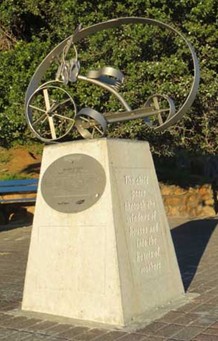
There is a memorial on the Gordon’s Bay beachfront. It is modest, a child’s tricycle set in a round arch on a marble stone, with words from a poem engraved on it. Most people who walk past it on their way to the water probably do not stop to read it. Those who do stop will find themselves standing at the intersection of one of the most beautiful places in South Africa and one of the most heartbreaking stories in its literary history.
The memorial is to Ingrid Jonker. And Gordon’s Bay was where her story began.
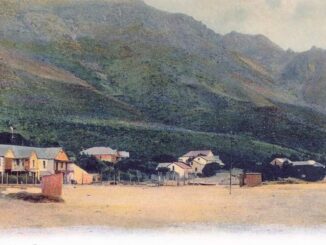
She and her sister Anna were brought up by her mother and grandmother in the small coastal town of Gordon’s Bay, across False Bay from Cape Town. The girls played on the beach and in the sea like two small otters or buried themselves in the white sand below the mountain. Gordon’s Bay is where Jonker spent much of her childhood and where she was happiest.
Ingrid Jonker was born on 19 September 1933 in Douglas in the Northern Cape, a farm child from the dry interior, not the coast. But her parents’ marriage collapsed almost immediately after her birth and Ingrid and Anna would spend their childhoods moving between farms owned by her grandfather, Fanie Cilliers. His death brought more change for the family and they moved again, from Strand to Gordon’s Bay. The mountains and the sea and the particular quality of False Bay light became the landscape of her earliest years, the landscape that formed her imagination before she was old enough to understand what imagination was.
In 1943 her mother died from cancer and Ingrid would spend time between her father’s home and a local boarding house. She was eleven years old. The stability of Gordon’s Bay, the beach, the sea, the mountain behind the village, was gone. What replaced it was a childhood of disruption and loss that would mark everything she wrote.
She wrote from very young. She sent her first collected poetry manuscript to a publisher at sixteen. The poet and literary professor D.J. Opperman noticed her work and encouraged her even when that first collection was rejected. She kept writing. The sea kept appearing in what she wrote, not as decoration, not as background, but as something alive and necessary, the way the sea appears to someone who met it as a small child and never entirely left it behind.
An early poem recalls her childhood in Gordon’s Bay on the coast of False Bay. The closing lines are poignantly prescient of the death she would actually die. She was writing about the sea of her childhood while already imagining the sea of her end.
Her life was difficult in ways that are not the subject of this book. Her father, Abraham Jonker, a writer, editor and National Party Member of Parliament, was instrumental in implementing censorship laws on art, publications and entertainment. Their political differences were public and humiliating and Abraham publicly denied Ingrid as his daughter. She wrote poetry that challenged everything he stood for. She loved people who complicated her life. She struggled. She wrote.
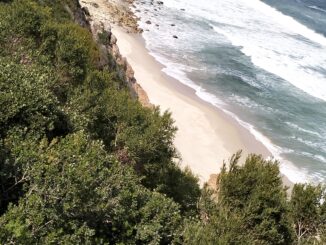
On the night of 19 July 1965, Ingrid Jonker was only thirty-one years old when she waded through jagged rocks into the icy sea. She did not come back. Her recovered body was strewn with seaweed, periwinkles and mussels and shellfish resting in her auburn hair.
She had walked into the Atlantic, far from False Bay. But the sea she first knew was this one, the sea below the Helderberg, the sea of Gordon’s Bay, the sea she had played in as a child when she and Anna buried themselves in the sand and the mountain rose behind them and the future was still entirely open.
Her life story weaves through Gordon’s Bay’s history and culture, kept alive by performers and an assortment of biographical books, plays and television documentaries. In 1994, Nelson Mandela read her poem The Child Who Was Shot Dead by Soldiers at Nyanga at the opening of South Africa’s first democratic Parliament, introducing her words to a generation that had not been alive when she wrote them.
The Gordon’s Bay beachfront memorial stands where the child played. The mountain has not changed. The sea has not changed. Only the child grew up and wrote and is gone.
Between You and Me:
A child’s tricycle, set in marble, on the Gordon’s Bay beachfront. I have walked past it many times and I think most people do, it is small, it does not announce itself and unless you already know the story it could be mistaken for almost anything. But once you know what it commemorates, it becomes one of the most quietly devastating objects in the entire Helderberg. Not a statue. Not a grand monument. A tricycle, the specific ordinary object of a happy childhood, placed on the beach where that childhood happened, for a woman who did not get to keep being that child and whose words outlived her by sixty years and counting. Nelson Mandela read her poem at the opening of the first democratic Parliament. The tricycle is on a beach in Gordon’s Bay. Both things are true and neither one is bigger than the other.
Historian – Harmen Bockelenberg
Next week: We leave the art class for now and turn to another corner of a Strand story.

Be the first to comment