

STORY 106
Featured Image: Die Kalfies – 1833
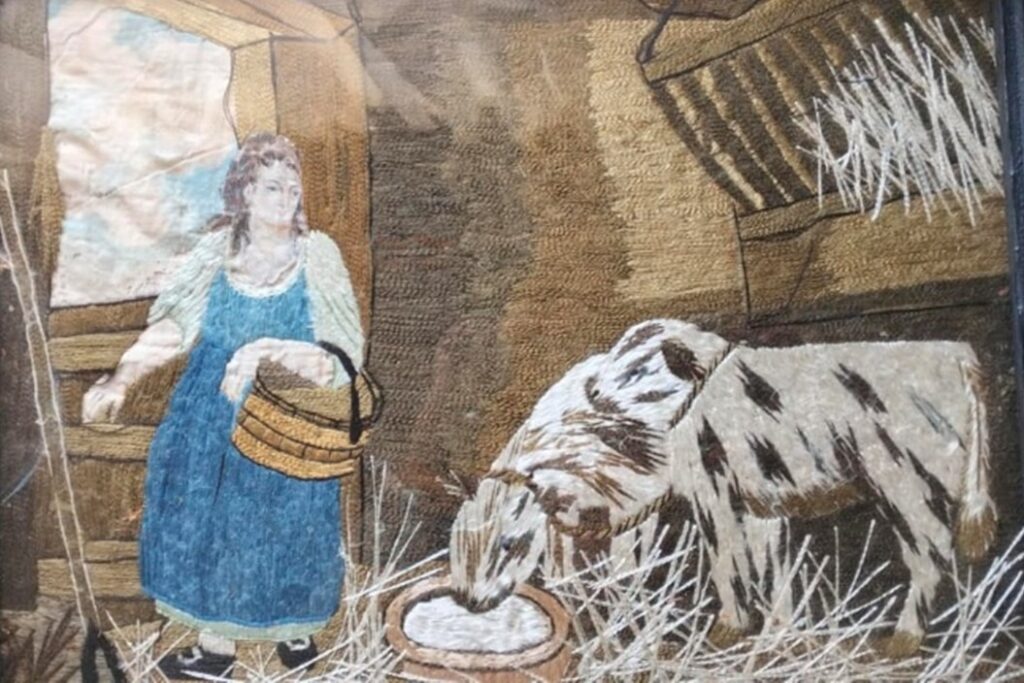
There is an object in the family that was made by hand in 1833.
Not printed. Not manufactured. Made, stitch by stitch and brushstroke by brushstroke, by someone whose name has not survived, in the Cape Colony of the early nineteenth century, when the British had been in charge for less than thirty years and the Great Trek had not yet begun and the world that would become South Africa was still being slowly and painfully assembled from its component parts.
The piece is called Die Kalfies. The calves. It shows a young woman in a blue dress, a wooden bucket on her arm, standing in a barn. In the foreground, two spotted calves feed from a dish set in the straw. The light in the barn is the particular warm half-light of a working farm building, not darkness, not brightness, but the in-between light that falls through a door or a high window and settles on animals and people going about their daily work.
The technique is unusual. It combines needlework tapestry with watercolour wash, the figures and animals worked in thread, the background and atmosphere built up in paint, the two disciplines meeting in a way that was practised in the early nineteenth century by skilled needlewomen who were also trained in watercolour, the two arts taught together as part of a young woman’s education in the Cape Colony of that era. The glass in the frame is hand-made. You can see it if you look carefully, the slight unevenness, the faint ripple and bubble of glass blown and drawn by hand before industrial manufacture made such variation obsolete. That glass dates the framing to the same period as the work itself. This object has been intact, in essentially its present form, for nearly two hundred years.
The De Villiers family made it and kept it. The De Villiers name is one of the oldest in the Western Cape, a Huguenot family that came to the Cape in 1689 and planted roots so deep that the name appears on farms, streets and family trees across every district of the winelands. By 1833, when Die Kalfies was made, the De Villiers family had been part of the Cape landscape for a hundred and forty years. Whoever made this piece, a daughter of the family, perhaps or a daughter-in-law, working in a farmhouse somewhere in the interior valleys, was the descendant of people who had come as refugees and stayed as farmers and become, over five generations, as much a part of this landscape as the vines and the mountains themselves.
The farms of the Breede River Valley, east of the Du Toitskloof Mountains, had been occupied by European settlers since 1709 and the De Villiers family was among those early settlers of the interior valleys. The Goudini School was formed in 1858 by forty-five people from the Rawsonville area and it was in Rawsonville that a later generation of the De Villiers family put down their particular roots. Jack de Villiers taught school there in the 1940s and 1950s, married to Hettie, the sister of Marjorie Faure, grandmother of this book’s author. The painting came down through that line.
Jack de Villiers as a schoolteacher, retired in Rawsonville in the 1960s, is a figure entirely recognisable to anyone who knows the small towns of the Western Cape interior. The schoolmaster, the onderwyser, was one of the anchoring figures of every rural Afrikaner community. He was educated when many around him were not. He was responsible for the children of farmers and labourers and shopkeepers equally. He taught in a building that was often also the community hall, the examination room, the place where the town’s children spent the years between childhood and whatever came next. Jack de Villiers did that work in a valley between the Du Toitskloof Mountains and Worcester and he did it for years and Die Kalfies hung on his wall while he did it.
Or Hettie’s wall. These things are never entirely clear.
What is clear is the object itself. A farm scene from 1833, made by a De Villiers relative whose name we do not know, of a subject she knew intimately, the daily life of a farm, the calves in the barn, the woman with her bucket, the straw on the floor. She was not trying to make art in any grand sense. She was trying to capture something she saw every day, using the skills she had been taught, in the medium that was available to her. She combined needle and brush because that is what she knew how to do. She put it behind glass and someone put it in a frame and it has been travelling with the family ever since.
It is not worth much in market terms. The artist is unknown. The provenance is family memory rather than auction record. But it is nearly two hundred years old and it is still intact and the calves in the straw are still feeding and the woman with the bucket is still walking toward them in her blue apron and the light in the barn is still exactly what it was on the morning or the afternoon or the long winter evening, when someone sat down and decided to make it permanent.
That is worth something. That is worth a great deal.
Between You and Me:
The artist is unknown. I keep returning to that phrase throughout this book. Flora’s real name unknown, the witnesses to the 1722 inventory whose names survive but whose lives do not and now this: a piece of needlework and watercolour, nearly two hundred years old, made by a woman whose name nobody thought to record. She made something that has outlasted everyone who knew her, that has been looked at by five or six generations of people who never met her, that is still intact and still doing exactly what she made it to do. She did not need her name on it for it to last. I find this oddly comforting. Most of what any of us make will not have our names on it either, eventually. The calves are still feeding. That turned out to be enough.
Historian – Harmen Bockelenberg
Next week: a bicycle, a dog and the freedom of a Sunday afternoon childhood in the Helderberg before anyone was watching.

Be the first to comment