


STORY 105
It was a weekday afternoon in 1974. School had not yet ended for the day or perhaps it had just ended, which amounts to the same thing, because the boy in question was still in his school uniform when he walked into the Somerset West Town Hall and sat down and waited for something to happen.
He did not know what was about to happen. Nobody had warned him.
The young woman who walked onto the stage was Sonja Herholdt. She was born in Nigel in Transvaal (now Gauteng) on 1 December 1952 and had begun performing publicly at the age of three. By 1974 she was twenty-one years old, not yet famous in the way she would shortly become, but clearly, to anyone paying attention in a civic hall that afternoon, on her way somewhere. Petite, with a voice that would soon make her the darling of Afrikaans music, she was in the middle of exactly the kind of pre-fame circuit that builds a career from the ground up: town halls, civic centres, school audiences, afternoon performances in places where people were genuinely hungry for live music because there was, in 1974, almost no other kind.
Television had not yet arrived in South Africa. It would come in 1976. Until then, if you wanted to see a performer, really see one, in the flesh, on a stage, with the lights on them, you went to wherever they were performing and you sat down and you looked. There was no other way. The Somerset West Town Hall on a weekday afternoon was, for a schoolboy in his uniform who had probably come straight from class, as close to the centre of the entertainment world as it was possible to get.
Her professional recording career would launch the following year, in 1975, with her debut single Ek Verlang Na Jou, which sold over 25,000 copies and immediately earned gold status. But that afternoon in Somerset West she was still pre-record, pre-fame, pre-gold disc, just a young woman on a municipal stage, performing for rows of schoolchildren in uniforms who had been brought or had drifted into the hall from the street and who were about to receive a cultural education that nobody had specifically planned for them.
The song that did the damage was Jantjie. Written by Anton Goosen, it is a heartbreaking song of a woman missing her man and Sonja delivered it with her innocent image and voice in a way that combined sweetness and longing so completely that a schoolboy in his uniform had absolutely no idea how to process it. The schoolboy crush that resulted was immediate. It was entirely without prospects. These things were understood at the time. None of it diminished the experience in the slightest.
This is the part of cultural history that never makes the official record.
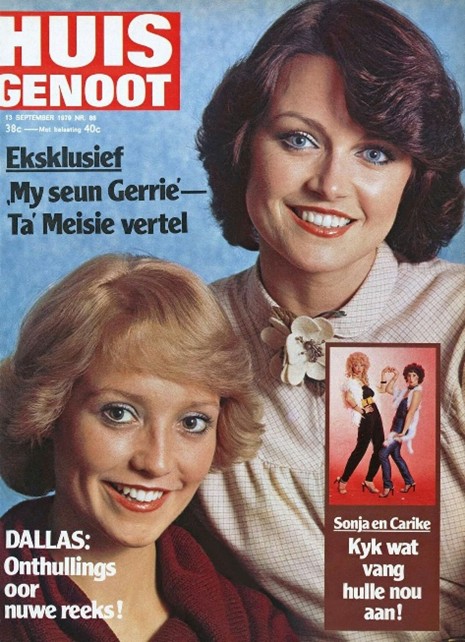
September ’79 Sonja & Carike
Sonja Herholdt went on to win eight Sarie Awards, with six consecutive victories as Best Female Singer between 1975 and 1980. In 1979 she starred in Sing vir die Harlekyn, winning a Rapport Oscar Award as Best Female Newcomer and later became the first South African singer invited to perform on Dutch television. She had the career that the voice in the Somerset West Town Hall had always promised. The schoolboy in the uniform could claim, with complete accuracy, that he had heard her before anyone else had heard of her.
The Somerset West Town Hall hosted many such afternoons across the middle decades of the twentieth century, touring artists, concerts, civic recitals, all the apparatus of cultural life in a town that took such things seriously enough to show up. Most of those days are entirely lost now. The programmes were thrown away. The performers moved on. The audiences grew up and remembered other things.
This one survived. It survived because a schoolboy was sitting on a hard wooden chair in his uniform, paying the kind of attention that you only pay when something unexpected reaches you before you have built up any defences against it.
He is still paying attention. This book is the evidence.
Between You and Me:
None of it diminished the experience in the slightest. I stand by that sentence completely. There is a particular dignity to a hopeless schoolboy crush that I think gets unfairly mocked in retrospect, as if the lack of any possible outcome makes the feeling itself less real or less worth having. It does not. The feeling was entirely real, the song was genuinely beautiful, the afternoon was genuinely memorable and none of those things required Sonja Herholdt to ever know the schoolboy existed. Fifty years later he can say, accurately, that he heard her before her first record came out. That is not nothing. That is, in its own small way, exactly the kind of thing this book exists to preserve.
Historian – Harmen Bockelenberg
Next week: an object made by hand in 1833 and what it tells us about the people of this valley.




Be the first to comment