


STORY 50
In 1971, the factory changed hands in a way that changed everything about its character. Armscor, the Armaments Corporation of South Africa, the state entity established to develop and manufacture weapons domestically as international sanctions began to bite, acquired two AECI factories producing propellants and explosives. The Somerset West facility became Somchem. The name was new. The site was the same. But the purpose had changed fundamentally: from commercial explosives for mining to military propellants and weapons systems for a state under growing international pressure.
What happened at Somchem between 1971 and 1992 is only now being fully acknowledged. Some of it was relatively straightforward, the development and manufacture of solid propellants for military applications, the production of rocket launchers, the engineering work that kept the South African Defence Force supplied during the Border War years when international sanctions made conventional procurement increasingly difficult. The Valkiri multiple rocket launcher, the FT5 anti-tank rocket, weapons that South African soldiers carried and used on the Angolan border, were products of the Somerset West site and the engineering minds it employed.
Some of it was considerably less straightforward.
In 1972 and 1973, a small team from the Atomic Energy Board worked under tight security at a propulsion laboratory at Somchem. They were working on mechanical and pyrotechnic subsystems for a gun-type nuclear device. In May 1974, a scale model was tested at the Somerset West facility. The test was successful. It convinced the Atomic Energy Board that a nuclear explosive was feasible. By 1977, the programme had been transferred from Somchem to Pelindaba, where South Africa’s nuclear weapons were eventually developed and manufactured, six devices in total, all subsequently dismantled before the country signed the Nuclear Non-Proliferation Treaty in 1991.
The people of Paardevlei and of Somerset West and of Strand and of Gordon’s Bay were living next to a nuclear weapons development site in 1974. They did not know this. Most of them still do not know it. The Somerset West site where scale model nuclear devices were tested is the same site where the Cape Explosives Works had been making dynamite for diamond mines since 1903.
The ambitions did not stop at weapons. In the late 1980s and early 1990s, as sanctions were biting and South Africa was simultaneously trying to rejoin the international community while completing the most ambitious engineering programmes in its history, Somchem became a central player in something that belongs more to the realm of science fiction than to a factory beside a horse marsh in the Western Cape.
South Africa was trying to build a rocket to launch satellites into space.
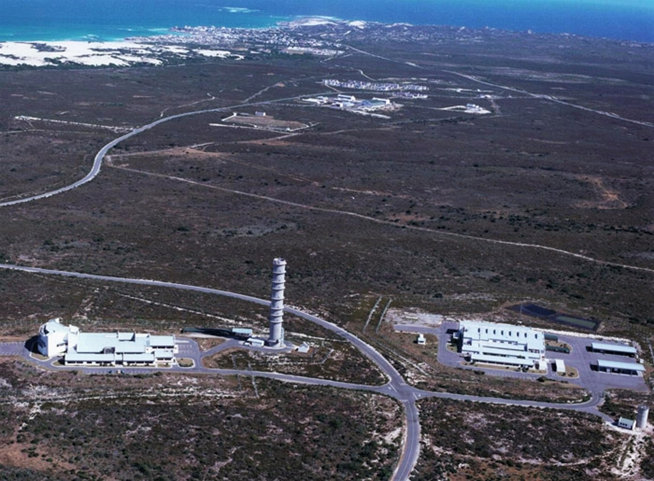
Overberg Test Range
The programme involved between fifty and seventy companies at its height, directly employing between thirteen hundred and fifteen hundred people. The prime contractor was Houwteq, based near Grabouw in the mountains above the Helderberg. Somchem was the propellant manufacturer, the company that would produce the solid rocket motors that would push a South African satellite into orbit. A high-technology static rocket motor test facility was established at Rooi-Els on the Kogelberg coast, the same dramatic stretch of coastline around the corner from Gordon’s Bay on Clarence Drive, where the mountains drop almost directly into False Bay and the Kogelberg Biosphere Reserve begins.
The scale of the programme was extraordinary. The first RSA rockets were test-flown on ballistic trajectories in 1989, reaching altitudes of one hundred and three hundred kilometres respectively. The RSA-3 was designed to place a small surveillance satellite into orbit. The RSA-4 was being developed as a commercial launch vehicle for international clients. South Africa was seeking to establish a Cape Canaveral-type space centre for the entire southern hemisphere, with the Overberg Test Range near Bredasdorp as its launch facility and Rooi-Els as its rocket motor testing ground.
For the Helderberg, the space programme was not an abstraction. It was economic activity of the most concentrated kind. Fifty to seventy companies drawn into the supply chain meant contracts flowing through Somerset West and the surrounding districts. The skilled workforce that Somchem and Houwteq required lived in the valley, spent their salaries in local shops and restaurants, bought houses in Somerset West and Strand, sent their children to Helderberg schools. Every engineer who worked on solid rocket motor development at Somchem was also a customer of every business in Somerset West.
The test facility at Rooi-Els sat on the southern edge of the Kogelberg nature reserve. The village council of Rooi-Els sued to have Somchem expelled from the region, arguing that a rocket motor testing facility had no business operating beside one of the most ecologically significant stretches of coastline in the world. The botanical and the ballistic were occupying the same piece of cliff above False Bay. They were not natural neighbours.
The argument became irrelevant before the courts resolved it. As the price for South Africa’s membership of the Missile Technology Control Regime, Pretoria had to give up its long-range missiles and cancel its space launch effort. Houwteq dismantled its largest rockets and retrieved blueprints and technical files from its subcontractors. Somchem filled in its large engine casting pits at Somerset West. The Hangklip static motor test facility at Rooi-Els was demolished and converted into a nature reserve. American inspectors visited the Somerset West site to verify that the dismantling had been completed as required.
South Africa came within a few years of becoming the first African country to launch a satellite on its own rocket, using propellants made at a factory beside a horse marsh in the Western Cape and tested on a clifftop above False Bay in the Kogelberg biosphere. The rocket never flew. The test facility is gone. The nature reserve has reclaimed the site on the cliff above the sea.
The local economy felt the cancellation. High-skill jobs disappeared. Specialist suppliers lost their contracts. The particular energy of a community working on something genuinely extraordinary deflated with the programme. It was not a catastrophic blow to the Helderberg economy, which had other foundations. But it was a real one.
In 1992, Armscor was restructured. The manufacturing companies were separated from the procurement function and incorporated into Denel, a new state-owned defence industrial company. Somchem became a Denel division. The transition changed the ownership structure without fundamentally changing the work.
Denel ran into serious financial difficulties through the early 2000s. In 2008, the German defence and technology company Rheinmetall purchased a majority stake. The Somchem divisions at Somerset West and Wellington became Rheinmetall Denel Munition, RDM, with Rheinmetall holding fifty-one percent and Denel retaining forty-nine.
RDM today is one of the world’s notable manufacturers of large and medium calibre ammunition, artillery systems, mortar systems and propellant technologies. In the first half of 2023, South Africa’s munitions exports reached R3.8 billion, a figure driven substantially by increased global military spending following Russia’s invasion of Ukraine. RDM was central to that growth, its Somerset West site working at a level of output that recalled the Armscor years.
One hundred and twenty years. Dynamite for diamond mines. Propellants for Border War rockets. A nuclear device tested in a laboratory. Solid motors for a satellite launch vehicle. Anti-tank weapons, artillery ammunition, export contracts for armies on four continents. The factory at Paardevlei has outlasted every political dispensation that has governed South Africa in its lifetime, adapted to every change of ownership and purpose, survived an explosion that killed its workers and a cancellation that ended its most extraordinary ambition.
The horse marsh beside it is now a nature reserve. The wetland is protected. The waders pick their way through the reeds at the edge of the water with the indifference that birds have always brought to the activities of the factory next door.
Most people drive past it on the N2 without knowing any of this.
Now you know.
Between You and Me:
South Africa had six nuclear weapons. They were all dismantled. This makes South Africa the only country in history to have developed a nuclear weapons capability and then voluntarily given it up. The scale model for the first device was tested at a factory in Somerset West. I have driven past that site more times than I can count and I did not know this until I started researching this book. There is a version of local history that is about streets and schools and cricket matches. This book is about that version too. But there is also this version, in which the factory between the retirement town and the beach resort was briefly part of the most significant arms control story of the twentieth century. Both versions are true. The mountain looks the same from either direction.
Historian – Harmen Bockelenberg
Next week: long after the fireless Borsigs fell silent, a different kind of engine took up the run to Firgrove, and for years it slipped past drivers on the old road without a single one of them knowing its name.



Be the first to comment