

STORY 109
The earthquake that struck on the night of 29 September 1969 did not announce itself. At two minutes past ten on a quiet spring evening, houses throughout the Western Cape simply began to shake.
Windows rattled. Crockery shuddered in cupboards. Beds vibrated and hanging lights swayed on their cords. Some people rushed outdoors, convinced that something had exploded somewhere nearby, the De Beers factory at Paardevlei, perhaps or something at Steenbras Dam. Others stood frozen in their hallways, trying to make sense of what their bodies were telling them. Earthquakes belonged to other countries, other continents. Not to the mountains and valleys surrounding False Bay.
The shaking lasted only seconds. It felt considerably longer to those experiencing it for the first time.
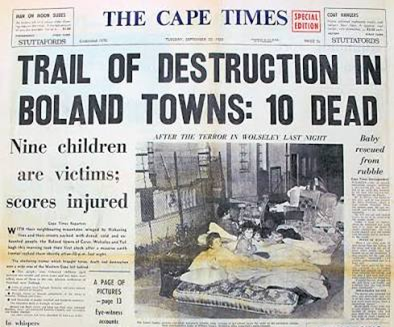
Telephones began ringing as neighbours called one another. Rumours moved faster than information. Only later did news arrive from beyond the mountains: the epicentre lay in the Tulbagh Valley, where the earthquake, measuring 6.3 on the Richter scale, the most destructive recorded in modern South African history, had brought down buildings, filled streets with rubble and taken lives. Tulbagh was devastated. Wolseley and Ceres had suffered badly. The Helderberg had escaped with rattled nerves and a few cracked walls. Others had not been nearly so fortunate.
But for one family, the story did not end there and it did not begin in the Helderberg at all.
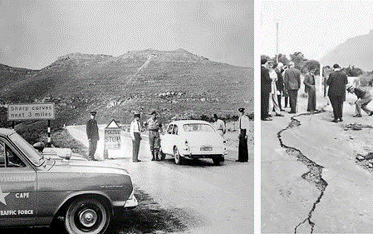
On that same night, a young boy, this book’s author, was living with his family in Worcester, close enough to the epicentre to feel the full force of what had happened. The ground shook. The walls shook. And when it was over, the world felt subtly different from the world that had existed before ten o’clock. Shortly afterwards the family relocated to Wolseley, arriving into a town still raw from the disaster, still living with broken walls and broken nerves, still trying to understand that the ground beneath its streets was not the fixed and permanent thing everyone had always assumed it to be.
Then, on 14 April 1970, six and a half months after the main earthquake, it happened again.
A magnitude 5.7 aftershock, the largest in the entire sequence of approximately 125 recorded tremors, rolled through the same broken landscape. For those who had lived through September, it was as though the Tulbagh earthquake had come back for what it had missed the first time.
In Wolseley, sitting at the centre of it all, the rumble arrived first, that deep, subterranean sound that preceded the shaking by just enough time to know exactly what was coming and be entirely unable to do anything about it. The house shook. Ornaments toppled from shelves. Glass broke. And across the foothills, on the mountain directly opposite, something stranger and more unsettling still: the rock faces began to burn. Flammable gases, disturbed by the violent movement deep below, escaped through fissures in the stone and caught alight in the darkness, the mountain glowing against the night sky in a way that no mountain should.
Families who had already lived through September now slept in their cars for the following nights, those fortunate enough to have one, parked in the street outside their homes, unwilling to trust the walls around them should the earth decide to move again before morning. Neighbours who had no cars made other arrangements. Everyone was outside. Nobody wanted a roof over their head that night. The South African Army was there to help, setting up a tented town down in the village.
About a week later, the decision was made. It was the boy’s mother who took charge, as mothers in such situations often do, quietly, firmly and without drama. They had been through the first earthquake in Worcester. They had moved to Wolseley and been through the second. She had seen enough. The family packed up and relocated to the Helderberg, putting the mountains and the broken valley behind them. Some decisions make themselves. This was one of them.
In the Helderberg, the earthquake had entered local folklore in the way that only a truly shared experience can. For years afterwards, whenever a loud blast echoed from the Paardevlei factory or a quarry detonation rumbled across the valley, older residents would look at one another and ask, with a smile that contained a genuine unease, whether another Tulbagh had arrived. It became a benchmark, a single word that carried an entire night inside it.
The 1969 earthquake also changed how engineers and planners across the Western Cape thought about the ground beneath their feet. The ancient faults of the Cape Fold Belt, long assumed to be dormant, had demonstrated otherwise. Smaller tremors continued intermittently until November 1971, each one a quiet reminder that the sequence had not entirely finished with the region.
The mountains that framed the Helderberg had always seemed permanent, immovable, simply there. On the night of 29 September 1969 and again on the evening of 14 April 1970, they served notice that permanence is, in geological terms, a relative concept.
Everyone who lived through it remembered where they were. That is the particular quality of a moment when the earth moves beneath you, it fixes itself in the memory with a clarity that ordinary evenings never manage. For a brief and deeply unsettling time, the people of the Helderberg were reminded that even the mountains surrounding them operated on a timetable entirely their own.
Between You and Me:
The rock face burning. I have read accounts of the Tulbagh earthquake before, but the detail of flammable gas escaping through fissures in the mountain and catching alight in the darkness, the mountain itself appearing to burn, on top of everything else that was happening that night, is the image that has stayed with me longest. It is the kind of detail that sounds invented, that sounds like something added for effect and is instead simply what happened. A family that had already been through one earthquake, in one town, watched a mountain catch fire during the second one, in a different town and decided that was the sign they needed. They came to the Helderberg. The mountain here has never caught fire from an earthquake. I suspect that was, for a while, considered one of its better qualities.
Historian – Harmen Bockelenberg
Next week: the December lights Main Road in Somerset West, strawberries and cream and the tradition that draws people from across the country.

Be the first to comment