
STORY 107
Before the internet. Before the PlayStation. Before parents organised playdates and supervised every moment of their children’s lives in the anxious, scheduled way that became standard in later decades. Before all of that, a child’s freedom had a very simple measurement: how far could you go on a bicycle before anyone noticed you were gone.
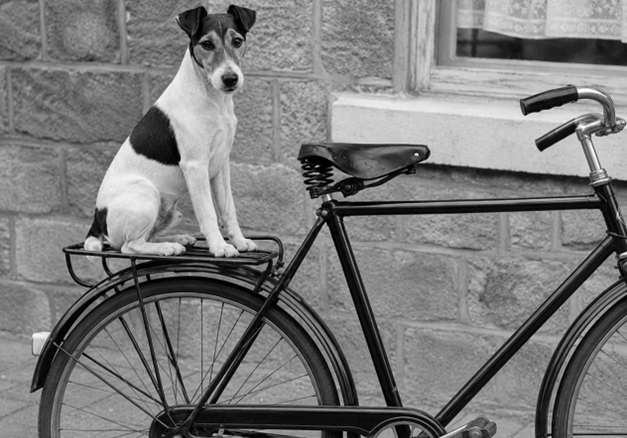
The answer, for an eight-year-old boy in Wolseley in the early 1970s, this book’s author, was further than his parents knew. While they slept on Sunday afternoons, that sacred, inviolable institution of the Afrikaner household, the Sunday middag-slapie, a small boy would slip out of the house with his dog Patch and get on his bicycle and hit the road.
The road from Wolseley to Tulbagh to Ceres forms a triangle. The distances are not large, seven kilometres of back roads linking three small Boland towns, the road from Tulbagh splitting left to Ceres and right to Wolseley, another road completing the loop. An eight-year-old on a bicycle, with a dog sitting on the carrier, could complete this circuit on a Sunday afternoon and be back before the adults woke up. This required confidence, a working bicycle, a cooperative dog and a complete absence of the risk awareness that adults would have brought to the same situation.
None of these things presented any difficulty.
Moving to the Strand changed the geography of freedom but not its logic. A bicycle in Strand meant the beach and the beach meant Melkbaai for body surfing, the section of the long Strand beachfront where the waves came in at the right angle for a body surfer to ride them without equipment, just arms out and the timing learned from doing it wrong many times first. It meant the “dakkies”, the structures that served the Strand beachfront community for generations, with ablution facilities and change rooms underneath and girls in the early stages of a bronzed tan stretched out on the flat roofs above, working the angles of the summer sun with the focused dedication of people who had nowhere else to be. The last of the dakkies was eventually converted into the Blue Café. Before that, they were simply part of the furniture of the beach.
It meant the Lover’s Lane area for the surfers, long boards, no kites, no windsurfers, none of the equipment that would arrive later and transform the beach into something more technically complex. Just boards and waves and the long flat swell of False Bay on a summer afternoon after school.
Lover’s Lane was used not just as a parking area for obvious reasons relating to its name and the other was that it was open to the public for picnics and braais. Anyone who ever used the LL braai area would know about the South Easter either removing the coals with force from underneath the rooster or if that did not happen your meat would have a gentle seasoning of dune sand spread over it.
Back to the bicycle and it meant the dips, the area now opposite Victoria Park, next to the Lourens River, where large canals and trenches had been dug to divert the river and spread its flow across the floodplain. To the engineers who designed them, these were flood mitigation structures. To a generation of Strand children on modified bicycles, modified meaning the mudguards had been removed, which was about as far as the modification went, they were a ramp park. Long before anyone in the Helderberg had heard of BMX or mountain bikes, children were wheeling and ramping and generally defying physics in the dips, on bicycles that the manufacturer had not designed for this purpose and would have been disturbed to learn about.
The area opposite, part golf course and part Victoria Park, was used at times as a rally stage, a speed trial, cars on a timed run through the flat ground opposite the riverbanks. Many of the locals watched from positions that no safety marshal would have sanctioned. Nobody got hurt. The era was like that.
The tidal pool on Strand beach was the destination for younger years, the years when parents still had to come with you, before you could think for yourself, when the sea was supervised and the waves were behind a wall and the water inside the pool was warm and shallow and safe. The tidal pool was always the destination for young mothers and toddlers being supervised. The beach itself, the open False Bay surf, was where you went when you were old enough to go without anyone watching.
The cafés completed the picture. The Springbok and the Monaco and some others, the two on the beachfront that everyone remembers, with their pinball machines and their arcade games. The pinball machines accepted ten-cent coins or any washer of approximately ten-cent dimensions, obtainable at the Koöp for a small fraction of the cost of the actual coins. The arcade era that followed demanded a genuine, un-washered twenty cents, for Asteroids and Donkey Kong, where certain gifted individuals had developed the ability to stretch a single twenty-cent piece across an entire afternoon through a combination of skill, patience and an intimate knowledge of the game’s geometry. This was respected as a talent in the community of Strand children. It deserved to be.
The Rialto cinema in Strand, now a block of flats and the Tria cinema, now the Tria arcade, offered afternoon matinees for somewhere between twenty-five and seventy-five cents. This was not nothing. A monthly allowance of one rand, with fifty percent compulsorily saved at the post office, left fifty cents for everything, a Matchbox car for 25c, a 7-single, a matinee or some combination of the three that required careful planning. Dinky cars were beyond the budget entirely. A vinyl LP at 99c was a month’s discretionary spending plus a little extra that had to be found somewhere. A newspaper round, Die Burger in the early mornings before school or the Cape Argus delivered in the afternoons, helped close the financial gaps. So did mowing neighbours’ lawns, which was not called “garden services” until considerably later.
Freedom, in the Helderberg of the 1970s, was negotiated on a bicycle, measured in ten-cent pieces and conducted at a speed that adults sleeping through Sunday afternoons never quite clocked.
Between You and Me:
The washer that was approximately ten-cent dimensions, available at the Koöp for a fraction of the cost of an actual coin, used to defeat a pinball machine. I want to be clear that I am not endorsing this as a model of civic virtue, but I have a genuine fondness for the specific kind of resourcefulness it represents. The careful identification of a loophole, the small economy that grew up around it, the fact that an entire generation of Strand children apparently knew exactly which washer worked and where to get it. Nobody taught you this. It was simply known, the way certain things are simply known among children, passed along without ceremony, more reliable than anything in the official curriculum. I suspect the arcade owners knew about it too and tolerated it, within limits, because that is also how these things work.
Historian – Harmen Bockelenberg
Next week: last rounds the hotels of the Helderberg and the disco that introduced Gordon’s Bay to a Saturday night that didn’t end at nine.

Be the first to comment