
If you drive into Gordon’s Bay today and look up at the mountainside above the harbour, you will see two things painted in whitewashed stones against the dark rock. An anchor. And the letters GB. Most people assume GB stands for Gordon’s Bay. It does not. But we will get to that.
First, let us talk about the man whose name the town actually carries. Because Robert Jacob Gordon is one of the most remarkable figures in the entire history of the Cape Colony and almost nobody knows his story.
Colonel Robert Jacob Gordon was born on 29 September 1743 in Doesburg in Gelderland, Netherlands. His father was a Scottish officer in the Dutch States Army and his mother was Dutch. Robert was therefore neither fully Scottish nor fully Dutch, but something in between, a man whose identity was always divided and who would ultimately be destroyed by that division.
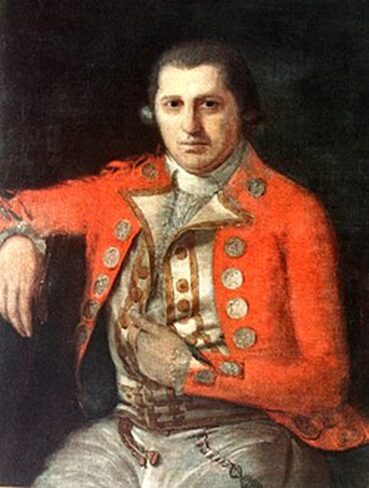
Colonel Robert Jacob Gordon
He was, in short, a genius. Fluent in French, Dutch and English, he also spoke Khoikhoi and Xhosa, an extraordinary accomplishment for a European officer in 18th-century South Africa. He was a trained soldier who was also a gifted botanist, zoologist, geologist, ethnographer, cartographer and artist. He went on more scientific expeditions into the South African interior than any other 18th-century European, documenting the topography, fauna, flora and inhabitants of southern Africa in extraordinary detail. His journals and drawings discovered in obscurity in Amsterdam in 1964, nearly 170 years after his death are now considered among the most important records of pre-colonial southern Africa ever compiled.
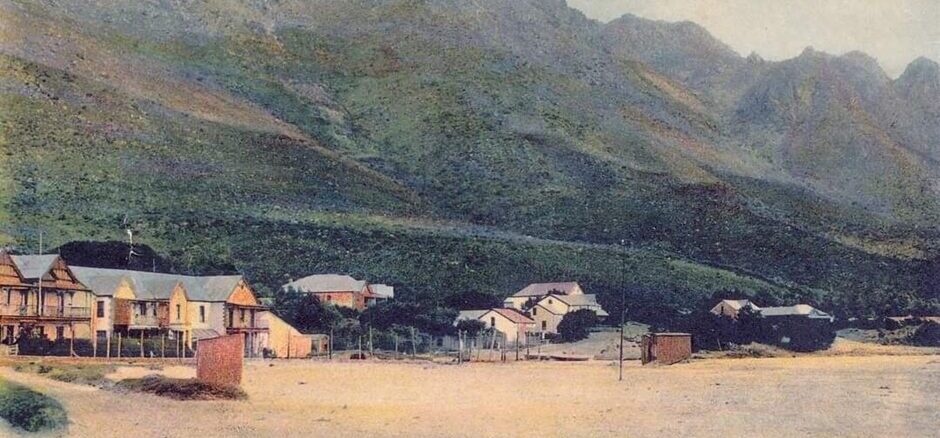
On an expedition in October 1777, Gordon was in the vicinity of Hangklip along the southern coast and from there found a path used by eland and buffalo. Using this pathway, he came to a sandy bay with a watercourse up the mountain. This place he named Gordon’s Bay. Before that, the locals had simply called it Vissers Baay, Fisher’s Bay and on old maps dating back to the early days of the Cape Colony, the little bay is variously referred to as Visser’s Baay in 1673, de Vishoek in 1676 and Combuys, evidence that it was known from the earliest colonial days as a place where fresh water, fish and game could be found.
The name Gordon replaced ran deeper still. Long before 1777 the bay was known as Vischhoeks Baay or Vissersbaai, on account of the abundant fish caught below Cape Hangklip. WA van der Stel had a fishing hut built there, where the catch was salted and packed before being carried by boat to Table Bay. Early in the eighteenth century grazing rights over the land were granted to Catherine Cloete, the widow of Jan van Brienen, though by 1720 her homestead had already fallen into ruin. In 1743, the same year in which Gordon himself was born, the farm known as Gustrouw was granted on loan to Maria Malherbe, the widow of Jurgen Radyn, who had occupied the land since 1723 and remained there until 1763. Gordon therefore did not name an empty bay. He renamed a place that fishermen, farmers and their widows had already known and worked for the better part of a century.
Gordon’s Bay was originally named Fish Hoek, many years before the town of the same name on the western side of False Bay was founded. The other Fish Hoek, across the bay, got the name later. Our Fish Hoek had it first. You can still see the evidence on the outside wall of the local Post Office in Gordon’s Bay, where the old name remains.
Gordon served as commandant of the VOC garrison at the Cape from 1780 to 1795. He was brilliant, respected and trusted. And then came 1795.
When the British arrived at the Cape in 1795, claiming to act in the name of the Dutch Prince of Orange who had fled to England from Napoleon’s armies, Gordon complied, accepting the British occupation rather than fighting a battle he knew he could not win. His own soldiers turned on him. He was accused of treason, became an outcast and a target of derision and violence. On 25 October 1795, just weeks after the British takeover, Robert Jacob Gordon committed suicide at his house, Schoonder Sigt, at the age of 52.
There are many indications of a more complicated explanation for Gordon’s death than simple disgrace. He had been ill since his last journey through the interior, visibly weakened, his behaviour at times erratic. Some of his children, many years later, ended in a lunatic asylum. In a letter written only two days before his death, Gordon confessed: “I am almost distracted”. His writing showed how emotions had overcome him. He was ill. He felt that his tough body and strong mind were deteriorating, the idea of becoming a shadow of the man he had been seemed intolerable to him and afraid of further decline, he took his pistol and shot himself.
He had spent twenty years mapping and documenting this country with extraordinary love and rigour. He named our bay. He named the Orange River. He discovered the remains of Bartolomeu Dias’s stone cross at Kwaaihoek. He introduced Merino sheep to the Cape Colony. And in the end, a combination of illness, political pressure and a mind that could no longer hold itself together cost him everything.
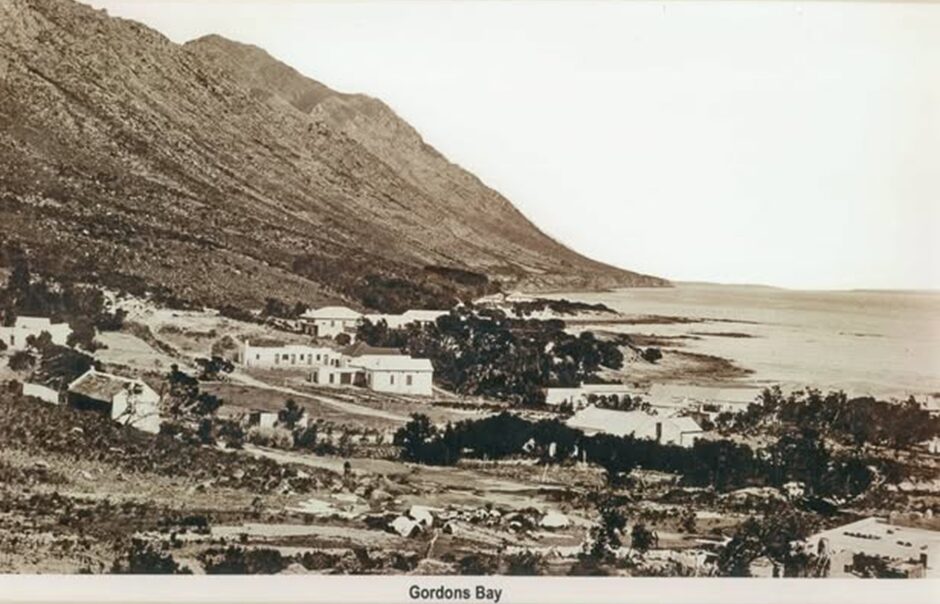
The bay Gordon named did not become a town for another sixty years, and the road to it was not a straight one. In 1813 the farm Gustrouw passed to Henry Alexander, who became Colonial Secretary after the death of Andrew Barnard. Alexander dreamed of building a town and a harbour on the bay, and went so far as to establish a whaling station there, but he died before the dream could be realised. William Bird, writing of the bay in 1822, believed that whale oil combined with salted fish could yet make it a profitable export harbour.
Over the following two decades Gustrouw changed hands repeatedly, until in 1844 it was bought by Colonel Robert Stanford, who settled there in 1848 with his own vision of a town, to be called Bellena Stanford. That vision collapsed within a year. In 1849 the ship Neptune arrived in False Bay carrying 282 convicts. Fearing the convicts would be permitted to settle in the colony, an Anti-Convict Association warned that anyone assisting the ship, even by supplying it, would be shunned by the community. Stanford and eleven others who provided the government with supplies for the vessel were denounced in the press and cast out by their neighbours. Their haystacks were burned, their children turned away from school, medical care withheld from their families, bank services suspended and their creditors called in every loan. Ruined, Stanford, who had been knighted in 1850, returned to England, and the second attempt to build a town on the bay failed as completely as the first.
It was only in 1852 that James William Miller took transfer of a 54 morgen portion of Gustrouw, later known as erf 425. Other buyers followed soon after, among them P.J. Korsten, J.E. de Villiers, P.C. Wium, P.H. Faure and, on 9 November 1855, J.S. de Villiers. These were the men who finally established the town on the bay Gordon had named seventy-five years earlier. The Miller family in particular became fixtures of the young settlement, serving on its Town Management Board from its establishment in 1902 and on its Municipality from 1961 to the present day.
Now. About those letters on the mountain.
The giant anchor and the letters GB on the mountainside above Gordon’s Bay harbour do not stand for Gordon’s Bay. They stand for General Botha, the name of the merchant navy training station established in the town, named after Louis Botha, the first Prime Minister of the Union of South Africa and Boer War general. The painted stones were placed there by naval cadets. The anchor is a symbol of the sea service. On 17 December 1958 the South African Navy took over the establishment and changed it to a military naval training college. The merchant cadets continued with dual training until 31 March 1966, when the SA Merchant Navy moved to Granger Bay in Cape Town.
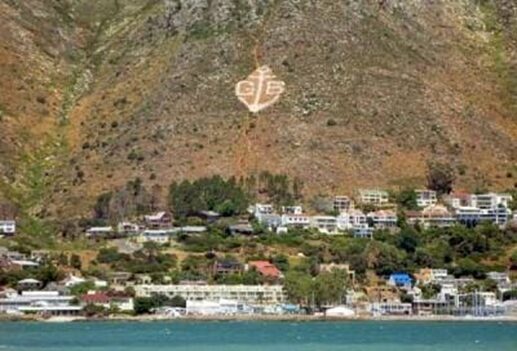
GB and the Naval base below
Gordon’s Bay. Named by a Scottish-Dutch genius who loved this coast more than his own life. The letters above it named for an Afrikaner general who never set foot here. Two names, one mountainside, three centuries of compressed history.
Between You and Me:
GB does not stand for Gordon’s Bay. I have now told you this and you will never be able to un-know it. The letters on the mountainside stand for General Botha, the merchant naval training station named after the first Prime Minister of the Union of South Africa, a man who also never visited Gordon’s Bay. We have a town named after a man who never came here and initials on a mountain for another man who never came here either. The man who actually did come here, who named the bay, mapped the interior, documented the fauna and flora with extraordinary love and rigour, got the name of the town. Which is something. Robert Jacob Gordon would probably have settled for that. It remains an upside-down world.
Historian – Harmen Bockelenberg
Next week: a name carried across nine thousand kilometres of ocean — how a city in Indonesia ended up on a highway sign between Somerset West and Cape Town.



Be the first to comment