

STORY 84
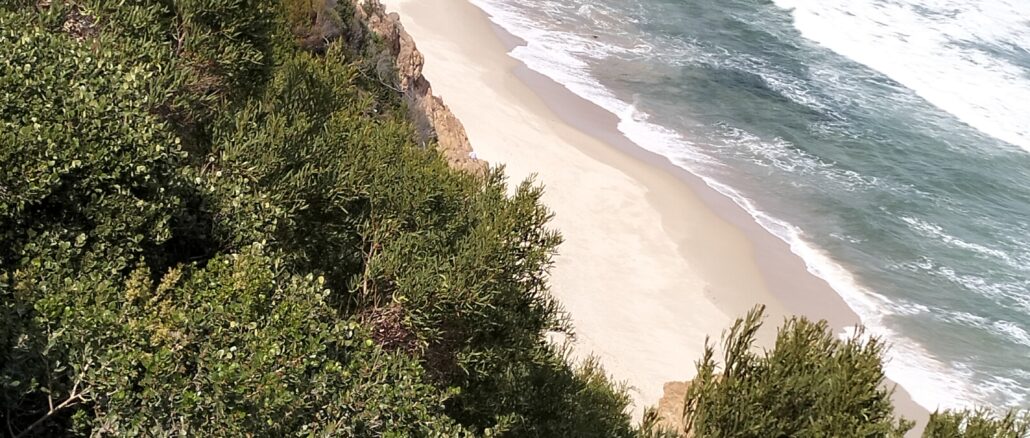
Feature image: Looking down towards the entrance of Dapatsgat.
The Afrikaans title of this story does not translate politely into English. Dappat se Gat means Dappat’s Hole and that is what the place has been called for as long as anyone can remember, which in the Helderberg means a very long time indeed.
The cave is still there. It sits along the rocky Kogelberg coastline on Clarence Drive between Gordon’s Bay and Kogel Bay tucked beneath the cliffs where the mountains drop almost directly into the sea, accessible only if you know where to look and are willing to make the effort to get there. On Instagram it appears regularly, photographed by people who found it and could not quite believe what they were looking at: a series of small jagged caves opening onto a hidden cove, the mountains rising behind, the cold green sea stretching ahead to the horizon.
But the name is older than Instagram and older than Clarence Drive and older than the tourism industry that has discovered the Kogelberg coast in recent decades. The name belongs to a man. And the man belongs to a story.
Back in the days when the area of Gordon’s Bay and Strand was still primarily used for farming, a livestock thief by the name of Dappat would descend upon the farms, grab some livestock and then disappear around the mountain and down to the caves. The Kogelberg coastline was, in those days, genuinely remote no road along the cliff face, no settlement between Gordon’s Bay and the farms further east, nothing but mountain and sea and the kind of silence that isolation produces. A man who knew the mountain paths could move animals through that terrain without being easily followed.
The plan was elegant in its simplicity. The high tide would wash away any tracks from the animals, leaving only confounded farmers and herders behind. The cattle disappeared. The tracks disappeared. The farmers scratched their heads and shook their fists at a landscape that offered no answers.
At the cave, Dappat would slaughter the animals and sell their meat. But this was no small domestic operation. He would load the meat onto a ship suggesting a maritime connection, a buyer offshore, a smuggling operation that used the cave as its processing point and the sea as its distribution route. False Bay has always been a working bay. Ships have always moved along its coastline. A man with a reliable supply of meat and a cave hidden from the road had the makings of a very tidy business.
This went on for quite a while before a fisherman out at sea noticed smoke coming from within the cave. That was the undoing of it. Smoke rises. A fire inside a cave is invisible from land but perfectly visible from the water, a thin column against the cliff face, rising at an angle that made no sense for a place where no one was supposed to be. The fisherman saw it. The authorities were alerted. Dappat and his whole loot were discovered.
What happened to him after that, the legend does not reliably say. The historical record to the extent that it preserves the name Dappat at all is thin. Whether he was a single man or whether several stories about several thieves accumulated over time into one composite figure is impossible to determine with certainty. Whether the events took place in the VOC era or the early British colonial period or somewhere in between, nobody can now say with confidence. The cave, however, is real. The name is real. And the logic of the operation mountain paths, tidal cave, offshore buyer, smoke that betrayed everything is entirely consistent with the geography and the history of the Kogelberg coast.
Some local historians have noted that a cave of this kind, remote and accessible only from the sea, would have served other purposes too in the centuries of the Cape Colony. Escaped slaves. Deserters. Runaways of every description. The Kogelberg was never an easy landscape to police and its coastline offered sanctuary to people who had excellent reasons to remain beyond the reach of official authority. Dappat the cattle thief may have had predecessors and successors in that cave whom history never named at all.
The author of this book knows the cave from a different angle. Many years ago, as a teenager with the particular combination of ambition and poor planning that characterises that age, he spent a night there with friends. It seemed like a fine idea in daylight the wild coastline, the cave, the adventure of it. The reality involved damp sea air, cold wind driving in off False Bay and the sound of the surf so constant and so close that sleep was essentially theoretical. By morning, stiff and unrested and considerably less romantic about the whole enterprise than the evening before, the group made their way back along the coast with a new and specific understanding of what it would have meant to actually live in such a place.
It would have been miserable. Dappat was either desperate or considerably tougher than the average teenager from Somerset West.
Probably both.
Between You and Me:
I spent one night in Dappat’s cave as a teenager and learned, in the most direct possible way, that the romance of a hidden coastal cave does not survive contact with an actual night in a hidden coastal cave. The wind. The damp. The surf, which from a clifftop is scenic and from inside a cave at three in the morning is simply loud, continuously, for hours. We left in the morning considerably more impressed by Dappat than we had been the evening before. Whatever else he was thief, smuggler, possibly several different people compressed into one legend he made that cave a base of operations for what sounds like an extended period. I lasted one night and counted it a considerable achievement. Dappat, whoever he was, deserves more credit than the legend gives him, even allowing for the cattle rustling.
Historian – Harmen Bockelenberg
Next week: False Bay’s most dramatic resident the great white shark and what happened when the orca arrived.



Be the first to comment