
STORY 73
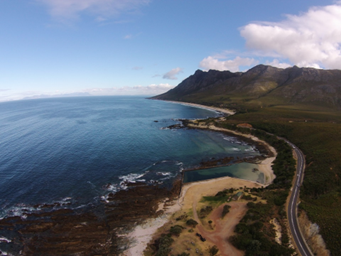
Drive out of Gordon’s Bay on the R44, around the dramatic coastal road that hugs the cliff face above False Bay, past the rocks and the kelp and the occasional whale in the bay below you and within twenty minutes you are inside one of the most botanically extraordinary places on the surface of the earth.
Most people do not know this. Most people think they are just driving to Betty’s Bay.
In 1998, the Kogelberg was registered as South Africa’s first UNESCO Biosphere Reserve, recognised by the United Nations as a place of such exceptional natural significance that it deserved international protection and scientific attention. It was the first in the country. Not Table Mountain. Not the Kruger. Not the Drakensberg. The Kogelberg, right on Gordon’s Bay’s doorstep.
The Kogelberg covers 100,000 hectares of terrestrial and marine territory from the coastal town of Gordon’s Bay to the Bot River estuary, including the inland Elgin Valley. Its plant diversity is more abundant, per square kilometre, than the Amazon rainforest.
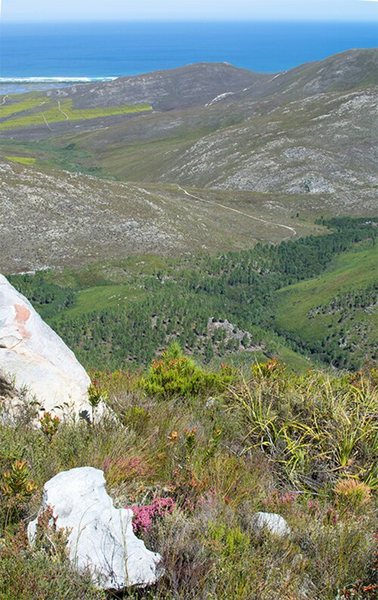
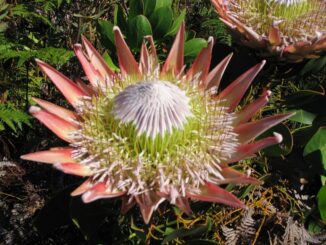
The Kogelberg Biosphere is considered the heart of the Cape Floral Kingdom, one of just six plant kingdoms in the world. It is home to more than 1,880 plant species. Of these, 77 are found just here and nowhere else on earth. Not in a greenhouse in London, not in a botanical garden in Amsterdam, not in a research station in California. Only here, in the mountains above False Bay, in a biosphere reserve that starts at the edge of Gordon’s Bay.
The marine component is equally remarkable more than 3,500 species occur in the 24,500 hectares of ocean within the biosphere boundary. The coastal belt and marine protected area is home to the highly threatened abalone and is a breeding ground for many fish and other marine life. Don’t quote me on these figures as it depends from which angle the statics are viewed.
The core of the reserve, 18,000 hectares, has been kept pristine and wild. It presents perhaps the finest example of mountain fynbos in the Western Cape.
Robert Jacob Gordon, the remarkable Dutch-Scottish explorer who named Gordon’s Bay in 1777 was one of the first Europeans to document the extraordinary plant life of this coastline. He would have walked through what is now the Kogelberg Biosphere and drawn and described species that had never been seen by European eyes. His journals, discovered in Amsterdam in 1964, contain botanical records from this exact stretch of coast.
The Helderberg Nature Reserve and the Kogelberg Biosphere together form one of the most significant conservation corridors in the southern hemisphere, mountain fynbos running from the Helderberg slopes above Somerset West all the way to Betty’s Bay and beyond, unbroken, ancient, burning and regenerating and burning again as it has for millions of years.
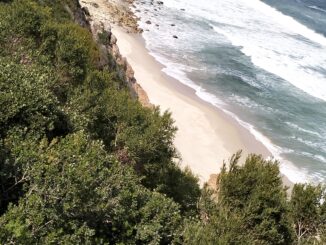
You can walk from Somerset West into a UNESCO World Heritage Site. You can drive from Gordon’s Bay into one of the world’s great botanical gardens. You can sit on the beach at Betty’s Bay with African penguins waddling past your feet and mountain fynbos on the slopes behind you and one of the world’s most productive marine environments in the water in front of you.
Twenty-five years after the biosphere reserve was established, it continues to thrive through partnerships between CapeNature, the Kogelberg Biosphere Reserve Company, the South African National Biodiversity Institute and WWF South Africa.
The Helderberg is not just a beautiful place to live. It sits at the edge of something genuinely world-class. Not world-class the way people use that phrase for shopping centres or wine estates. World-class in the way that matters, irreplaceable, unrepeatable, found nowhere else on earth.
Most people drive past it on the way to Betty’s Bay without knowing any of this.
Now you know.
Between You and Me:
South Africa’s first UNESCO Biosphere Reserve is not Table Mountain. It is not the Kruger. It is a stretch of mountain and coastline that most Capetonians drive past on the way to a holiday cottage in Betty’s Bay, occasionally slowing down to admire the view without ever quite registering what they are looking at. I find this entirely in keeping with the Helderberg’s general approach to its own significance. We have a nuclear test site that became a shopping centre, a dynamite factory that became a winery and a UNESCO World Heritage Site that doubles as a scenic route to the beach. Nothing here announces itself. Everything here simply is what it is and waits for you to notice. Thanks to Jan and Capt. Gordon for planting the fynbos.
Historian – Harmen Bockelenberg
Next week: the wine route reinvented how the Helderberg became an international wine destination and what that has meant for the valley.


Be the first to comment