

STORY 94
There is a particular kind of institution that comes into existence not because someone planned it from the beginning, but because the community around it simply outgrew what already existed. The Helderberg produced several schools of exactly this kind, each one born from growth, each one named for the landscape or the people it replaced.
By the early 1950s, Hendrik Louw Primary in Strand was full. Not inconveniently full. Genuinely, operationally, cannot-fit-any-more-children full. The school had grown since 1880 from a single room in the old Wesleyan Church into a proper campus with twenty-three classrooms, and even that was no longer enough. Strand was growing faster than any one school could hold. In 1955 the Department of Education told the Stellenbosch School Board that the old Methodist Church School building had been bought and was ready to become the town’s second primary school. The facilities weren’t much to look at yet, the Department admitted as much itself, but improvements were promised.
Then came the morning of 17 July 1956, straight after the winter holidays. Karl Kielblock, Hendrik Louw’s deputy principal and already a well-known Afrikaans author, led seven staff members and 243 pupils on foot from Hendrik Louw to the new site. Three days later, on 20 July, education inspector Dr G. J. Joubert officially opened what would become Lochnerhof Primary School, named for the old estate on whose land it stood, farmland turned suburban streets, its agricultural past preserved in a school built for a town that had moved on from farming. The motto chosen was Rotsvas, rock solid.
Kielblock only carried the acting headship for a few months, stepping down on 5 December 1956, and from there the documented trail runs cold, at least for Lochnerhof itself. What survives on paper concerns only Hendrik Louw. A Mr Potgieter took a promotion away from that school a year after the split, and Mr H. J. Roelofse of Stanford took over there in January 1958, followed later by Mr G. J. J. Swart. Who ran Lochnerhof through those same years, the school Kielblock had marched into being, isn’t written down anywhere that has turned up so far. It is exactly the kind of gap that living memory has to carry instead.
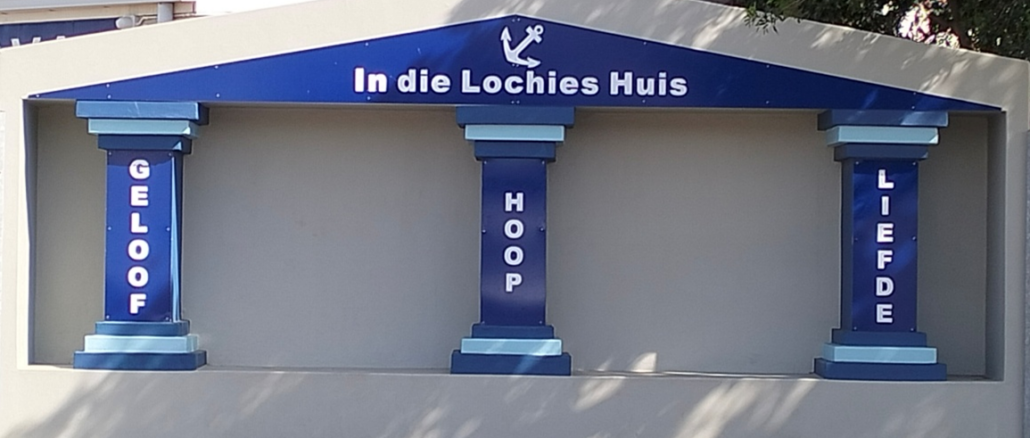
De Hoop Primary in Somerset West came fourteen years later, born from the same logic in a different part of the valley. By 1970, Somerset West was spreading eastward and southward into new suburbs, and new suburbs needed new schools. De Hoop opened that year with 320 learners and twelve teachers, built on land that had once formed part of the historic De Hoop farm, itself a portion of the old Parel Vallei estate associated with Willem Adriaan van der Stel. The school’s setting, on the Old Stellenbosch Road with views of both the Hottentots Holland Mountains and False Bay, gave it a physical grandeur that no planning committee could have designed. Its motto, Constantia et Perseverantia, persistence and perseverance, reflected the qualities the Helderberg expected of its children. Its crest featured a ship sailing toward new horizons, which is either a metaphor or a very accurate description of a school in a town that could see the sea from its classrooms.
Gordon’s Bay Primary grew from different roots, not suburban expansion but the simple fact of a village community that needed a school and had nowhere else to go. Gordon’s Bay in the early twentieth century was genuinely isolated, mountains on one side, sea on the other, roads that were not always dependable in either direction. The children of fishing families, railway workers, harbour employees and the handful of tradespeople who made the village function needed somewhere to learn. What began as a modest facility became, over decades, something more significant, a school so closely identified with its village that for many Gordon’s Bay residents, memories of the school and memories of childhood are essentially the same thing. Teachers knew entire families. Siblings followed siblings. The children of former pupils sat at the same desks a generation later. In a small coastal town, that continuity is not a small thing.
Three schools, three different origins, the same underlying cause: a community that believed its children deserved a place of their own.
Between You and Me:
Rotsvas. Rock solid. A school born out of pure overcrowding, given a motto that promised permanence before it had earned any. I have a soft spot for institutions that name themselves aspirationally rather than descriptively. The motto is a promise, not a report, and Lochnerhof has now been rock solid for nearly seventy years, which retroactively makes it true. I wonder how many institutions survive precisely because they were given a name that did not yet fit, and then spent decades growing into it. I sat in that school myself in 1969, under a principal everyone knew as Hansie Schoeman, and what stays with me most isn’t the motto but the man. He knew every single child in that school by name and surname, not just the ones in his own class, not just the troublemakers who ended up outside his office, but every child. In a school with hundreds of pupils, that’s no small feat, and it’s exactly the kind of detail that never makes it into an official history but stays with a person sixty years later.
Historian – Harmen Bockelenberg
Next week: the high schools where the Helderberg’s older memories live and the school that began in a rented house on Mill Street.



Be the first to comment