

STORY 99
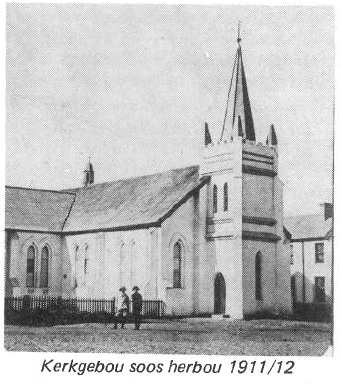
Featured image: Church 1911
The Dutch Reformed Church built the Helderberg before any municipality did.
This is not a metaphor. The Dutch Reformed Church, the Nederduits Gereformeerde Kerk, the NGK, was the institutional presence in the Cape Colony long before there were local councils, magistrates’ courts or schools funded by government. The church was where the community gathered. The church was where births and deaths and marriages were recorded. The church was where the community’s moral life was publicly managed, where discipline was administered, where the boundary between acceptable and unacceptable behaviour was maintained by a congregation that knew everyone’s business because everyone knew everyone’s business.
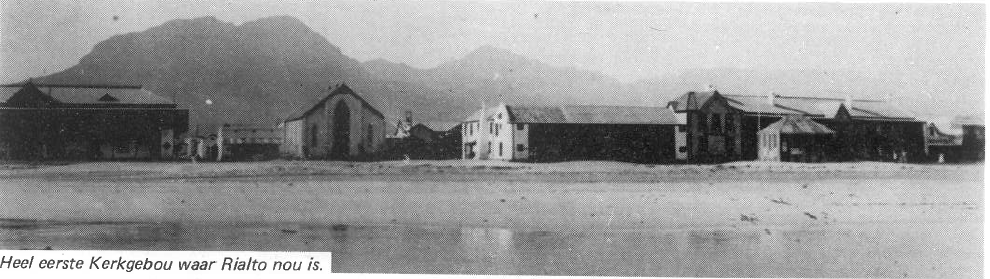
First church building in the Strand pre-1911.
The Somerset West congregation was established in 1819, carved out of the Stellenbosch mother church as the population of the valley grew too large for the faithful to travel to Stellenbosch every Sunday. The establishment of a local congregation was a milestone. It meant the community had reached a size and permanence that warranted its own spiritual infrastructure. The building of the church followed. The appointment of a minister followed. The church became the centre around which the town arranged itself.
The predikant, the minister, was among the most important figures in any Dutch Reformed community. His influence extended well beyond Sunday sermons. He married people and buried them, advised on family disputes, mediated between neighbours and carried an authority that was simultaneously spiritual and social. The succession of predikants who served the Somerset West congregation across two centuries shaped the community in ways that are impossible to fully trace but impossible to ignore.
The NGK in the Helderberg was also the church that provided theological justification for apartheid, a fact that no honest account of the Dutch Reformed Church in South Africa can omit. The policy of apartheid was developed within a framework of NGK theology and the church’s leadership endorsed and sustained it for decades. When the apartheid system finally collapsed, the NGK underwent a prolonged and painful reckoning with what it had done. That reckoning is not complete. The church that stands in Somerset West today is not the same institution as the one that endorsed the racial classifications of 1950, but it carries the weight of that history.
The Anglican Church established its presence in Somerset West to serve the English-speaking community that arrived with and after the British colonial administration. St Paul’s Anglican Church in Somerset West, its stone building, its colonial-era gravestones in the churchyard, its architectural language borrowed from English parish churches, served as an anchor for a community that was far from home and wanted familiar forms of worship in an unfamiliar landscape. The graveyards of the Anglican church are, in their way, one of the most detailed records of the English-speaking community of early Somerset West, the names, the dates, the occupations, the ages at death that tell you about life expectancy and the hazards of the nineteenth century.
The Catholic Church arrived later and served a more diverse congregation. The Roman Catholic community in the Helderberg was never large, but it was present and it built its own infrastructure, a church, a school, community networks. For many immigrant families who arrived in South Africa from Catholic countries in southern and eastern Europe, the Catholic parish was the first point of community in a new country. The Helderberg’s Italian and Portuguese communities, some of them descended from families who had arrived as workers on the docks and farms in the early twentieth century, found their community in the Catholic Church.
There were many other denominations. The Methodist church served communities that the Dutch Reformed and Anglican establishments did not. Pentecostal and charismatic churches grew rapidly in the latter half of the twentieth century, particularly in the coloured and Black communities of the Helderberg, offering forms of worship that were more immediate, more emotional and more politically inflected than the established churches could provide. The Apostolic Faith Mission. The Assemblies of God. The NG Sendingkerk, the Dutch Reformed Mission Church, the separate denomination established for coloured congregants because the white NGK would not worship with them.
The NG Sendingkerk has a particular place in South African history. It was within the NG Sendingkerk that the Belhar Confession was adopted in 1986, a theological document that explicitly rejected apartheid on biblical grounds, that declared racial separation incompatible with Christian faith and that became one of the most significant religious statements produced in South Africa in the twentieth century. The Belhar Confession was written and adopted by people who worshipped in the separated, unequal churches that apartheid had created and who used the tools of theology to dismantle the system that had built those separations.
The Strand’s own religious history runs on a slightly different timeline from Somerset West’s, reflecting the different character of a coastal fishing and resort town. The earliest formal Christian presence in Strand dates to the mid-nineteenth century, when Methodist fishermen and working families began gathering for worship, as early as 1849, initially under the wider Somerset West circuit. By 1850 a small thatched church had been built, generally regarded as the first permanent church building in Strand, a modest structure serving a community that was still more fishing settlement than town.
The Dutch Reformed congregation in Strand followed as the settlement expanded and the farming community around it grew. The formal establishment of the Strand NG Kerk congregation in the early 1900s, with the mother church building completed in 1930, its sandstone form rising as one of the defining landmarks of the developing town, marked Strand’s arrival as a community substantial enough to require its own full institutional presence rather than relying on the Somerset West congregation.
But the religious landscape of the Strand was never exclusively Christian or exclusively Dutch. The Javia Mosque, built between approximately 1850 and 1870, stands as one of the oldest surviving places of Muslim worship in the Helderberg. It predates the NG Kerk mother church by sixty years. The Muslim community it served was part of the same Cape heritage that the broader Helderberg history carries, rooted in the slave era, in the communities that formed around Macassar and the coastal districts, in a presence that long predated the formal municipal structures of the town. The mosque is a reminder that the Strand’s history is not only European settler history. It is also, substantially and continuously, an Asian history.
The Jewish community in the Strand and wider Helderberg was smaller and less formally structured, with families settling in the area from the late nineteenth and early twentieth centuries. Rather than a dedicated synagogue, Jewish residents generally maintained their religious observance through connections with Cape Town’s established congregations, while participating fully in the commercial and civic life of the Helderberg, in trade, retail and professional services, in the economic development of towns that were growing rapidly through the interwar period. Their contribution is most visible in the names of businesses and in the commercial character of the main streets, rather than in any single surviving building.
The Baptist congregation began gathering in Strand in 1952 and was formally recognised in 1954, part of the mid-century growth of English-speaking Protestant denominations as the town’s population diversified. Anglican, Pentecostal and smaller fellowships followed. By the 1960s and 1970s, the Strand’s religious landscape had become what it remains today, layered, plural, representing the full range of communities that had made the town their home across a century of continuous settlement and growth.
The Methodist chapel of the 1850s. The thatched first church. The Javia Mosque that was already standing when the NG Kerk was still being planned. The sandstone mother church of 1930. The Baptist fellowship of the 1950s. The charismatic congregations in their converted spaces. Each is a different thread in the same story.
It is, as anyone who has watched the Strand on a Sunday morning will know, a genuinely mixed and culturally layered community that its religious buildings reflect more honestly than almost any other form of civic architecture. Churches, mosque, the invisible presence of the Jewish community in the commercial record, together they are the fullest portrait the Helderberg has of what it actually was and what it actually is.
Churches across the Helderberg today are more integrated than they were thirty years ago, though the patterns of Sunday morning still reflect, to a degree, the patterns of the society that built them. The buildings are still there. The Dutch Reformed church in its prominent position in the town centre. The Anglican church with its English churchyard. The newer evangelical congregations in their converted warehouses and school halls.
The mountain is visible from most of them. It has been looking down on this community’s attempts to live together and to worship and to work out what they owe one another, for three hundred years.
Between You and Me:
The Javia Mosque predates the Strand’s NG Kerk mother church by sixty years. I find that single fact more illuminating than almost anything else in this chapter, because it quietly upends the assumption that so much of this book’s earlier history operates under, that the religious landscape of the Helderberg began with Dutch Reformed congregations and other denominations arrived later, around the edges. The mosque was there first. The Muslim community of the Strand has a longer continuous religious presence in that town than the church that most people would assume was the original one. The Belhar Confession, written within the NG Sendingkerk by people worshipping in the churches that apartheid had built for them, used theology to dismantle the system that had separated them in the first place. Both facts say something about who actually built the moral architecture of this valley and it is not always who the official histories suggest.
Historian – Harmen Bockelenberg
Next week: the missionary and the painting a watercolour given as a gift in 1924 and the man who earned it without ever being ordained.



Be the first to comment