

STORY 100
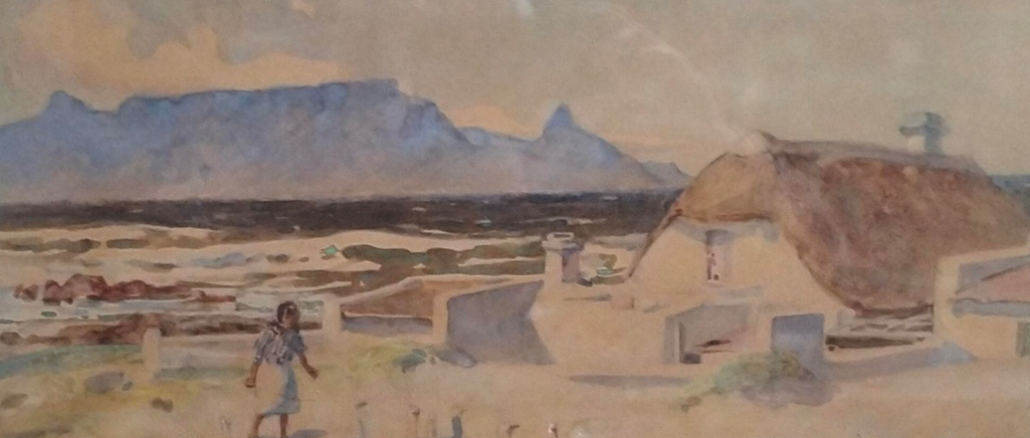
There is a painting in the family. It has been in the family for over a hundred years.
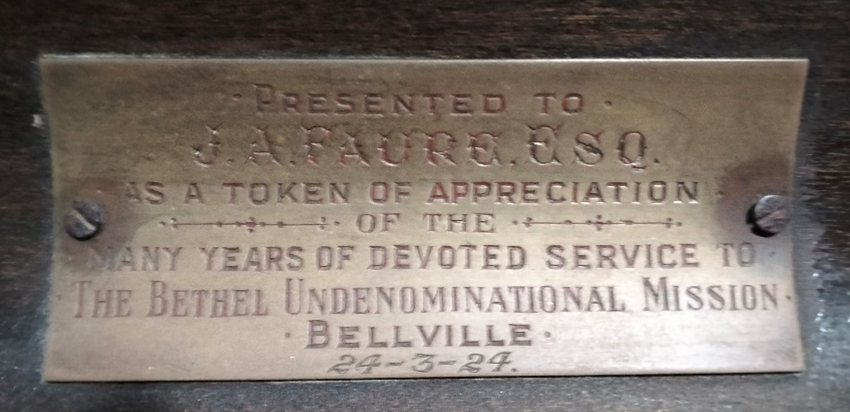
The plaque on the back of the frame reads, precisely: Presented to J.A. Faure Esq. as a token of appreciation of the many years of devoted service to The Bethel Undenominational Mission, Bellville, 24-3-24.
The painting itself is a beautiful watercolour, a whitewashed thatched cottage in the foreground, a figure with geese walking before it and Table Mountain sitting blue and unmistakable across the flat Blaauwberg plain behind it. It is a quintessential Cape scene, probably painted in the late Victorian or Edwardian manner. The frame is dark wood, heavy, respectful, the kind of frame a committee chooses when they want the gift to last.
The date on the plaque, 24 March 1924, places the presentation two years before the Bethel congregation formally joined the Presbyterian Church of Southern Africa. J.A. Faure was honoured at the height of the mission’s independent existence.
The man is James Abercrombie Faure, born in Cape Town on 25 May 1864, died in Strand on 26 September 1950. He was the father of Margaret Petronella Faure, who married into the Naudé family. Margaret Petronella was the grandmother of this book’s author. James Abercrombie Faure was his great-great-grandfather.
He lived eighty-six years and he died in the Helderberg, in the valley his family had helped to shape across six generations at Vergenoegd. But the painting was not given to him for anything he did on a wine estate. It was given to him for what he did in a hall on the corner of Rhos Street and Voortrekker Road in Bellville.
The Bethel Undenominational Mission was one of those institutions that formal church histories rarely record, because it existed precisely outside the boundaries of the formal church. It had begun, sometime in the closing years of the nineteenth century, in the most unpromising of settings, the ladies’ waiting room of Bellville railway station. A group of residents wanted to worship on Sunday evenings. There was no building, no minister, no endowment. So they used what was available. A Miss Anna Neethling began a Sunday School in the railway goods shed. In time, a hall became available on the corner of Rhos Street and Voortrekker Road and the congregation gathered there under the name the Bethel Undenominational European Mission, undenominational because it belonged to no single church, open because it could afford to be nothing else, built from scratch by people with nothing but their own conviction that a community deserved a place to gather.
James Abercrombie Faure gave that mission many years of devoted service.
The plaque calls him Esq., not Reverend. He was not ordained clergy. He was a layman, one of the countless men and women in the mission tradition who did the quiet, unglamorous, essential work that allowed the spiritual work to happen. Teaching Sunday School, perhaps. Organising. Administering. Visiting. Maintaining. Showing up, week after week, in a hall that had started as a goods shed, for a congregation that had no denomination to fall back on and no institution to sustain it except the people who came through the door.
On 24 March 1924, two years before the Bethel Mission formally affiliated with the Presbyterian Church of Southern Africa, the congregation gathered and presented him with a painting. Not a certificate. Not a carved plaque. A painting, in a proper dark wooden frame, of a Cape scene that any person who had spent a life in this corner of the world would immediately recognise and love.
Someone on that committee understood the difference between an occasion and a gift. A certificate marks a date. A painting stays on a wall. It travels with the family. Grandchildren grow up looking at it without knowing the full story and then one day someone reads the brass plaque and the story comes back.
The Faure family connection to this landscape ran deep by 1924. The hamlet of Faure, between Somerset West and Cape Town, had been named for the family that farmed Vergenoegd across six generations. The great churchman Abraham Faure, James Abercrombie’s grandfather, had served the Groote Kerk in Cape Town for forty-three years and shaped the Dutch Reformed Church of the nineteenth-century Cape Colony in ways that are still felt today. The family name was on the map, literally, before James Abercrombie was born.
But James Abercrombie’s service was of a different kind. Not the great church in the heart of Cape Town. Not a historic estate. A railway waiting room that became a goods shed that became a hall on Voortrekker Road, among people who simply wanted to gather and do some good and had found a man willing to help them do it, year after year, without title or salary or public recognition.
Until one evening in March 1924, when they gave him Table Mountain in a frame.
He died in Strand in 1950. The painting came to his daughter Margaret Petronella, who had married into the Naudé family. It passed to her daughter Marjorie. It is still in the family. The brass plaque is still on the back. The geese are still walking across the Blaauwberg plain. The mountain is still there on the horizon, exactly as it has always been.
Between You and Me:
A railway waiting room. A goods shed. A hall on Voortrekker Road. That is the entire infrastructure of the Bethel Undenominational Mission for the years that James Abercrombie Faure served it and at the end of all that quiet, unglamorous service, the congregation gave him a painting of Table Mountain rather than a certificate. I think whoever chose that gift understood something the rest of us sometimes forget, that the things which actually last in a family are not the documents. Nobody frames a certificate and passes it down through four generations. But a painting goes on a wall and gets looked at, every day, by people who do not know its story, until one day someone turns it over and reads the plaque and the whole thing comes back to life. The painting did its job for a hundred years before anyone wrote down why.
Historian – Harmen Bockelenberg
Next week: why this landscape makes people want to make things the artists, writers and craftspeople the Helderberg has produced.

Be the first to comment