

STORY 98
Every town has a story it almost forgot. This is one of them.
Kalden Street in Strand, sometime in the late 1940s or early 1950s, was the last street in town. Not the last street in the sense of being at the unfashionable end of things, the last street in the literal sense that beyond it the houses stopped and the open veld began. The town ended at Kalden Street. Everything beyond it was flat, clay, shrub-covered river plain stretching away toward the mountains and the farms.
A family I knew lived on Kalden Street. And in that family, a teenage boy was developing an interest in chemistry.
Not chemistry in the sense of school laboratory experiments with test tubes and Bunsen burners. Chemistry in the sense of wanting to understand what happened when certain substances were combined under certain conditions and then subjected to a sufficient initiating force. He was, to use the polite terminology that his family would later apply to this period of his life, a demolition enthusiast. To use the less polite terminology that his mother would have applied at the time, he was making bombs in the house.
One of them went off indoors.
The exact sequence of events is not recorded with the precision that a formal investigation might have required, largely because there was no formal investigation, the matter was handled internally, in the manner of families who prefer not to involve the authorities in the educational development of their children. What is known is that the device the boy had constructed was of sufficient power to move the kitchen ceiling. Not collapse it. Not damage it in a minor and easily explained way. Move it. Shift it on its foundations, creating the kind of visible evidence of an energetic chemical event that is difficult to attribute to any innocent domestic cause.
His mother’s response was appropriately comprehensive. The reprimand that followed was, by family account, stern enough to constitute a formative experience in its own right.
It did not stop him.
The children of Strand walked to Hottentots Holland High School in Somerset West along the vlakte pad, the flat path, a footpath through the open veld that connected the coastal town to the school on the other side of the low ridge separating Strand from Somerset West. It was the route that generations of Strand children used, cutting across the flat coastal plain in a more or less straight line, shorter and more direct than any road route. The path was as much a part of growing up in Strand as the beach or the jetty, a daily walk through open country, in all weathers, shared with every other child making the same journey.
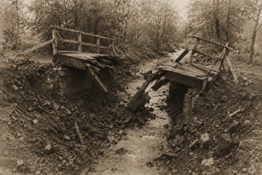
The municipality had built a new bridge along the vlakte pad. It was a modest structure, a bridge over one of the small drainage channels or watercourses that crossed the flat ground. It was new and recently completed and represented a modest civic investment in the infrastructure of the daily walk.
The boy from Kalden Street blew it up.
Not accidentally, not experimentally, not as a test of a new formulation. Deliberately, at a time of his own choosing, with a device he had constructed for the purpose. The bridge that the municipality had completed only weeks earlier was, on one particular morning, substantially no longer a bridge.
The schoolchildren who used the vlakte pad noticed. Of course they noticed. A bridge that had been there the day before was not there anymore. Children have a sharp eye for changes in the landscape of their daily route and a demolished bridge is not a subtle change. The information spread through the school population with the speed that important information always travels among children, rapidly, comprehensively and without any adult involvement.
No investigation produced any result. No newspaper reported the incident. No police file, to anyone’s knowledge, was ever opened. The municipality presumably repaired or replaced the bridge and attributed its destruction to whatever cause seemed most plausible, subsidence, perhaps or a structural failure or some event involving water that could be blamed on the flat coastal terrain rather than on a teenager from Kalden Street with a proven interest in energetic chemical reactions.
The boy grew up. He became a photographer and a filmmaker. He co-founded a business in Somerset West in the early 1960s with two partners, the kind of business that has the power to record visual prosperity for many years in the Helderberg area.
If any municipal engineer of the early 1950s is still puzzling over an unexplained structural failure on the vlakte pad between Strand and Somerset West, this story is, seventy years late, the explanation.
Nobody found out at the time. Very few people have known since. The bridge was there one day and gone the next and the secret went with the schoolchildren who knew it into the decades that followed, kept with the particular loyalty that children extend to stories too good to tell adults but too good to forget entirely.
It is told now. Theo would probably have approved.
Between You and Me:
Theo again. By now, anyone reading this book in order will have met Theo twice, once filming a motor race on a mountain road above Gordon’s Bay with a two-metre photographic enlargement on his studio wall and now as the teenager who moved a kitchen ceiling and demolished a municipal bridge with what his mother would have called, accurately, a bomb. I think these two stories belong to the same person for a reason. The instinct that makes someone want to understand exactly how something works, chemistry, explosives, the precise mechanics of a controlled event, is not so different from the instinct that makes someone want to capture a moment on film at exactly the right second. Both require patience, precision and a willingness to do something nobody has specifically asked you to do, simply because you want to know what happens. Theo’s reprimand for the kitchen ceiling was, by all accounts, considerable. I do not think it changed him much. I am glad of that.
Historian – Harmen Bockelenberg
Next week: the churches that held the Helderberg together and the layered, plural religious history that the buildings tell more honestly than almost anything else.

Be the first to comment