
For most people in Somerset West, The Strand and Gordon’s Bay, the Second World War was something that happened somewhere else. The news came through the radio. The men left on trains. The telegrams arrived. But the war itself, the guns and the bombs and the dying, was in the North African desert, in Italy, in the skies over Britain.
Except it was not entirely elsewhere. Because in 1942, the war came quietly to the waters just outside the front door.
When war broke out in September 1939, the Cape of Good Hope became almost overnight one of the most strategically important places in the world. The Mediterranean was closing to Allied shipping, German and Italian forces made it dangerous, then effectively unusable. Every ship carrying troops, fuel, food, ammunition and raw materials between Britain and the Middle East, India, Australia and the Far East had to go around the bottom of Africa. The sea lanes off the Cape were a lifeline. If something disrupted those lanes, the consequences for the Allied war effort would be severe.
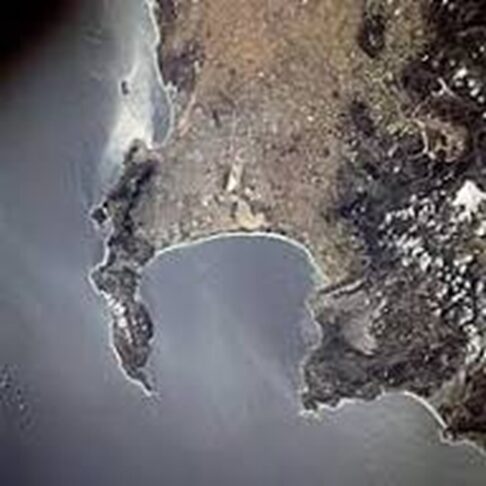
False Bay
During 1942 and 1943, German U-boats operated extensively in South African waters. Merchant ships were sunk within sight of the Cape coastline, close enough that survivors sometimes made it to shore, close enough that South African coastal communities understood, with sudden clarity, that the war was not only happening on the other side of the world. Ships went down in waters that fishermen from Gordon’s Bay and Strand had worked all their lives. The sea that looked beautiful from Clarence Drive carried a different kind of darkness that year.
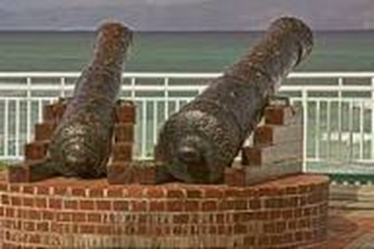
False Bay, with its broad entrance and its proximity to Cape Town’s naval facilities, became a concern for military planners. A direct attack was unlikely, the Germans never had the naval capacity in the South Atlantic to mount one, but unlikely is not impossible and the ships rounding the Cape were too valuable to leave undefended on the basis of probability alone. Coastal artillery batteries were established around the peninsula. Observation posts scanned the horizon in shifts, day and night. The machinery of coastal defence, modest but functional, spread itself around the bay.
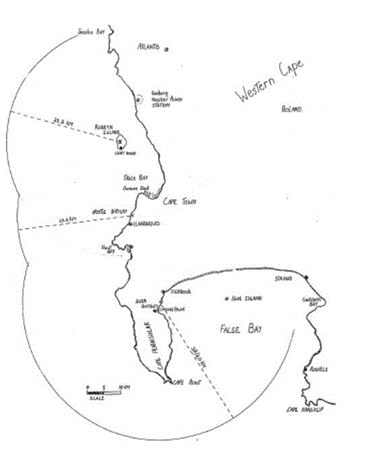
Coverage of naval batteries
The guns never fired in anger. The enemy never came within range. But the danger was real and the watching was not wasted, because the watching was the point. The sea lanes stayed open. The ships kept coming around the bottom of Africa. The Allied war effort kept moving.
When peace came in 1945 the coastal installations were abandoned almost overnight. The guns were removed. The military personnel left. Nature began the slow work of reclamation that it always begins on anything humans leave behind in the Western Cape mountains.
What remained was concrete, vegetation and silence. And the same bay that had looked out at three centuries of ships, now looking out at an ocean that was, once again, simply the ocean.
Between You and Me:
Merchant ships were sunk within sight of the Cape coastline in 1942 and 1943. Within sight. People standing on the beach at The Strand or on the cliffs above Gordon’s Bay could, on the right day in the right conditions, see the smoke on the horizon. The war that was supposed to be happening somewhere else was happening there, in the water below the Helderberg. I find this detail more affecting than any of the larger statistics. The horizon you looked at every day was, for a period, not safe. That changes what a horizon means.
Historian – Harmen Bockelenberg
Next week: the war comes home, how blackout curtains, rationing and a Helderberg family’s own memories carried the Second World War from the horizon into the house.


Be the first to comment