

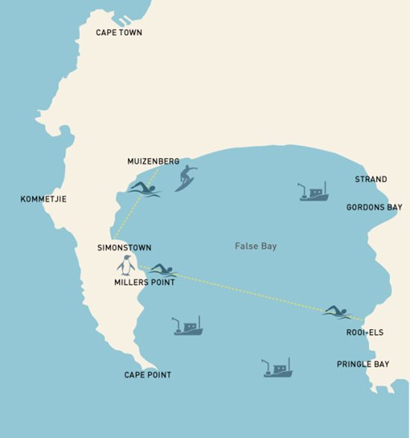
False Bay earned its name from navigators who mistook Cape Hangklip, the headland at its southeastern corner, for the Cape of Good Hope itself. Realising their error too late, they found themselves inside a wide, exposed bay with a dangerous shore on three sides and a south-easter building behind them. The name is a warning. The bay has been issuing that warning for as long as ships have sailed this coast.
The number of ships lost in and around False Bay is not precisely known. Estimates vary. But maritime historians count well over fifty significant wrecks along its shores and those are only the ones that were documented. The wrecks of small fishing vessels, coastal traders and the nameless boats of three centuries of maritime traffic have left a graveyard on the seabed that divers are still exploring.
The Dutch East India Company maintained the Cape as a refreshment station from 1652. Every ship that rounded the Cape on its way to or from Batavia, Ceylon and the Spice Islands passed through these waters. The VOC was the largest commercial enterprise in the world at the height of its power. Hundreds of its ships made the Cape passage. Not all of them made it.
The hazards were several. The south-easter, the wind that scours Cape Town in summer, can turn False Bay into a chaos of steep, short-period waves within hours. The berg wind blows offshore in winter with deceptive ferocity. The bay’s eastern shore, from Strand past Gordon’s Bay to Hangklip, is a lee shore in a south-easter, the most dangerous configuration for a sailing vessel. And the shoals, the rocks just below the surface and the hidden reefs along the Kogelberg coast were unmarked on any chart that early navigators possessed.
The wreck of the São Gonçalo in 1630 is one of the earliest recorded on the Cape coast, a Portuguese vessel driven ashore near the Cape with 500 men aboard. The survivors built rafts and boats from the wreck and eventually made it home. The story was famous in maritime circles for generations. It established the reputation of this coast as a place that ate ships.
The Stavorendam, a VOC vessel outbound for the East, wrecked in False Bay in 1686. The Africa, a British East Indiaman, was lost near Gordon’s Bay in 1782. The Sceptre, a Royal Navy 64-gun ship, sank in Table Bay in 1799 with the loss of 491 lives, one of the worst maritime disasters in South African waters. These are the named ships, the ones with records. The seabed holds others that are simply iron, timber and ballast stones with no name attached.
The geology of the bay assists preservation. Cold water. Low salinity in certain zones. Limited current in the deeper sections. Wrecks that would have been eaten by wood-boring organisms in tropical waters are skeletal but present in False Bay, timbers intact, anchors in place, cannon still in their rows.
Diving on the wrecks of False Bay has been a Cape Town institution for decades. The Clan Stuart, a cargo steamer that ran aground at Miller’s Point in 1914, is one of the most visited dive sites in the country, its boilers and cargo winches visible in ten metres of water, kelp growing through its superstructure and reef fish in every cavity. The Rosamund, the Maori, the Nolloth, each a story of a night when the weather turned, a captain made a mistake and a ship became a reef.
False Bay is also a graveyard of more recent loss. The World Harmony, a bulk carrier, dragged anchor and was wrecked near Cape Point in 1967. The Treasure, a Maltese-registered bulk carrier, ran aground off Robben Island in 2000, spilling 1,300 tonnes of fuel oil and setting off one of the largest seabird rescue operations in history. More than 40,000 African penguins were affected.
Three centuries of sailors paid a toll in False Bay. Many of them left no trace. The bay took what it wanted and kept it.
Between You and Me:
False Bay earned its name from navigators who thought they had rounded the Cape when they had not. They looked at Hangklip, saw what appeared to be the right headland and sailed in — only to find themselves in a wide bay with a lee shore building on three sides and the wind increasing behind them. The error was understandable. The consequences were sometimes fatal. I have thought about this in the context of other things that look like what you are looking for until you are already inside them with the wind building behind you. The bay has no particular malice. It simply does not make allowances for being mistaken.
Historian – Harmen Bockelenberg
Next week: the war beneath the water — how the Second World War came quietly to the shores of False Bay.


Be the first to comment