

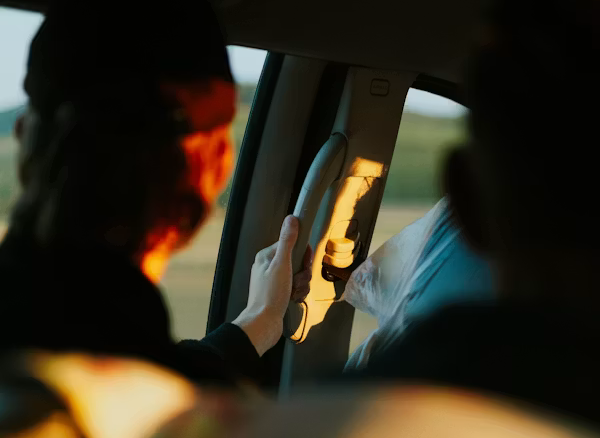
A Character Study
An investigation into the passenger who has not held a licence since 1987 but has retained full confidence in their right to an opinion about your driving
My mother-in-law surrendered her driver’s licence voluntarily in 1989. She has explained the reasons for this decision on several occasions and the explanation, while consistent, has evolved over the years in ways that suggest it is being refined rather than remembered. The core of it is that the roads got worse, that other drivers became less reliable and that she made a considered judgment that she was better positioned, temperamentally, as a passenger.
She has been a passenger for thirty-five years. She is extraordinarily good at it.
She is also extraordinarily good at the other thing.
THE TAXONOMY
The Helderburger Motoring Desk has spent considerable time in vehicles with various configurations of passenger and has identified four distinct categories of backseat driver, which we present here in ascending order of intensity.
The Gentle Suggester operates through implication. They do not tell you what to do. They create conditions in which you arrive at the correct action independently: a slight intake of breath at a junction, a small shift in posture before a speed bump, a hand placed lightly on the door handle before a tight corner. The Gentle Suggester is technically not saying anything. They are, however, saying everything.
The Narrator provides a running commentary on the driving environment that stops just short of instruction: “There’s a car coming.” “That robot is about to change.” “There’s a speed bump here.” These observations are, individually, accurate. They are also all things you can see from the driver’s seat, having been in possession of functional eyesight for your entire driving life. The Narrator does not consider this relevant. The Narrator is providing information. What you do with it is your business.
The Historian addresses not the current driving situation but the pattern of past driving situations: “You always brake late at this corner.” “You took this road last time and it was slower.” “You did exactly this on the way to Stellenbosch in 2019.” The Historian is not backseat driving in the traditional sense. The Historian is conducting a retrospective performance review, live, at 60 km/h.
The Uninhibited, into which category my mother-in-law falls on her more candid days, operates without the filter of any of these strategies. “Slow down.” “Why are you in this lane?” “This is not the way.” “You’re too close to that car.” “I said slow down.” The Uninhibited backseat driver has concluded, at some point in the past, that the social contract around driver autonomy does not apply to them and that life is simply too short for diplomacy when someone is approaching a yellow robot at a speed they find optimistic.
THE LICENCE QUESTION
It is tempting, when receiving unsolicited driving instruction from someone who has not held a licence for three and a half decades, to raise the licence question. To note, gently, that the person offering guidance on your approach speed at a four-way stop last navigated a vehicle during the era of leaded petrol and is therefore not current on developments.
We advise against this.
The licence question escalates things in a direction from which there is no clean return, particularly on a long trip. My mother-in-law’s response to the licence question, which I raised once and only once on the road to Knysna in 2018, was to note that she had been driving longer than I had been alive and that the absence of a current licence was a bureaucratic technicality that had no bearing on her understanding of road conditions, vehicle dynamics or the fact that I was too close to the truck in front.
She was, on that last point, correct. I moved back. We did not discuss it further. The rest of the trip to Knysna was conducted in a negotiated peace that held until Wilderness, where I missed a turn.
CONCLUSION
The backseat driver loves you. This is, at root, the explanation. The commentary, the intake of breath, the gentle hand on the door handle — these are expressions of investment in your continued existence, delivered in the only form available to someone who is not behind the wheel.
The correct response is patience, selective hearing and the occasional concession — a slight reduction in speed, a lane change a little earlier than necessary — that costs you nothing but communicates that the message has been received.
Drive safely. For your own sake and for theirs.
My mother-in-law, reading this over my shoulder, has asked me to add that she was not too close to the truck in Knysna either and that she was simply pointing it out.
I have added it. We are moving on.
The Helderburger Motoring Desk wishes to clarify that no mother-in-law was harmed in the production of this column and that all characterisations are entirely fictional. My mother-in-law does not read THE HELDERBURGER. We are fairly confident of this.
THE HELDERBURGER
Motoring Desk
Kobus Liebenberg


Be the first to comment