

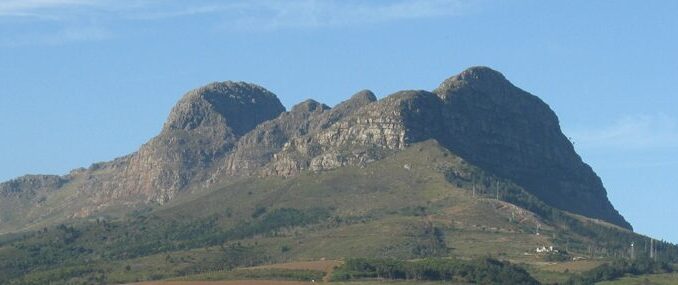
Before there were farms here, before there were roads or towns or wine estates or the N2 highway, before any human hand had shaped a single thing in this valley, there was the mountain.
It is still the first thing you see.
Drive out of Cape Town on the N2, pass the airport, come around the curve past Macassar and suddenly there it is — a wall of mountains rising out of the flat coastal plain, catching the late afternoon light on its western face and glowing with a clarity that seems almost deliberate. As if the mountain is trying to tell you something.
The people who eventually named it understood exactly what they were looking at. Helderberg. In Afrikaans: clear, bright mountain. Not tall mountain, not big mountain. Clear mountain. They named it for what it does with light.
It rises to 1,137 metres at its highest point, a peak known simply as The Dome. It is part of the great Hottentots-Holland mountain range that sweeps in a long arc across the eastern edge of the Cape Peninsula — the natural wall that separates the coastal plain from the vast interior of the country. For thousands of years, that wall kept two worlds apart. Everything on the sea side was one world. Everything beyond the mountains was another. The mountains were not just scenery. They were a boundary.
On the western side of that boundary, where the Helderberg’s lower slopes catch the afternoon sun and the Lourens River runs south toward False Bay, the land is extraordinary. Rich alluvial soils deposited by rivers over millennia. A Mediterranean climate — long dry summers, wet winters — gentle enough to grow almost anything. Mountains to the north and east catching rain and feeding streams. The ocean close enough to moderate the temperature, far enough not to flood the land.
If you were a farmer looking at this from the deck of a passing ship in 1652 and wondering where on this wild continent you might settle, the Helderberg foothills would be an obvious answer. Almost everyone who came here said so.
The mountain itself is part of the Cape Fold Belt, one of the oldest mountain systems on earth, formed around 250 million years ago when the ancient supercontinent Gondwana was still pressing itself together. The rock is predominantly Table Mountain Sandstone — hard and pale, carved by hundreds of millions of years of wind, water and the slow patient grinding of geological time into the peaks and valleys and ravines you walk through today.
At its feet, covering every slope and valley that has not been ploughed or planted, grows the fynbos — that extraordinary, ancient, fire-born vegetation that exists almost nowhere else on earth. We will talk about the fynbos properly in the next story. But understand this now: the mountain and the fynbos are inseparable. One made the other. They have been working together for longer than human beings have existed anywhere on earth.
The mountain was here before all of us. It will be here after.
Everything else in this book happened in its shadow.
Between You and Me:
I grew up looking at that mountain, climbing the mountain. Using the mountain to predict rain when the “kappie” forms. Went to school in its shadow at Hoërskool Strand, where on certain day the Helderberg caught the light in exactly the way the name promised: clear, bright, almost unreasonably beautiful for something made of sandstone. We took it entirely for granted, the way you take for granted anything that has always been there. It is only later, when you live somewhere flat for a while, that you understand what it meant to have a mountain at your back every morning. I have never entirely forgiven flat places for not having one.
Historian – Harmen Bockelenberg
Next week: the ancient plant kingdom that covers the mountain’s slopes — and why it needs fire to survive.



Be the first to comment