

STORY 86
Every working sea produces its legends. The people who spend their lives on the water or studying it or racing across it, accumulate stories that the land-bound community repeats with a mixture of admiration and mild disbelief. False Bay produced its share of such people men whose relationship with the sea went far beyond what most residents of the Helderberg ever experienced and whose names still circulate in the memories of older residents and maritime circles.
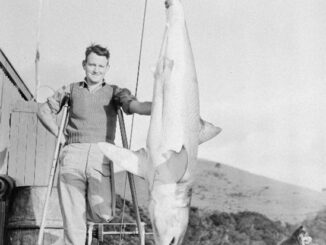
Hansie Schoeman was one of the Helderberg’s more improbable characters a respected education official who was as well known in local fishing circles as he was in teaching ones. In the years before great white sharks became a protected species, before False Bay became internationally famous for its cage-diving operations and its breaching behaviour at Seal Island, Schoeman was catching enormous great whites from his boat in the bay. Photographs of him with his catches appeared regularly in local newspapers the kind of images that generated the mix of excitement and civic pride that a local man doing something extraordinary on familiar water always produces in a small community.
He belongs to a particular era now closed. The great white shark has been fully protected in South African waters since 1991. The False Bay that Hansie Schoeman fished is not the False Bay that exists today not legally, not ecologically, not in the public understanding of what the shark represents and why it matters. He operated in a different time, under different rules, with a different relationship between the human community and the apex predator sharing the bay. Older residents still recall his exploits with the affection people reserve for local legends. In the digital age he has left almost no trace. He survives in memory, which is where most legends eventually end up.
Bertie Reed is a different kind of legend entirely a man whose reputation extends far beyond the Helderberg into the global community of offshore sailing. A former South African Navy warrant officer who became one of the country’s most celebrated ocean racing skippers, Reed earned the nickname Biltong Bertie in the international sailing circles where he competed. His name became known in the early 1980s when South African entries began appearing in the great solo ocean races the BOC Challenge, the predecessors of the Vendée Globe the races that sent single-handed sailors around the world in boats that were remarkable even when they stayed afloat. He received Springbok colours 5 times for sailing.
Reed’s most celebrated moment came during the 1990–91 BOC Challenge a solo around-the-world race when his fellow South African competitor John Martin’s yacht struck an iceberg in the Southern Ocean. Reed turned back. In conditions that would have persuaded most people that the only sensible decision was to keep going, he reversed course and went to Martin’s aid, conducting one of the most remarkable maritime rescues in ocean racing history. The international sailing community, which does not give its respect cheaply, knew who Bertie Reed was after that.
The Helderberg connection is not incidental. The False Bay coast the sailing waters, the harbour at Gordon’s Bay, the maritime community that the NSRI and the naval college and the fishing industry had built across the twentieth century produced people who understood the sea in ways that went beyond recreation. Bertie Reed came from that world. Hansie Schoeman, in his different way, came from the same world. Both of them understood False Bay as a working environment, a place where the sea was not scenery but substance the medium in which they operated, the thing that defined what they did.
The bay that looks beautiful from the Clarence Drive coastal road and from the Gordon’s Bay harbour wall looks different from the water, in the dark, in bad weather, a long way from shore. The people who knew it from that angle saw something that most residents of the Helderberg never saw.
They are part of the valley’s story too.
Between You and Me:
Bertie Reed turned his boat around in the Southern Ocean to go and find another sailor whose yacht had hit an iceberg. The Southern Ocean does not forgive turning around. Every additional hour out there is an hour of additional risk, in waters that are cold enough and remote enough that rescue, if it comes at all, comes very late. He turned around anyway. I think about this story in relation to the NSRI volunteers who go out into False Bay at two in the morning for people they have never met. It is the same instinct, scaled up to an ocean. Someone is in trouble. You go. The calculation of risk happens afterwards, if at all. The Helderberg produced men who thought this way about the sea. That is worth remembering, the next time the bay looks calm from the harbour wall.
Historian – Harmen Bockelenberg
Next week: the Helderberg Hospice how a community built, by hand, the thing it needed most.


Be the first to comment