

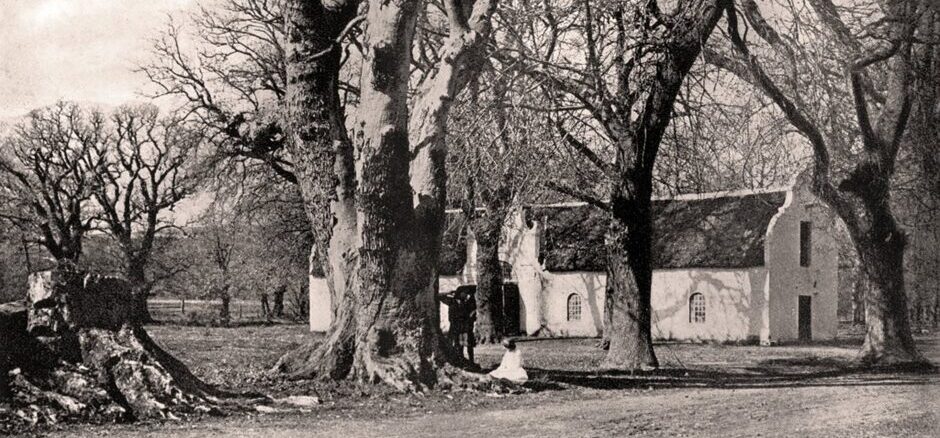
Featured image: Vergelegen 1931 (These trees, originally planted by Willem Adriaan van der Stel between 1700 and 1705)
The Helderberg Wine Route is one of the most popular tourist attractions in the Western Cape today. On any given Saturday you can find people from Cape Town, Johannesburg, Germany and the United States driving between estates, sipping Cabernet on a stoep, admiring the mountain view. It looks effortless. It looks like it was always this way.
It was not. Behind every beautiful label is three hundred years of hard farming, shifting ownership, bankruptcy, revival and the kind of stubborn patience that only the vine rewards.
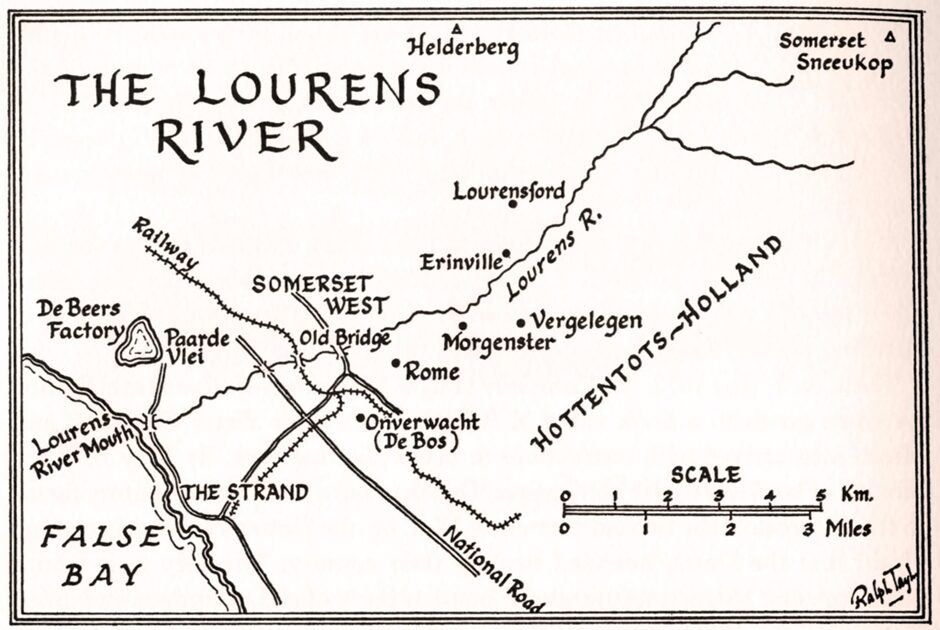
The wine story of the Helderberg begins, as so much of the Helderberg’s history does, with the scandal of Vergelegen. When Willem Adriaan van der Stel planted half a million vine stocks in 1700 with VOC slave labour and VOC money, he was building what was effectively the first large-scale wine operation in the region. It was corrupt and it was built on exploitation. But it also proved something that would define the Helderberg for the next three centuries, that this particular combination of mountain air, False Bay breezes and rich alluvial soil produced wine of exceptional quality.
Vergelegen
After the great scandal and the carve-up of 1709, Vergelegen passed through a succession of owners. The Theunissen family took ownership in 1798 and cared for the vineyards for nearly a century. Then in 1917 it was purchased by Sir Lionel Phillips, a mining magnate who had made his fortune on the Kimberley diamond fields and the Witwatersrand gold mines, for his wife Lady Florence Phillips. The Phillips family spent vast sums restoring the dilapidated estate into a floral and cultural treasure. Anglo American acquired it in 1987, invested heavily in restoration and produced their first commercial vintage in 1992. Today Vergelegen draws around 50,000 visitors a year and its wines regularly win international awards.
Lourensford
The north-western quarter of the original Vergelegen estate, carved off in 1709, covers 4,000 hectares of forest, fynbos, fruit orchards and vineyards rising up the slopes of the Helderberg. For most of the 19th and 20th centuries it was primarily a fruit farm, deciduous fruit, apples and pears grown in the cool mountain air. Today it hosts the Saturday market that draws half of Somerset West every weekend, a sports car museum, restaurants and a market garden. The mountain it backs onto is the same mountain that was there when Jacques Malan bought Morgenster in 1709 and the first vines were planted on the southern slopes.
Morgenster
Still on Lourensford Road, still making wine and olive oil from groves first planted centuries ago. The olive oil is award-winning. The view from the tasting room toward the mountain has not changed in three hundred years.
Vergenoegd
Situated on the Cape Town side of the Eerste River and the edge of False Bay, Vergenoegd is widely regarded as one of South Africa’s oldest surviving wine farms, by some accounts the third oldest. The estate was granted in 1696 to the Dutch free burgher Pieter de Vos, who named it Vergenoegd, meaning contentment or well satisfied. Over more than three centuries, the farm passed through the hands of several notable Cape families, including Ferdinandus Appel, the Colijn family of Constantia wine fame and later six generations of the Faure family. Jack Faure, a keen photographer and his wife Betty, along with his brother, went on to win many awards for the wines they produced.
The historic homestead, cellar buildings, slave lodge and farmyard form one of the most complete surviving examples of an early Cape wine estate. When the economy of scale grew difficult to sustain, Professor Peter Löw, a German businessman, historian, philanthropist and heritage conservationist, purchased Vergenoegd in 2015. After the purchase he added his surname to the farm’s name, creating Vergenoegd Löw. Under his ownership, extensive restoration and conservation work has been undertaken to preserve one of the Cape’s oldest wine estates and its historic buildings. Today it remains a working wine farm and living heritage site, preserving a remarkable link to the earliest years of settlement and winemaking at the Cape.
Stonewall: From Verdruk Mij Niet to Happy Vale
Many Helderberg residents know the property simply as Stonewall, but the farm’s history stretches back much further than the modern wine label. The land was originally part of the neighbouring farm Scholtzenhof and was granted as a separate property in 1824. It was initially known as Verdruk Mij Niet, Do Not Oppress Me, a name that hints at the hardships often experienced by early Cape farmers.
In 1873 the property was purchased by the De Waal family, who renamed it Happy Vale. Known to us as Kosie De Waal’s farm, it was a name well recognised in rugby circles of the time. A distant relative of mine was the farm foreman, we would call him the farm manager today, one Kosie Visser and his wife Marie, who baked the finest mosbolletjie in the area. De Waal Koch, representing the fourth generation of the family to farm there, continued the farming operation and established the Stonewall wine brand. Both names, Happy Vale and Stonewall, describe the same historic farm and both carry the weight of the families who worked it.
But the Helderberg’s agricultural identity was never just wine. For much of the 19th and 20th centuries, deciduous fruit was equally important. The cooling maritime influence of False Bay and the altitude of the Helderberg slopes created ideal conditions for apples and pears that would supply Cape Town markets and later export markets. The cold stores that appeared in Somerset West in the 20th century were not incidental, they were the infrastructure of a fruit economy that employed hundreds of farm workers and sustained the valley.
The wine route as a tourist concept came much later. The idea of tasting rooms and cellar tours and pairing menus is a late 20th-century invention. For some local students from Stellenbosch, it was also a reliable way to obtain wine for free by hopping from one estate to another, though this was back when students did not have much spending money and one cannot judge them too harshly for it. For most of the Helderberg’s farming history, wine was simply a crop. Something you grew, pressed, sold to the KWV at a fixed price and hoped the rains came right and the wind stayed away or at least arrived as a gentle breeze rather than a catastrophe.
Raithby: The Valley Between the Farms
Hidden between Somerset West, Stellenbosch and the lower slopes of the Helderberg Mountains lies the small rural community of Raithby. Unlike many parts of the Helderberg that have been transformed by modern development, Raithby has retained much of its agricultural character.
The area’s history stretches back to the early days of Cape settlement, when fertile soils and reliable water attracted farmers to establish vineyards orchards and livestock farms. The name Raithby, dating from 1834, is believed to have originated from Raithby Hall, a property associated with Scottish settlers during the nineteenth century.
For generations, Raithby was home to farm workers, craftsmen and farming families whose lives revolved around the agricultural seasons. At the centre of community life stood the Raithby Methodist Church, one of the district’s most recognisable landmarks. Built in the nineteenth century, the church served not only as a place of worship but as a social and cultural gathering point for generations of local families. Weddings, baptisms, funerals and community events all revolved around the church and its congregation.
Today, while vineyards, guesthouses and wine estates have brought new life to the area, Raithby remains one of the few places in the Helderberg where the rural character of the valley can still be experienced. The winding farm roads, historic buildings and surrounding vineyards offer a glimpse into a time when farming shaped nearly every aspect of life here.
A New Chapter
Some of the later estates that transformed the Helderberg countryside deserve a mention and yes, there could be many more, but space requires a selection.
Idiom Wines, established on the mountain slopes above Sir Lowry’s Pass, represents one of the latest chapters in the agricultural story of the Helderberg. Unlike many of the region’s historic farms, whose origins stretch back to the VOC era, Idiom is a thoroughly modern enterprise. The Bottega family, who also produce wine under the neighbouring Da Capo label, planted the first vines on the property in 1999, transforming what had largely been natural mountain veld into a productive wine estate. Today the vineyards cling to the slopes of the Helderberg, producing wines that combine European tradition with Cape terroir, demonstrating that the story of farming in the Helderberg is still being written more than three centuries after the first settlers arrived.
During the closing years of the twentieth century and the beginning of the twenty-first, a new generation of farms emerged. Ken Forrester breathed new life into the historic Scholtzenhof. Cavalli transformed farmland into a modern wine and lifestyle destination. Together with Idiom, they created vineyards where none had existed before, demonstrating how the Helderberg continues to evolve, blending centuries of agricultural heritage with innovation and international ambition.
The romance came after the hard work. It always does.
Between You and Me:
Kosie Visser’s wife Marie baked the finest mosbolletjie in the Helderberg. I am prepared to put that in print and defend it. Mosbolletjie, that particular sweet bread made with grape must, eaten warm, that smells of the harvest and somehow of every Sunday morning simultaneously, is not a thing you can produce adequately from a recipe alone. It requires a specific combination of knowledge, patience and a farm kitchen with the right kind of warmth. Marie had all three. I have eaten mosbolletjie in many places since. None of them were wrong, exactly. None of them were what I remember from that farm kitchen on a winter morning. That, I think, is the definition of a specific memory: it cannot be reproduced. It can only be remembered.
Historian – Harmen Bockelenberg
Next week: the wagons head north — how the Great Trek reached the Helderberg and what it left behind when it moved on.


Be the first to comment