

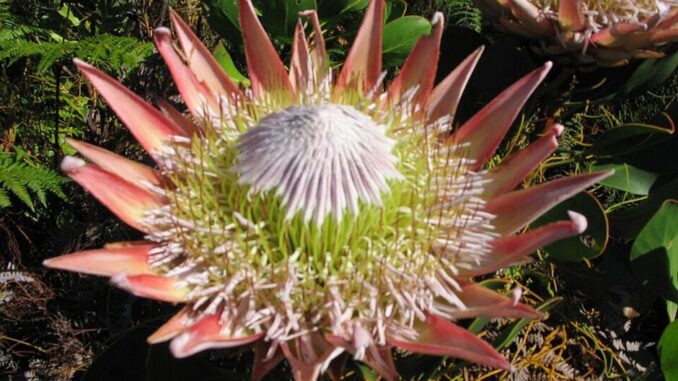
Fire, Fynbos and the Helderberg
There is something growing on the slopes of the Helderberg that is found almost nowhere else on earth. Most people who live in its shadow do not fully realise what they are looking at. It looks like scrubby bush. It looks ordinary. It is neither of those things.
It is called fynbos. And it is one of the most extraordinary botanical phenomena on the planet.
The Cape Floristic Region — the technical name for the area stretching roughly from the Cederberg in the north to the Helderberg and Overberg in the south and east — is one of only six floral kingdoms on earth. The other five cover entire continents. This one covers a strip of land at the southern tip of Africa roughly the size of Portugal, yet it contains more plant species per square kilometre than the entire United Kingdom, Australia or the Amazon rainforest. The Helderberg Nature Reserve alone — 398 hectares on the mountain’s southern slopes — contains species of protea, erica and restio found nowhere else on the planet.
Let that settle for a moment.
The mountain you look at every day from your stoep in Somerset West is, botanically speaking, one of the most remarkable places on earth.
The fynbos has been here for an almost incomprehensible length of time. The Cape Fold mountains that anchor it were formed 250 million years ago and the vegetation adapted to these specific soils, this specific climate and these specific conditions over millions of years of evolution. The result is a plant community so finely tuned to its environment that it cannot survive anywhere else. Take fynbos out of the Cape and it dies. It belongs here and only here.
Its relationship with fire is what surprises most people.
Fynbos does not merely survive fire. It needs fire — specifically, naturally occurring fire, on its own cycle. Many fynbos seeds will not germinate at all unless they have been exposed to heat or smoke. The proteaceae — the great protea family, the king proteas and sugarbushes that cover the Helderberg slopes — store their seeds in hard, woody cones that only open after a fire burns through. The parent plant dies. The soil, enriched by ash, cools. The rains come. And out of the black ground, a new generation erupts.
When you see the Helderberg burning — and if you have lived here long enough, you have seen it burning, that dreadful orange glow against the night sky — you are watching something that has been happening on these slopes for millions of years. The mountain knows what it is doing. What frightens us is, from the fynbos’s perspective, simply Tuesday.
The first people who lived in these valleys understood this instinctively. The San hunter-gatherers managed the landscape with fire for thousands of years, burning sections deliberately to flush game and encourage new growth. They were not destroying the fynbos. They were unknowingly participating in its cycle.
The colonists who arrived in the 1600s and 1700s did not always understand this. They saw fires as catastrophe. They were both right and wrong simultaneously — catastrophic for the farms and homesteads in the path of the flames, yes. But for the mountain itself, just another turn of a very old wheel.
A sustained anti-fire campaign from the 1940s onward, vividly depicted in the awareness booklet Bokkie die Grysbok whose posters adorned walls well into the 1960s, had created powerful community resistance to fire on the mountain. The ecological science that would eventually demonstrate the opposite — that suppressing fire in fynbos was actively harmful — was still being developed in research stations that had not yet communicated their findings to the communities living below the slopes.
So when the mountains above Gordon’s Bay caught fire in the 1960s, the men went up. They went with beaters and water tanks and the particular determination of people who live in the shadow of something and cannot allow it to come down on them. Boys watched their fathers and uncles leave the domestic world for something dangerous and necessary. The orange glow was visible from the street. The smell of fynbos burning — a specific, resinous, not entirely unpleasant smell that anyone who has lived near the Cape mountains knows immediately — came down into the towns on the evening air.
The concern about man-made fire, as distinct from natural ignition, was not misplaced. Nature finds its own balance without human interference; it is the human element that disturbs that balance. The mountain should not burn in consecutive years. When it does, the consequences extend beyond the mountain itself: after the fires come the winter rains and with nothing left to hold the soil in place, the mountain crumbles. Erosion carries the hillsides onto the roads below — Clarence Drive has not forgotten this lesson.
Back in the fifties through the eighties, much of the mountain was covered in managed pine plantation — trees planted by man but also watched and controlled. Lookout posts were manned throughout the summer months, their occupants scanning the slopes for the first sign of smoke, ready to set off the chain of events that would bring firefighters to the scene before a spark became an inferno.
The fires that have marked the Helderberg’s modern history are numerous. Almost every decade has produced at least one significant blaze, some driven by the ferocious Berg wind that howls down off the mountains when a cold front approaches — hot, dry and capable of turning a spark into an inferno within minutes. In April 2011, a fire that began as a controlled environmental burn at Erinvale Estate spread at speed into the Helderberg Nature Reserve and onto farms at the southern foot of the mountain. Fanned by near-gale-force south-easterly winds, the blaze wrapped around the Helderberg, surging toward the Stellenbosch winelands and cresting the Helderberg Dome. Then in June 2022, fire started near Lourensford among pines on the slopes and spread into the Nature Reserve, charring houses, injuring firefighters and displacing animals. One hundred and twenty firefighting staff were involved — crews from the City of Cape Town, Working on Fire, CapeNature, Volunteer Wildland Services and the Helderberg Nature Reserve itself — all fighting simultaneously on a mountain front that stretched from Lourensford to Kings Kloof to Silverboomkloof.
After each fire, the same thing happens. The mountain looks dead. Black sticks. Ash. Silence where there was birdsong. Visitors who come in the weeks after often leave feeling that something irreplaceable has been destroyed.
Then, within weeks, the green shoots appear. After the 2022 fire, the Helderberg Nature Reserve reported that the reserve was alive with birds and animals, all adapting to the renewed landscape. The fynbos does not burn evenly; there are always unburnt islands where species shelter and from which recolonisation begins. The management approach has changed too. Controlled burns are now recognised as an essential tool and the community has learned, slowly, what the fynbos always knew.
The mountain knows what it is doing. The problem is not the fire. The problem is the houses we build in the fire’s path, the alien vegetation we grow between the houses and the mountain and the man-made ignition sources that force the mountain to burn before it is ready.
Walk the Helderberg Nature Reserve today — established in 1960 after a community campaign to protect what remained of the natural mountain — and you are walking through a botanical garden that designed itself over millions of years. The proteas flowering along the path. The ericas in their hundreds of varieties. The restios, reed-like plants that look like ordinary grass until you learn to see them differently.
Nothing here is ordinary. It never was.
The Helderberg has burned before every one of us arrived. It will burn after we are gone. What we choose to plant on its slopes, how close we build to its edge and whether we light fires that nature has not yet called for — that is the only part of the equation we actually control. And someone will always go up when the mountain burns. That, too, has not changed.
Between You and Me:
It is called fynbos not wynbos that’s something totally different. I remember the night the mountains above Gordon’s Bay burned when I was a young boy, 4 to 5 years old. The orange glow was visible from the street and the smell, that particular fynbos smell, not entirely unpleasant and entirely unforgettable, came down into the town on the evening air. The men went up. That is what I remember most. The domestic world emptied out and the men went up the mountain with beaters and water tanks and the particular determination of people who live in the shadow of something and will not allow it to come down on them. We now know the mountain did not need saving. But the men went up anyway. Some things do not require ecological justification.
Historian – Harmen Bockelenberg
Next week: the first people who called this place home — the San, their rock art and the world they lived in before everything changed.

Be the first to comment