

STORY 81
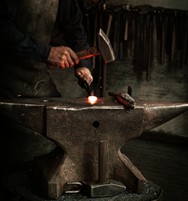
There are ways of knowing a place that no map records. The sound of a hammer on iron on a weekday morning. The smell of coal smoke and hot metal from the back of a yard in Bright Street. The sight of a horse standing patiently outside a workshop while a man bent over its hoof with tools that his father’s generation had also used and his fathers before that.
The man was Vaatjie Hollander. When he stopped, something ended in Somerset West that had been continuous since the first ox wagons rolled through the Hottentots Holland Pass.
His real name was never what people called him. The nickname came from a rugby match, vaatjie means small barrel in Afrikaans and the story went that he had once rolled over the try line with the particular shape and momentum of a barrel rather than a man. The name stuck for life, as nicknames do in Afrikaans communities when they are accurate enough and affectionate enough simultaneously. He was Vaatjie Hollander to everyone who knew him, recorded that way in the NG Kerk community history that preserved his story and remembered that way by the people of Somerset West long after the forge on Bright Street had gone cold.
He was born in 1908 in what is now Namibia and came to Somerset West as a child of six in 1914, arriving in a valley that still ran, in significant part, on the power of horses and oxen. The motor car existed but had not yet won. Farms still moved their produce to market in horse carts. Ox wagons still crossed Sir Lowry’s Pass on the old routes that wagons had been using since before the pass had a road. The blacksmith was not a picturesque relic of an earlier age. He was a working professional whose skills were as essential to the economy of the valley as the farmer’s knowledge of soil or the miller’s knowledge of grain.
Vaatjie Hollander trained as a grofsmid a rough smith, a blacksmith in the full traditional sense, from 1924. He was sixteen years old, learning a trade that had existed in essentially the same form since iron was first worked in the Western Cape. The forge, the anvil, the coal fire, the hammer, the tongs. The skill of heating metal to precisely the right temperature, judged by colour, by the quality of the glow, by an intuition built from years of practice rather than any thermometer. The skill of shaping it while it held that temperature, working fast because the window was short, because iron cools and stiffens and loses its willingness to be shaped if you hesitate.
He built ox wagons. He built horse carts. He became a skilled farrier, making his own horseshoes from iron stock and fitting them to the horses of the farms and households of the Helderberg. His workshop and home were in Bright Street, one of the older residential streets of Somerset West, where the pattern of mixed residential and workshop use that characterised the working town in the first half of the twentieth century had left small forge buildings and craft yards tucked behind houses, audible to the neighbourhood, visible from the street, part of the daily texture of life in a way that no modern industrial estate ever is.
The NG Kerk community history that records his life notes two other things about Vaatjie Hollander that deserve their place in the picture. He was a church elder, an ouderling, serving the congregation that was the social and spiritual centre of the Afrikaner community of Somerset West. And in the 1930s he ran a boere-orkes, a traditional Afrikaans folk music band. The man who spent his days bending iron to his will spent his evenings making music. This combination, craftsman, churchman, musician, is not surprising in the community that produced him. These were not separate identities. They were facets of the same person and of the same community, in which work and faith and celebration were not easily disentangled.
The world changed around him. Tractors came to the farms. Motor vehicles replaced horse carts on the roads. The ox wagon became a ceremonial object, dragged out for the Voortrekker centenary celebrations of 1938, preserved in museums, remembered with sentiment but no longer used for the work it was built to do. The farrier’s trade shrank as the horse population shrank. The blacksmith’s forge, which had once been essential to every farming district in the Western Cape, became something people remembered their fathers mentioning.
Vaatjie Hollander kept going. He was still working on farms in the area well into his later years, still shoeing horses for the farms that kept horses, still doing the forge work that the farms still needed, still the man you called when the machine had not yet replaced the animal and the animal still needed iron on its feet.
The author of this book remembers seeing the last portion of the workshop on Bright Street, the forge, the anvil, the tools hanging in their places on the wall, the particular darkness of a building that has been filled with coal smoke for decades and absorbed it into its very fabric. He was a child. He did not understand what he was looking at. He understands it now.
What he was looking at was the end of something that had begun before Somerset West had a name, the continuous presence of the blacksmith in the farming community of the Helderberg valley, the man who kept the wagons rolling and the horses shod and the iron implements of agriculture repaired and ready for the next season’s work.
Vaatjie Hollander was, as the community that knew him understood, the last of that line in Somerset West. When the forge in Bright Street went cold, no one lit it again. The trade that had served this valley since the first settler needed a wheel repaired or a share for his plough had finally run its course here.
The anvil is silent. The hammer is still. The horses that lined up patiently outside that Bright Street yard, waiting their turn, are long gone from the streets of Somerset West.
The music and the band has also become silent.
But the memory of the man is in the record, in the NG Kerk community history, in the minds of the people who knew him and now in this book, because someone who saw the last of the forge thought it was worth writing down.
It was.
Between You and Me:
Craftsman, churchman, musician. Vaatjie Hollander spent his days at the forge and his evenings with a boere-orkes and his Sundays as an ouderling and none of those things were considered separate roles requiring separate identities. He was simply Vaatjie Hollander, who did all of those things, in the way that people in small communities have always done several things because the community needed several things done and there were only so many people available to do them. I think we have lost something in the specialisation of modern life, not the specialisation itself, which has obvious benefits, but the particular wholeness of a person who was the blacksmith and the elder and the bandleader, all at once, all known by the same nickname, all part of the same life.
Historian – Harmen Bockelenberg
Next week: the Saturday market and the new Helderberg how a weekly gathering on a three-hundred-year-old farm became a mirror of everything the valley had become.


Be the first to comment