
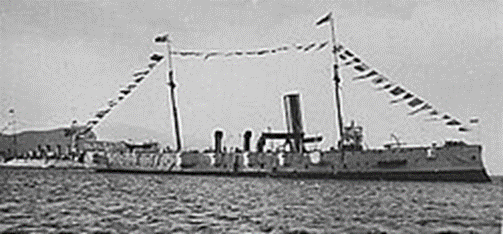
Featured image: General Botha in 1925.
There is a wreck lying on the floor of False Bay, nine nautical miles east-southeast of the Roman Rock lighthouse, in about 30 metres of water. Divers visit it occasionally. They find the old steel ribs of a once-proud ship, encrusted with sea life, slowly becoming part of the seabed. It is called the General Botha. And its connection to Gordon’s Bay is one of the most remarkable stories in the whole Helderberg.
The Roman Rock lighthouse, for those who have not noticed it: first lit in 1861, a fourteen-metre cylindrical cast-iron tower near Simon’s Town, one of the oldest surviving lighthouses on the South African coast. It marks the rock that has caught ships for centuries. The General Botha now lies not far from it, on the same seabed that the lighthouse was built to keep ships off.
The story begins in England in 1885 with the launch of a Royal Navy light cruiser called HMS Thames, a sleek warship built for a Victorian empire at the height of its confidence. She served her time, was decommissioned and by 1920 was sitting surplus and unwanted in a British naval yard. Enter Thomas Benjamin Davis, South African businessman, yachtsman and one of the most generous philanthropists the country has ever produced.
Davis bought the old cruiser from the British Admiralty in 1920 and donated it to the South African government with a single condition: it had to be used exclusively for the full-time training of boys for careers at sea. He had her stripped of weapons, converted into classrooms and mess halls and sailed south to South Africa. She was renamed the General Botha, after Louis Botha, the Boer War general and first Prime Minister of the Union of South Africa and on 15 March 1922 the first intake of seventy-five boys joined ship in Simon’s Bay.
The General Botha, known to her cadets as the Bothie almost from the start, was moored in the bay, a floating school that over the next two decades would train some of the finest seafarers South Africa ever produced. They were boys, some barely sixteen, living aboard a ship at anchor, studying navigation and seamanship and meteorology, learning to splice rope and read the stars and understand the behaviour of the sea. The bay they looked out at was the same bay that had swallowed ships for three centuries. The lesson was not lost on them.
By the time the Second World War broke out, over nine hundred cadets had been trained aboard. What happened next is a statistic worth reading twice. During the war, the General Botha had the highest number of military awards per capita of any school in the entire British Empire. A small naval training ship moored in Simon’s Bay produced more decorated servicemen per head than any other school in an empire that stretched across a quarter of the globe. The names of former cadets appear on the General Botha’s Roll of Honour, twenty-four in the Merchant Service, seventeen in the Royal Navy, fourteen in the Royal Air Force, eleven in the South African Air Force, nine in the South African Army. Boys who had learned to tie knots and read charts on the Bothie went on to fight and die on every ocean on earth.
The war also threatened the ship itself. The presence of German submarines in the southern oceans caused the naval authorities to move the cadets ashore to Red Hill above Simon’s Town. The ship was commandeered by the navy for the duration. When peace came in 1945, the trustees examined the old girl. She was found to be beyond economical repair.
On 13 May 1947, she was towed into False Bay, positioned nine nautical miles east-southeast of the Roman Rock lighthouse and sunk by gunfire from Scala battery. The ship that had trained over a thousand young South Africans for lives at sea was sent to the bottom of the bay she had looked out over for twenty-five years. It is the kind of ending that seems brutal and then, the more you think about it, seems entirely fitting. She went down in False Bay. She had always belonged to it.
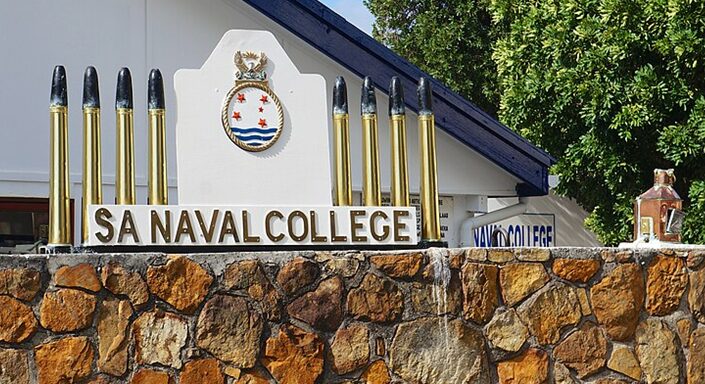
The Bothie’s story was not finished. At the end of April 1948, the cadets moved to the former South African Air Force crash boat station at Gordon’s Bay. The training college, renamed the South African Nautical College General Botha, set up beside the Gordon’s Bay old harbour and the name transferred from the sunken ship to the new shore-based institution. Over its entire history the General Botha produced four Chiefs of the South African Navy, a generation of admirals and civic leaders and, in more recent years, Captain Nick Sloane, the man who salvaged the Costa Concordia, the cruise liner that capsized off the coast of Italy in 2012. The salvage of the Costa Concordia was one of the most complex maritime engineering operations in history. The man who led it learned to love the sea at Gordon’s Bay.
The college finally closed in 1987 as air travel and containerisation reduced the demand for merchant navy officers to the point where a dedicated training institution could no longer be sustained.
Look up at the mountain above Gordon’s Bay harbour. The letters GB and an anchor, assembled from painted stones on the slope, visible from the harbour and from the bay. Not Gordon’s Bay. General Botha. Painted there by generations of cadets who trained on that waterfront, looking up at their mountain, leaving their mark the way young men always want to leave their mark.
The Bothie lies on the floor of False Bay. Her boys are scattered across the world. Her initials are on the mountain.
The Bothie lies on the floor of False Bay. Her boys are scattered across the world. Her initials are on the mountain.
Between You and Me:
Thomas Benjamin Davis bought a decommissioned Royal Navy cruiser and donated it to the South African government so that boys could learn to go to sea. He asked for nothing in return except that the ship be used for exactly that purpose. He did not name anything after himself. The ship was named after Louis Botha. The institution was named after the ship. Davis’s name is on a plaque somewhere and in the records of the Admiralty’s transaction and in this paragraph. I think about this kind of philanthropy occasionally, the kind that funds something specific and useful and then steps back. It produced a school that trained the man who salvaged the Costa Concordia. That is a fairly long chain of consequence from one man’s decision to buy an old warship and give it away.
Historian – Harmen Bockelenberg
Next week: the shore college that carried the Bothie’s name — life as a naval officer cadet at Gordon’s Bay and what a Sunday afternoon in False Bay could teach you about the distance between confidence and wisdom.



Be the first to comment