
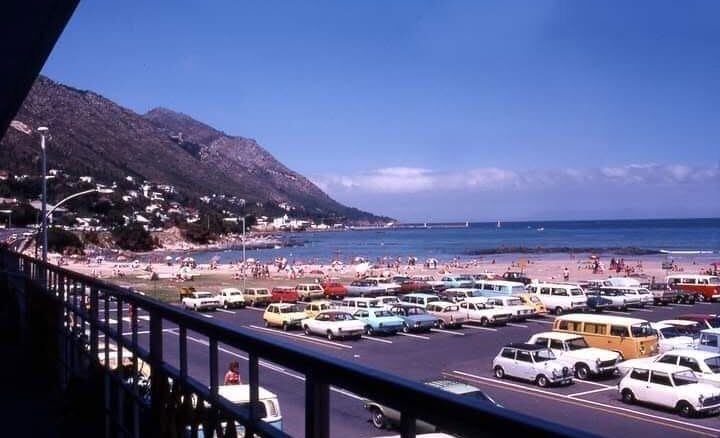
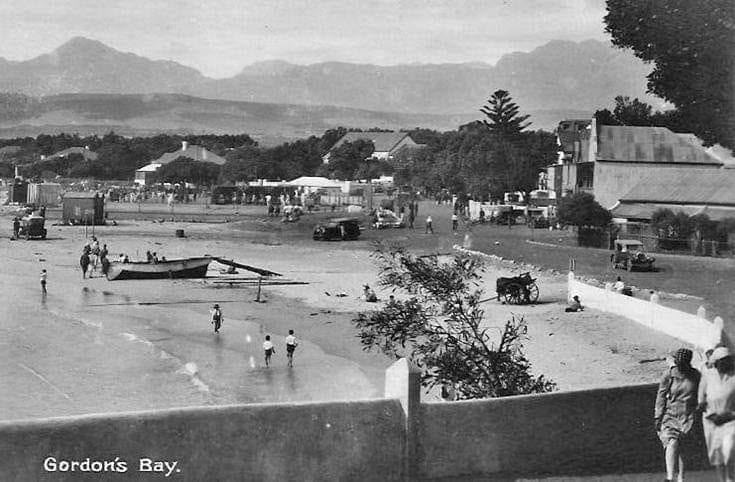
Gordon’s Bay never had a Main Road in the way Strand or Somerset West did. It had a harbour, a beachfront and a handful of landmarks close enough together that everyone in town knew them by name, which amounted to the same thing in a town this size.
The harbour came first, in every sense. Fishermen had worked this stretch of coast since at least 1672, but the harbour itself, the stone structure people still call the old harbour, was built in 1937, when Albertus Brand Faure laid its first brick with a gold coin hidden inside for luck. It anchored the town for more than half a century before Gordon’s Bay acquired a second, very different kind of harbour. Harbour Island was carved out of the coastline in 1990, the work of three founders, Tony de la Fontein, Albert Murphy and Fred de Kock, who began developing it in deeply uncertain times, in the years just before South Africa’s democratic transition, when investors were nervous and the project came close to collapse more than once. What was landfill and, by some accounts, close to a dump at the start of the 1990s is today one of the most valuable stretches of residential canal-front property on the Cape coast, a strange enough transformation that it belongs in this story on its own merits.
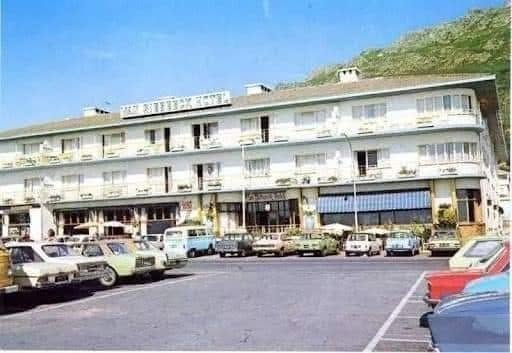
The Van Riebeeck Hotel stood for decades beside the post office and was, for that whole stretch of time, simply what a landmark was in Gordon’s Bay, the fixed point everyone used to orient themselves. It was eventually demolished and the site sat empty for years afterward, used from time to time as an informal parking lot, a strange ending for a building so many people had used as their point of reference for so long.
No memory of Gordon’s Bay is complete without its bookshop, the one with the car on the roof. Bikini Beach Books was started by Anton Grick, who arrived in South Africa from Graz in Austria in 1969 and bought the old Gordon’s Bay boarding house, known as the Oleander, in 1979. The Mercedes-Benz parked on the roof, along with the three tall palm trees out front, has made it one of the most recognisable landmarks on the whole beachfront, the kind of shop you give directions by rather than an address. I have always suspected the owner sleeps in that car at night, though I have never actually caught him at it.
The Pop In Café did what its name suggested, a small, easy stop that generations of Gordon’s Bay residents and holidaymakers popped into without ever really thinking of it as anything grand, which was rather the point. On the other side of town’s social life, the Gordonia Hotel hosted the Windjammer disco, remembered by anyone who was young in Gordon’s Bay in its 80’s era as the place to be on a Saturday night, though the hotel and its dance floor have long since passed out of the town’s daily life.
The old police station, built in 1903, still stands as one of Gordon’s Bay’s oldest surviving buildings, a heritage site in its own right, doing quiet civic work in the background the way police stations and post offices always seem to, unnoticed until they are gone. There is also, in the town’s history, talk of a planned railway line and station that would have connected Gordon’s Bay to the network that reached Somerset West and Strand’s beachfront by 1897. Whether it ever moved beyond talk is not something I can confirm, but the idea alone says something about how differently this small harbour town might have developed had that branch line ever been laid.
There was, too, a first petrol station at the entrance to Gordon’s Bay opened around the early 1930s. It was known as the Gordon’s Bay Garage, located on Beach Road. This historical site has evolved over the decades. Today, the very same plot on Beach Road operates as a modern service station. Like the Van Riebeeck, Windjammer and the Gordonia, faded into the layers of this town’s history that lives mostly our memory of how it was before now.
Between You and Me:
Bikini Beach feels overcrowded these days; on a hot sunny afternoon you can barely find your own patch of sand. I remember it differently, though memory is not always an honest witness to a crowd. There was the drive up to the filtration plant, just to stand there and look out over False Bay, no particular reason, just the view and the quiet. Ice cream on a Sunday at the Pop In Café, which asked nothing more of the day than that it be a Sunday and that there be ice cream. Whether those were good days or not, I leave entirely up to you. Good is a flexible thing. It bends to whatever standard the person remembering happens to be using and mine may not match yours. That does not make either of us wrong. What would Jan say about his Hotel in Gordon’s Bay? Perhaps his fault that they demolished it.
Historian – Harmen Bockelenberg
Next week: vines, fruit and the farming soul of the Helderberg — the agricultural story behind the beautiful labels and the oak-lined estate roads.




Be the first to comment