


There is a particular ritual that every officer cadet at the Gordon’s Bay Naval College experienced, usually on a Sunday afternoon around five o’clock, usually within minutes of arriving from a weekend pass in what they believed to be their best uniform and their most confident frame of mind.
It ended with them standing chin-deep in False Bay in their step-outs.
The Naval College at Gordon’s Bay was where young men went after completing basic training at Saldanha Bay, after surviving, as they put it, the recruit phase, after enduring everything that basic training required of them. They arrived at Gordon’s Bay as Midshipmen and Ensigns, believing, not unreasonably, that they had already proved something. They arrived in polished shoes and pressed uniforms, parents and girlfriends waving goodbye at the gate. They walked through with the confidence of young men who had already been through the worst.
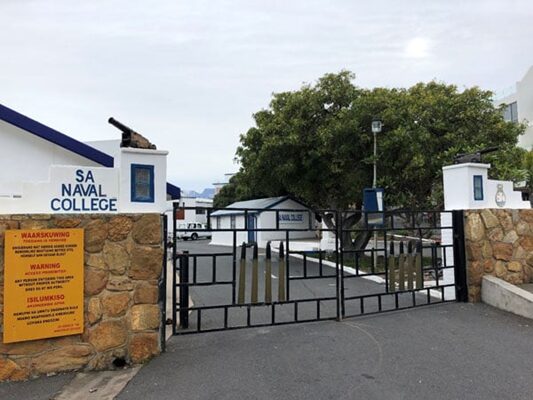
Entrance to the Naval College in Gordon’s Bay
Warrant Officer Nick Roodman was usually waiting at the main gate.
Roodman believed that discipline was not taught in a classroom but forged through experience and he had a reputation that generally arrived before he did. The shouting began almost immediately. The new arrivals were formed into ranks. Orders echoed across the base. Boots struck the tar in unison. The column marched at pace, toward the barracks, it seemed, toward unpacking and settling in, toward the slightly more refined phase of naval life that officer training was supposed to represent.
Then a sharp right turn.
Then another.
The column marched straight down the slipway into False Bay.
With full kit on their shoulders and dressed in their carefully prepared step-outs, they marched until the leading man was standing chin-deep in the cold water of the bay. The bay that had trained the Bothie’s cadets. The bay that had watched three centuries of ships come and go. The bay that had no particular interest in the sartorial condition of the South African Navy’s new officer class.
Only then came the order to halt, about turn and march back.
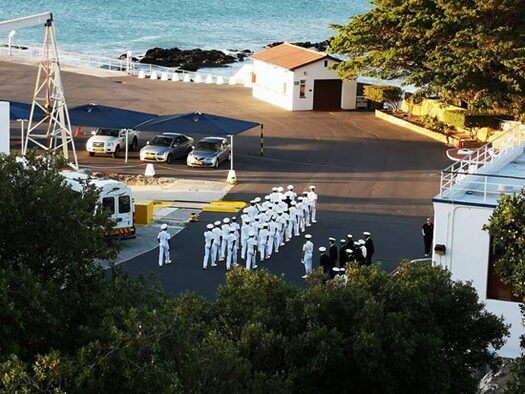
Typical marching formation
The polished shoes were ruined. The pressed uniforms were saturated. The carefully packed kit was soaked through. It took most of the remainder of that Sunday to recover, with inspection still waiting that evening. The lesson was delivered without a word of explanation and required none: basic training might be finished, but becoming an officer was only just beginning. Survival week, exhausted, starved, deliberately stripped of every comfort, still lay ahead.
The Naval College was responsible for shaping young officers of the South African Navy: maritime warfare, practical seamanship, navigation, leadership, the responsibilities that came with command. Among the many young men who passed through its gates were future captains, commodores and admirals. One young officer who trained there during this period would eventually rise to become Admiral of the South African Navy. He was, at the time of his training, indistinguishable from the rest, another young man in sodden step-outs on a Sunday afternoon, learning that the sea would not accommodate vanity.
The college was commanded by Captain Groenewald of SAS General Botha. But the name most vividly remembered by the generations of officers who trained there was Roodman’s.
Naval service carried its own risks, even in peacetime. One of the most tragic reminders came in February 1982, when the frigate SAS President Kruger was lost following a collision during naval exercises in False Bay. Sixteen sailors lost their lives. The disaster was deeply felt throughout the South African Navy and throughout the Helderberg community that had watched the naval presence in Gordon’s Bay for decades. The sea that looked beautiful from Clarence Drive was not always beautiful from the deck of a warship conducting exercises in winter conditions.
On a Sunday afternoon at Gordon’s Bay, if you stand at the naval harbour and look at the slipway that runs down to the water, you are looking at the same slipway that generations of young naval officers walked down in their best uniforms and their most confident state of mind and returned from wet, cold and considerably wiser.
False Bay has always been an effective teacher. It taught the Bothie’s cadets. It taught Warrant Officer Roodman’s officers. It taught everyone who ever took it less than seriously.
The water in the bay is still exactly as cold as it was then.
Between You and Me:
The march down the slipway into False Bay in full dress uniform is, I think, one of the finest pieces of institutional pedagogy I have encountered in the research for this book. No speech. No lecture. No written instruction about the gap between self-confidence and actual competence. Just a right turn and another right turn and the cold water of False Bay making the point more effectively than any classroom ever could. Warrant Officer Roodman understood something important: the lesson that stays with you is the one that gets your shoes wet. I have tried to apply this principle in various areas of my life. The shoes have not always appreciated it.
Historian – Harmen Bockelenberg
Next week: the map gets redrawn — how apartheid came to the Helderberg and a law called the Group Areas Act began to reorganise the valley along lines nobody had asked for.


Be the first to comment