

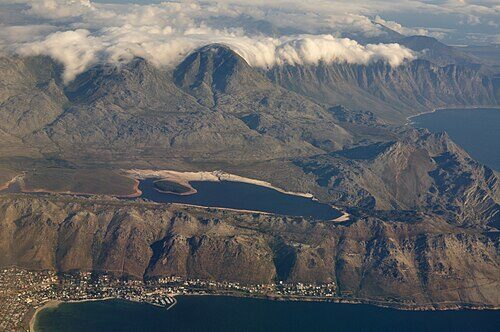
There is a dam in the mountains above Gordon’s Bay that most residents of the Helderberg have never seen. It is not hidden exactly, it is simply behind the mountain, tucked into the folds of the Hottentots Holland range where the Steenbras River collects the winter rainfall of the upper catchment and holds it. But its water has been flowing down through a tunnel and a sixty-four kilometre pipeline to Cape Town since 1921 and without it the city that grew up around Table Bay would have been a very different and considerably thirstier place.
In 1916 a Board of Engineers was appointed to report on a water augmentation scheme for the City of Cape Town. Their proposal was the Steenbras scheme, a concrete gravity and arch dam on the Steenbras River, connected to the Molteno reservoir through a tunnel in the Hottentots Holland mountains and a sixty-four kilometre long cast iron pipeline.
The decision was not simple. Two catchments were under consideration, Steenbras and Wemmershoek, the arguments for each were genuinely contested. Work began on the scheme in 1918, delayed partly by the material shortages of the First World War, during which seventeen thousand six hundred cast iron pipes, seven hundred and sixty millimetres in diameter and weighing two tonnes each, were shipped from Britain despite the dangerous nature of the seas during those war-torn years.
Think about that for a moment. In the middle of the First World War, with ships being sunk across the Atlantic and engineering materials desperately scarce, the City of Cape Town was shipping cast iron pipe from Britain to build a water supply dam in the mountains above a small harbour town on False Bay. The ambition of it is striking. The timing was terrible. They did it anyway.
A light railway was constructed from the South African Railways siding thirteen kilometres up the valley to the dam site. All cement and stores were conveyed along this narrow-gauge line, two steam locomotives providing the motive power. The workforce that built the dam lived in construction camps in the valley, working in conditions that would be considered unacceptable today and that were considered simply normal then. The Hottentots Holland mountains in winter are cold, wet and unforgiving. The work continued regardless.
The Steenbras Lower Dam was completed in 1921, the first major dam built by the City of Cape Town to meet its growing water demand. Since that year it has remained a main supply source to the Strand, Somerset West, Newlands, Molteno and Wynberg reservoirs, serving areas from Gordon’s Bay in the east to Wynberg in the southwest and as far north as the CBD.
The demand for water, however, did not wait politely for the supply to catch up. The dam wall was raised for the first time in 1928, significantly increasing storage, followed by a second raising in 1952 that further expanded capacity. Each raising was a major engineering undertaking in its own right, adding height to a structure already embedded in a mountain gorge, increasing the load on foundations designed for a smaller dam, solving problems that the original engineers could not have anticipated because they could not have anticipated the rate at which Cape Town would grow.
In the 1970s the dam was converted into a hydroelectric producer. The Steenbras Upper Dam was constructed in 1977 directly upstream, a second, larger dam on the same river, working in partnership with the original to store water pumped up from below during off-peak electricity hours and released back down through turbines during periods of peak demand. The mountain above Gordon’s Bay became, quietly, one of the Western Cape’s electricity generators as well as its water suppliers.
The Steenbras River itself, the small, clean, perennial stream that the dam was built to impound, has a name that tells you something about the world before the engineers arrived. The steenbras is a fish, endemic to South African coastal waters, found in the rocky reefs of False Bay. Before there was a dam, the river ran freely down to False Bay and the fish ran up it. The dam changed the river’s life as completely as it changed the city’s.
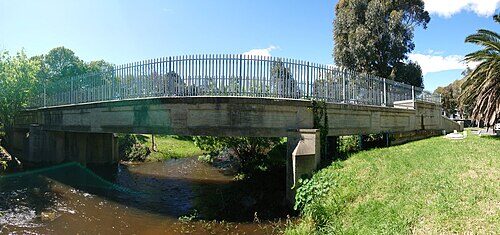
Pipeline from Steenbras dam crossing the Lourens River in the Strand
The Helderberg residents who drive through Gordon’s Bay on their way to Clarence Drive and the Kogelberg coast pass within a few kilometres of a structure that has been supplying water to Cape Town for over a hundred years. The intake tower, valves and cast iron pipeline are still in their original state, as old as the original dam wall. A hundred years of Cape Town’s water has flowed through the same Victorian cast iron that arrived on ships during the First World War.
The mountain above Gordon’s Bay holds a great deal of history. Most of it is invisible from below.
Between You and Me:
Seventeen thousand six hundred cast iron pipes, each weighing two tonnes, shipped from Britain through submarine-infested waters during the First World War to build a water pipeline in the mountains above Gordon’s Bay. The City of Cape Town ordered them anyway. Ships were being sunk. The war was very much in progress. The pipes were coming. I find this an instructive approach to infrastructure planning. When someone tells you the timing is terrible, the correct response is apparently: the pipes are already on the ship. This attitude built the dam that still supplies water to Somerset West, Strand and Gordon’s Bay today. The timing was terrible. The dam is excellent.
Historian – Harmen Bockelenberg
Next week: the modern Strand — how a beach town grew up, filled in and became something its founders could not have imagined.



Be the first to comment