

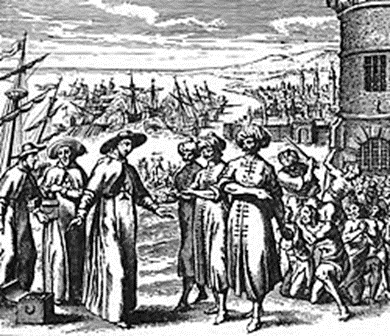
Featured image: Christian slaves
Before we talk about the slaves who built the Helderberg, we need to talk about something that most people do not know or prefer not to think about. Slavery did not begin in Africa. It did not begin with the Atlantic slave trade. It did not begin with Dutch ships crossing the Indian Ocean.
It is, in the most uncomfortable sense, one of the oldest human institutions on earth.
No one knows who started slavery because it dates back to before written history. After the Neolithic Revolution around 10,000 BCE, communities began producing food surpluses. Cities needed large, inexpensive labour forces. Slavery appeared in the very first written records of the very first civilisations in ancient Mesopotamia, in Egypt, in China.
In ancient Athens during the classical period, roughly 450 to 320 BC, there were around 100,000 slaves living in Attica alone. Slavery was not the practice of barbarians and outsiders. It was the economic engine of the civilisation that gave us democracy, philosophy and the Olympic Games. The Romans took it further still. Most ancient slaves were captured or defeated through warfare. The face of ancient slavery was not African. It was Greek. It was Roman. It was broadly European.
And then, in the 1600s, came something that often gets overlooked entirely.
In 1625, King James I of England issued a proclamation requiring Irish political prisoners to be sent to the Caribbean and sold to English settlers. It escalated dramatically under Oliver Cromwell after his brutal campaign in Ireland from 1649. Cromwell ordered the forced transportation of tens of thousands of Irish men, women and children to Barbados, Virginia and the West Indies. In 1652 alone, over 12,000 Irish people were forcibly deported, many of them children. Entire villages were cleared.
Between 1652 and 1659 an estimated 50,000 Irish people, including thousands of women and children, were sold into forced labour by the British, most transported to Barbados to work the sugar plantations.
Were they slaves? Historians argue about the precise legal category. The English called them indentured servants, people serving a fixed term rather than owned for life. But the conditions were those of slavery in everything but name: forced transportation, no consent, no wages, no freedom of movement and brutal treatment. The distinction between indentured servant and slave mattered enormously in law. In practice, on a Barbados sugar plantation in 1653, it mattered very little whether you were Irish or African. You were property.
This is the world into which the Cape Colony was born in 1652, the same year Cromwell’s transportation orders were at their peak. It was a world that had long since decided that some people existed to serve others and had spent thousands of years constructing legal and moral frameworks to justify it.
What happened in the Helderberg was part of that world. It did not invent it.
The farms, vineyards, roads, walls, homesteads and orchards that transformed the Helderberg from wilderness into one of the Cape’s most productive agricultural districts were not built by European settlers alone. Much of the physical labour was performed by enslaved men, women and children brought to the Cape by the Dutch East India Company and private settlers.
They came from many places: Madagascar, Angola, Mozambique, India, Ceylon, Indonesia and other parts of the Dutch trading world. Torn from their homelands, families, languages and cultures, they found themselves working in the fields, vineyards, kitchens, workshops and homes of the expanding Cape settlement.
Their names seldom appeared in official records except as property, inventories or transactions. Their stories were rarely written down and their voices were largely absent from the historical documents that survive. Yet their presence was woven into every aspect of daily life at the Cape. The growth of the early farming economy depended not only on the determination of settlers but also on the labour of people whose contributions remained largely unrecognised for generations.
The history of the Helderberg is therefore not only a story of pioneers, farmers and frontier families. It is also the story of those whose hands planted the vineyards, built the homesteads and helped shape the landscape that exists today. To tell the story honestly requires remembering them as well.
Between You and Me:
The ancient Athenians owned slaves while simultaneously inventing democracy. They appear to have seen no contradiction in this. The Egyptians and Romans built empires on slave labour and wrote philosophy about the dignity of man. Oliver Cromwell shipped Irish children to Barbados in the same decade that Jan van Riebeeck was planting his vegetable garden at the Cape. I am not sure what conclusion to draw from all of this except that human beings have a remarkable capacity for constructing moral frameworks that apply to some people and not others and an equally remarkable capacity for being surprised when later generations point this out. We are all downstream of something. The honest thing is to know what it is.
Historian – Harmen Bockelenberg
Next week: the remarkable man who named Gordon’s Bay — soldier, botanist, cartographer, linguist and one of the most extraordinary figures in Cape Colony history.

Be the first to comment