

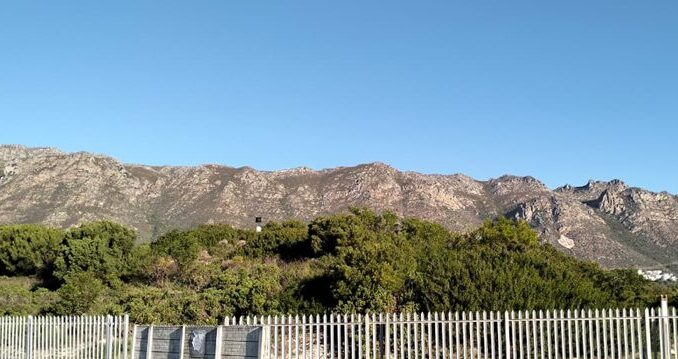
At Hendon Park in Gordon’s Bay, beneath what looks from the path like an ordinary stretch of coastal scrub, there is a rubbish heap nearly three thousand years old.
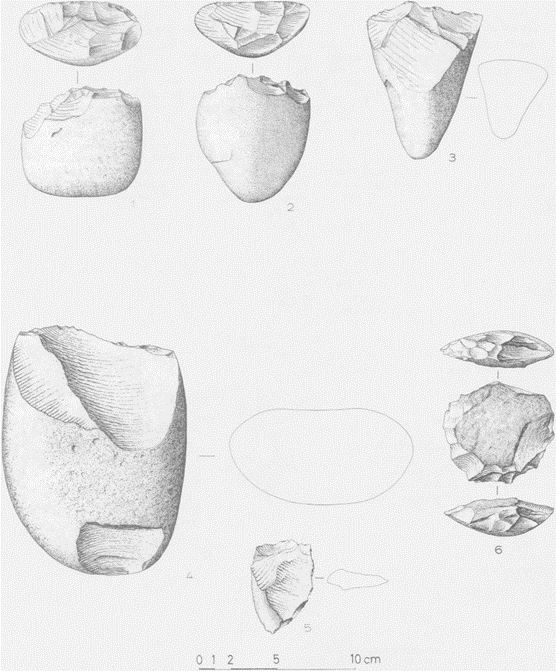
Archaeologists call it Dune 111. Locally it is known as Sandkop. It was excavated in 1967 and what came out of the sand was not treasure in any conventional sense, no gold, no ornament, nothing a museum case would light dramatically. What came out were shells. Fish bones. Stone tools worked from beach pebbles. Charcoal and the pale ash of long-dead fires. A midden, in the plain sense archaeologists use the word: the accumulated leavings of people who ate here, again and again, over a very long time.
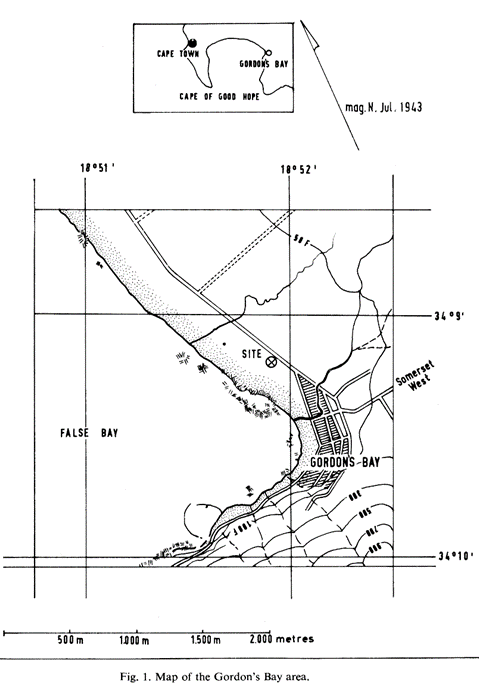
Radiocarbon dating places the occupation of the site at somewhere between 2,700 and 3,220 years ago. Not a single visit and not a single generation. Layer after layer, separated by clean windblown sand, shows a pattern repeated many times over: people arriving, staying, gathering shellfish off the rocks and fish from the bay, hunting in the surrounding country, cooking over open fires and eventually moving on, only for sand to drift back over what they left behind and sometime later, for others to return and begin again.
Archaeologists are careful about who these people were. The site is often described loosely as a San settlement, but the more precise, more honest description is coastal hunter-gatherers, very likely ancestors of the San-related peoples who lived across the southwestern Cape long before any European ship rounded the point at Cape Point. Precision matters here for the same reason it mattered in the story of the mountain and the story of Flora: naming carelessly is its own small erasure and this site has already had enough taken from it by time.
What makes Dune 111 unusual is not really what it contains. Middens like it exist along coastlines all over the world, wherever people have gathered shellfish for long enough to leave a record of it. What makes it unusual is that it survived at all. It is one of the last significant shell-midden dunes remaining along this stretch of the False Bay coastline, most others have long since been built over, ploughed under or simply eroded away. This one happened to lie beneath a dune that kept covering it faster than the sea or the town could take it.
It is protected now, formally, under South Africa’s National Heritage Resources Act. Nothing may be removed from it without a permit from Heritage Western Cape. That protection is not merely a line in a piece of legislation, either. At Hendon Park today, a slow rehabilitation is under way: the invasive Port Jackson scrub that took hold around the dune over the past century is being gradually cleared and replaced with indigenous vegetation, at the same patient, unhurried pace the midden itself represents. Nobody excavating in 1967 could have promised the site this kind of ongoing, present-tense care. It is getting it anyway.
Stand on the dune today, if you go looking for it and there is very little to see. Scrub. Sand. The ordinary shape of a coastal path. Beneath your feet, though, is a record of meals eaten and fires lit by people who came back to this exact spot for a thousand years before anyone thought to write any of it down and who left nothing behind to mark the place except the evidence of having simply, repeatedly, been there.
That, it turns out, was enough.
PS: Images supplied by: Francis Van Noten’s foundational 1974 paper, “Excavations at the Gordon’s Bay Shell Midden, South-Western Cape”, published originally in the South African Archaeological Bulletin and hosted by the Stellenbosch Heritage Foundation.
Between You and Me:
I have driven past Hendon Park more times than I could count and for most of those years I had no idea what was under the scrub near the entrance to Gordon’s Bay CDB. It is a caravan park. People go there to swim, to braai, to let their children run around on a Saturday. How many visitors walked straight over three thousand years of somebody else’s dinner / dump site without knowing it.
That is the part that stays with me. Not the shells, not the dates, but the ordinariness of it. Nobody built a monument on that dune. Nobody needed to. The people who ate there simply kept coming back, generation after generation, because it was a good place to be sheltered, fed by the sea, close to fresh water. That is not so different from why any of us end up living where we do. We just got better at writing it down afterwards and somewhere along the way convinced ourselves that writing it down was what made it matter.
Established three thousand years ago sat quietly under a caravan park on the beach and nobody thought to put a date on a sign for that. It is being looked after now, which is something. Whether it is being remembered is a different question and I am honestly not sure the two are the same thing.
Historian – Harmen Bockelenberg
Next week: the shape of the land — how the VOC divided the Helderberg valley into farms whose boundaries you can still trace on a modern map.




Be the first to comment