

STORY 96
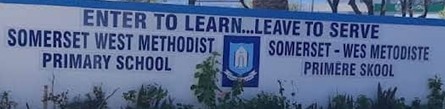
The schools named in the previous three instalments, Summies, Hendrik Louw, Lochnerhof, HH, Hoërskool Strand, Gordon High, are the schools that appear in the official histories, the centenary publications, the prize-giving programmes kept in family albums. They are real institutions with real histories and they deserve the space given to them. But they were not the only schools in the Helderberg. And the story of education in this valley is not complete without the schools that those histories rarely mention.
Before apartheid formally divided South African society, inequality in education was already the condition rather than the exception. During the nineteenth century, coloured children in the Helderberg received whatever education was available primarily through mission schools established by churches, institutions that operated on limited resources, in modest buildings, without the government funding that supported the schools serving white communities. The missionaries who established these schools believed that education was as essential as the gospel they preached. For many children, the mission school was the only door that opened.
One of the earliest and most significant of these was the Rhenish Mission Station at Steynsrust, on the outskirts of Somerset West. Established during the nineteenth century, the mission became both a spiritual and educational centre for the local coloured community. Classrooms and church shared the same grounds, the same purpose, the same conviction that knowledge, of Scripture, of letters, of numbers, was a form of liberation. The teachers who worked in those classrooms, often themselves products of mission education, gave their careers to communities that the state had decided to serve inadequately.
In Macassar, one of the oldest non-white communities in the Helderberg, its name and its Muslim identity reaching back to the exile of Sheikh Yusuf in 1694, schools grew from and alongside the community’s own cultural and religious institutions. The children of Macassar learned in classrooms that reflected their community’s particular identity, in a setting that the official history of the region too often passed over in silence.
Further inland, small schools served the coloured farming communities of Firgrove, Raithby and the surrounding districts. Teachers in these schools were frequently the most educated people in their immediate communities, carrying a social weight well beyond their formal role, shaping the cultural and civic life of places where the government’s investment in education was visibly and deliberately inferior to what it provided a few kilometres away.
The experience of Black children in the Helderberg was shaped by a different set of policies with the same underlying logic. The establishment of Lwandle in the late 1950s, a migrant labour township created to house African workers employed across the Helderberg and Cape Peninsula, brought with it the need for schools. Those schools operated under the Bantu Education system, a policy of such deliberate and calculated restriction that its architect, Hendrik Verwoerd, stated its purpose openly in Parliament: Black children should not be educated above the level of certain forms of labour. The schools of Lwandle functioned within that framework, under-resourced by design, their teachers underpaid by policy, their pupils offered a curriculum calibrated not to open horizons but to limit them.
What the children and teachers of those schools achieved within that framework is the more remarkable for its context. They produced nurses, teachers, artisans, community leaders, clergy and businesspeople, not because of the system, but in spite of it, through the specific determination of families that understood education as the one thing that could not be taken back once given.
To tell the history of the Helderberg’s schools honestly is to hold both realities simultaneously: the schools that were built with care and investment and pride and the schools that were deliberately starved of all three. They existed at the same time, in the same valley, sometimes within sight of each other. The mountain looked down on all of them equally. The system did not treat them equally. That is not a footnote to the educational history of the Helderberg. It is a central chapter.
Between You and Me:
Education as the one thing that could not be taken back once given. I have sat with that phrase for a long time, because it explains something that otherwise seems almost inexplicable, why families under a system designed to limit their children’s horizons nonetheless invested everything they had in getting those children educated. The system could control the curriculum, the funding, the buildings, the teachers’ salaries. It could not, in the end, control what a child did with what they had learned once they had learned it. That is a narrow door and it was deliberately made narrow, but the families of Lwandle and Macassar and Steynsrust pushed their children through it anyway, generation after generation. The mountain looked down on all of it equally. I think that is the most honest thing that can be said about the mountain’s relationship to any of this. It does not choose sides. It never has.
Historian – Harmen Bockelenberg
Next week: one family’s thread through nine schools and the morning two fighter jets came in low over a rugby field.



Be the first to comment