
STORY 51
Every Helderberg driver of a certain age would remember the kink in the road. Long before the N2 cut its straight modern line through the valley, the old national road did something stranger just past Firgrove. It bent sharply to skirt the railway station, ran tight along the fence of the old De Beers explosives works, then split. One direction carried you on toward Strand, the other pushed straight through to Somerset West. It was an odd little detour, the kind of road quirk nobody questions as a child because it has simply always been there.
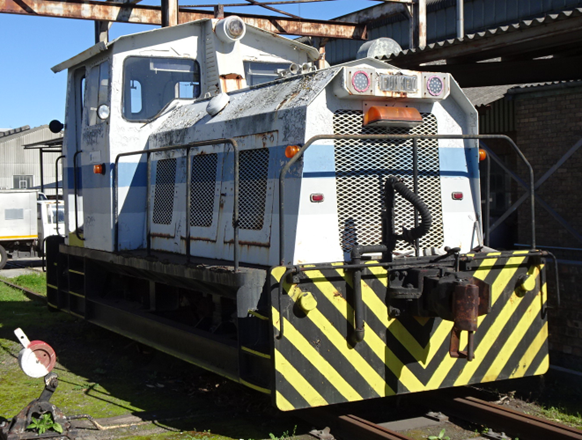
On the “new” N2 it was by the Blue gum trees (Eucalyptus globulus), where the road passed over the rail line, that you could have caught a glimpse of it. A white locomotive with a blue stripe down each side, engine bonnet stretched out long in front of a single cab, rolling steadily toward Firgrove station with a string of white wooden wagons behind it. Nobody in the passing traffic ever seemed to know quite what it was hauling or where exactly it had come from inside the fenced-off works. It just appeared, crossed beneath the road and disappeared again toward the sidings, leaving a small mystery behind for anyone who happened to look up at the right moment.
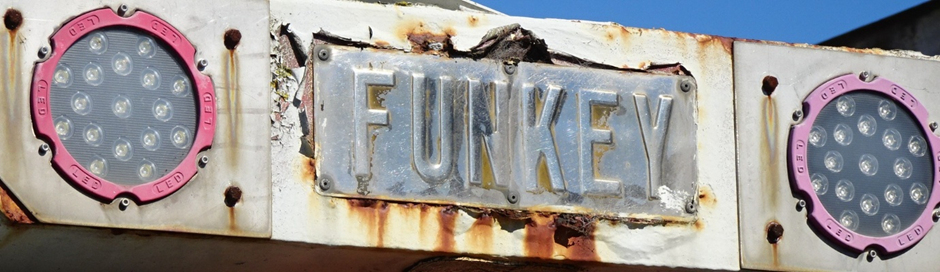
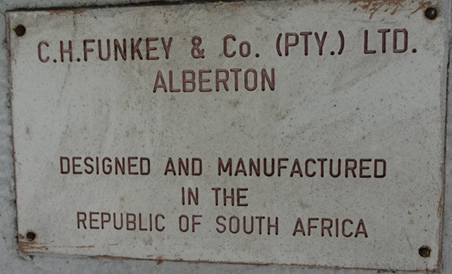
That locomotive was a Funkey and by the time it was making those runs, it represented a completely different generation of machine to the fireless Borsig engines from Story 48. Where those little steam locomotives had been built in Germany before the First World War, the Funkey was proudly South African, manufactured by C. H. Funkey & Co. out of Alberton on the East Rand. Charles Funkey himself had come to South Africa from the United States during the Great Depression and the company he built went on to become something of a household name in local industry, so common on mine properties, factories and grain silos across the country that people still call almost any small industrial shunting engine a “FUNKEY,” the badge is actually on the cab.
The machines themselves were built for hard, unglamorous work. The diesel-hydraulic unit in the class of its own worked the Somchem line typically weighed in around the mid-twenties to high-twenties of tons, powered by rugged Cummins or Caterpillar diesel engine pushing output through torque converters and cardan shafts rather than the old-fashioned rods and cranks of a steam engine. A locomotive that size could comfortably shunt well over a thousand tons of wagons on level track, more than enough for the job it had at Somchem: gathering wagons from the dispatch areas deep inside the factory and hauling them out along the factory’s own line to the exchange sidings at Firgrove, where South African Railways, later Transnet, took over for the long haul to the mines.
It wasn’t the only diesel on site. Smaller narrow-gauge locomotives handled the tighter, more restricted movements between the manufacturing buildings and the magazines where explosive material was stored, work too delicate and too confined for a full-sized machine. The Funkey’s job began where theirs ended, consolidating that traffic into proper trainloads for the run to the interchange. Two different machines, two different scales of danger, working the same site decades after the last fireless Borsig had gone quiet.
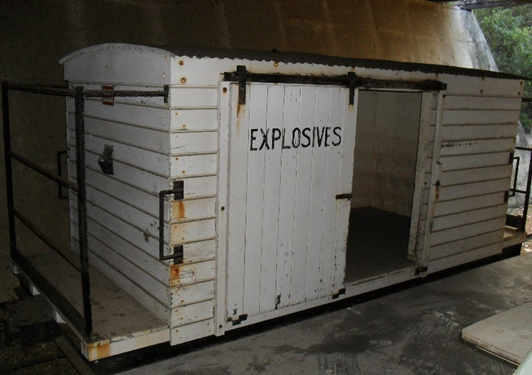
What’s perhaps most remarkable is how long that arrangement lasted. Explosives production at the works finally stopped in 1989, yet the railway line itself refused to disappear. Chemical and fertiliser traffic kept the tracks busy into the 1990s and remarkably, containers were still being hauled out to Firgrove station by rail as recently as the early 2020s, more than a century after the very first fireless Borsig locomotive rolled off a ship from Germany to begin work at the same factory.
Between You and Me: I must have driven over that stretch of railway line a hundred times as a young man, always on that kink in the old road before the N2 straightened everything out and every single time I’d catch that white locomotive gliding past below or alongside and wonder exactly the same thing. What EXPLOSIVES was actually in those white wagons? Where had it come from inside that fenced-off secret world we weren’t allowed to see into? It took me until writing this book, decades later, to finally learn its name.
Historian – Harmen Bockelenberg
Next week: what rose from the ruins — how the old factory site became a shopping centre, a winery and a nature reserve.

Be the first to comment