


STORY 48
Featured image: Borsig No. 2, 0-4-0F fireless
Push a child on the swings at the playground on Du Toit Street in Strand and you might walk right past it. A squat iron hull on four wheels, no chimney, no smokestack, nothing that says “locomotive” at first glance. Most people who pass it today have no idea what it once was or where it once worked.
The Cape Explosives Works at Firgrove, later AECI, was never a simple factory. Making dynamite was only half the problem. Moving it safely was the other half and that took almost as much engineering as the chemistry itself. The site sprawled for kilometres, laced together by twenty-seven miles of internal railway track, nearly forty-three in all, built so that raw materials and finished explosive could travel from plant to magazines without ever crossing a public road, except for the line going from the factory to Firgrove station. From there the old faithful SAR transported it to the deepest part of Africa.
Cape Explosives was, in fact, established primarily to supply explosives to the De Beers diamond mines and by 1907 it was producing approximately 340,000 cases of dynamite per year, each weighing 50 lb.
In a factory where a single stray spark could set off a catastrophe, the factory turned to something almost unbelievable: locomotives that carried no fire at all. Three fireless steam locomotives handled the network in the factory which was considered safe enough for transporting explosives.
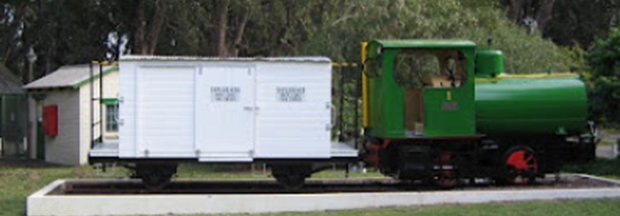
Borsig No. 1, 0-4-0F fireless
A fireless locomotive works like a giant thermos flask on wheels. Instead of a boiler and firebox, it carries a sealed tank charged with steam and hot water piped in from the factory’s own boiler house. No flame, no cinders, no burning fuel anywhere near the wagons of explosives it hauled. A full charge could keep the engine working for most of a shift – 4 to 8 hours depending on the workload. When the pressure dropped, the driver simply took it back to a charging point for more steam. It was slow, it was heavy and it was about as safe as a steam engine could possibly be built to be.
They were built in Germany and shipped out to the Cape between 1909 and 1924. At the end of the era, they retired – No. 1 stayed on at the works itself. No. 2 eventually found its way to the children’s playground in Strand. No. 3 ended up at a pre-primary school on Reservoir Road in Somerset West, of all places, three retired dynamite locomotives scattered quietly across the Helderberg without most residents ever knowing what they were looking at.
Working around explosives was never entirely without incident, fireless engine or not. One old hand who worked in the loco shed in the early 1960s remembered a night shift where a driver, whether through a lapse in concentration or a mechanical failure, failed to stop his engine in time entering the recharge shed. It went straight through the buffers and into the boiler room wall, wrecking the steam connection and shifting the boiler clean off its mounting. Fortunately nobody was hurt. The driver, so the story goes, was never seen at the plant again.
The finished product still had to leave the site somehow and that meant a connection with the outside world. A three-kilometre branch line ran from the works to exchange sidings at Firgrove, linking the factory’s private railway to the main line and from there, to the mines that needed what it made. Explosives production at Firgrove finally came to an end in 1989, but for eight decades before that, this quiet stretch of track carried some of the most carefully handled cargo in the country.
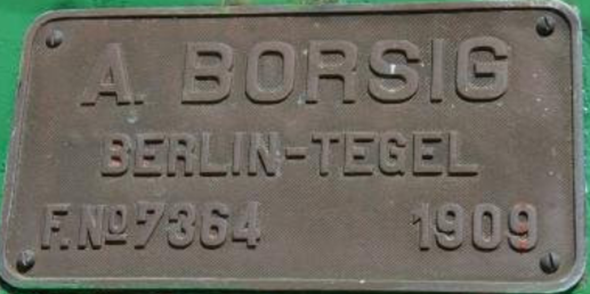
| Factory number | Builder | Works no. | Year | Type |
| AECI No. 1 | Borsig, Germany | 7364 | 1909 | 0-4-0F fireless |
| AECI No. 2 | Borsig, Germany | 8370 | 1912 | 0-4-0F fireless |
| AECI No. 3 | Borsig, Germany | 11796 | 1924 | 0-4-0F fireless |
The numbers behind the design tell their own story. A full charge could push the reservoir up to around 27 bar, with the water inside heated to roughly 200 degrees Celsius, though the cylinders themselves only ever worked at a fraction of that, closer to 10 bar. That drop in pressure between tank and cylinder was deliberate. It meant the locomotive could keep moving wagons long after the reservoir had cooled well below its original charge, squeezing hours of useful work from a single fill at the boiler house. Borsig built all three of Firgrove’s fireless engines as 0-4-0 machines, four coupled driving wheels and no leading or trailing wheels at all, a simple, sturdy arrangement suited to slow, heavy shunting rather than speed. The company behind them was no small operation either. Founded in Berlin, Borsig had grown by the 1870s into the largest locomotive builder in Europe, with works stretching from Berlin to Dortmund and Silesia and it would go on to produce over sixteen thousand steam locomotives before the last one rolled out of the factory in 1954. For an explosives works like Firgrove, though, what mattered most wasn’t the company’s reputation for speed or power, but this one modest design: no flame, no exhaust cinders, nothing but hot water and patience doing the work.
Between You and Me: I climbed on that locomotive in the Du Toit Street playground more times than I can count as a boy and I never once thought to ask what it was or where it came from. To me it was just a brightly painted iron shape to scramble over, not a machine that had spent decades hauling dynamite through one of the most dangerous factories in the country. I wonder how many other Strand children grew up the same way, playing on a piece of explosive history without a clue what they were sitting on.
Historian – Harmen Bockelenberg
Next week: the day the ground shook — the 1962 explosion that lifted the curtains in the Rialto Cinema and left a crater that looks natural now.




Be the first to comment