


Kultuur • Wyn • Skandaal • Tonge in die Kies
The Helderberg Blind Tasting Challenge ends in humiliation for the experts, a R49 Oom Tas Dry Red wins the evening, Sebastiaan does not take questions.
Die Helderburger organised the Helderberg Basin’s first independent blind wine tasting last Saturday, assembling five local wine experts, four self-described connoisseurs and one retired plumber named Fanus who came for the cheese. Twelve wines were tasted, scored and ranked. Wine A – described by the panel as “confident,” “complex,” and “almost certainly barrel-aged for a minimum of fourteen months”, was revealed at the evening’s conclusion to be Oom Tas Dry Red, available at Pick n Pay Strand for R49 a bottle, currently on promotion at R43.99 with a Smartshopper card. Wine L — scored last, described as “thin,” “agricultural,” and “possibly made from sadness”, retails at R420. The panel has requested that their surnames not be used. We are using their surnames.
Deur ons Kultuurkorrespondent, Marietjie Bosman
Maandag, 28 April 2026
The evening was conceived in the spirit of honest inquiry. Die Helderburger, following its coverage of the Helderberg wine culture feature and the subsequent correspondence it generated, some of it from readers, most of it from one winemaker in particular, decided that what the Basin needed was not more tasting notes, but a test. A clean, blind, democratic test, in which the wine would have to stand on what it was rather than on what was written about it, what it cost or how it was described by a man in a linen shirt who had studied in Burgundy.
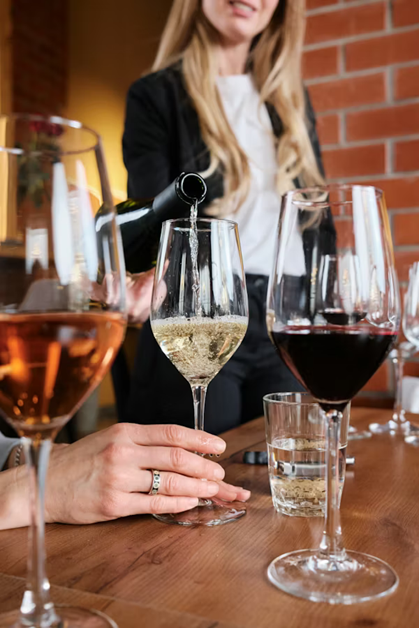
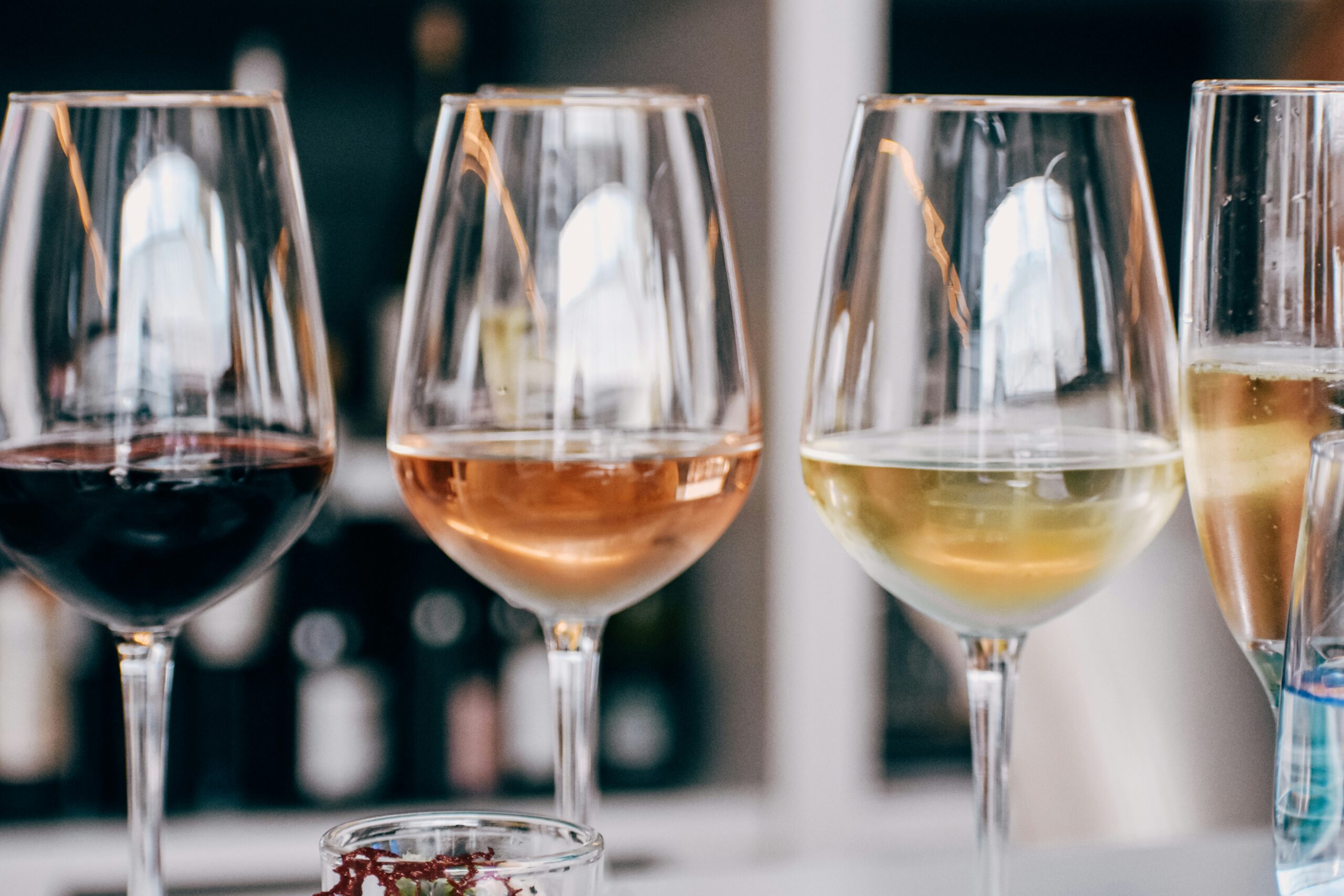
We booked the back room at the Strand Civic Hall. We sourced twelve wines; six red, six white covering a price range from R43.99 to R580 per bottle, decanted them into identical black-glass vessels numbered A through L and invited the judges. We provided bread – plain bread, not Carl’s bread, not the sourdough fermented for 72 hours, just bread from the Checkers bakery at R12.99 a loaf, which performed, it must be said, admirably.
We told no one which wine was which. This is, we were later informed by several of the judges, “not how serious tastings are done.” We took this as confirmation that we were doing it correctly.
I. The panel: a brief introduction
Five judges were recruited through the Helderberg Wine Appreciation Circle, which meets on the first Thursday of each month at a member’s home in Somerset West and which, its chairperson confirms, has “a rigorous selection process for new members,” by which she means she knows them all personally and they bring good bottles.
The five judges were:
Tarquin Adendorff, 38, Cape Town, self-described “natural wine evangelist” and frequent tasting room visitor;
Professor Elmarie du Toit, 57, Stellenbosch University, retired lecturer in Hospitality and Tourism Management, “wine has been my life since 1991”;
Gerhard Rademeyer, 62, Somerset West, retired banker, “I have a cellar of 340 bottles and I know what I’m doing”;
Yolanda Ferreira, 44, Gordon’s Bay, food blogger, 23,000 Instagram followers, captions her wine photographs with the single word “yes.”; and
Kobus Liebenberg, 67, Parel Vallei, retired civil engineer and chairman of the Lourens Street Traffic Circle Oversight Working Group, invited on the grounds that he attends everything and brings rigour to all proceedings.
The four self-described connoisseurs were members of the public who responded to a notice in this newspaper requesting “wine lovers with strong opinions and the courage of their convictions.” We received eleven applications. We selected four on the basis that they had described themselves as knowledgeable, which we felt created appropriate stakes.
Fanus Botes, 74, retired plumber, Somerset West, was present because his wife Elna was on the catering subcommittee and he “had nowhere else to be.” He was given a scorecard. He used it.
II. The tasting: a minute-by-minute account
The session began at 6:30pm with the white wines, served in the order A through F. The judges were asked to score each wine out of 20 on four criteria: appearance, nose, palate and finish and to add a brief tasting note. Scorecards were collected after each flight to prevent revision.
Wine A (the whites), produced the first notable moment of the evening. Tarquin swirled, sniffed, held the glass at arm’s length against the light, sniffed again and said, with the quiet authority of a man who has earned it: “Chenin. Definitely Chenin. Old vine. The nose is incredibly expressive, I’m getting white peach, honeycomb, a touch of ginger and something that’s almost oxidative in the best possible way. This is a serious wine.” He scored it 17/20.
It was Muscadel…
From a box…
Decanted into a bottle to disguise the packaging. Retail price: R38 for 1.5 litres or R19 per notional bottle equivalent. We had included it as a control. We had not expected it to score 17.
Reporter’s note: We decided at this point that the evening was going to be considerably more interesting than we had planned.
III. The scores: full results
| Wine | Panel’s tasting notes (selected) | Avg score | Actual wine | Price |
| A (Red) | “Confident. Complex. Barrel-aged minimum 14 months. Notes of dark plum, tobacco, graphite. This wine knows where it comes from.” – Tarquin “Structured. A serious red. Whoever made this understood tannin management.” – Prof. Du Toit | 17.4 / 20 | Oom Tas Dry Red | R49 (R43.99 Smartshopper) |
| B (Red) | “Pleasant. Approachable. A crowd-pleaser. Not challenging.” – Yolanda “My neighbour would like this.” – Gerhard (not a compliment) | 14.1 / 20 | Kleine Zalze Cabernet Sauvignon 2021 | R185 |
| C (Red) | “Interesting. I detect a certain wildness, is this natural? There’s a funk here I find exciting.” – Tarquin “Smells like my garage.” – Fanus | 13.8 / 20 | Lourens Valley Pétillant Naturel (Sebastiaan’s) | R380 |
| D (White) | “Honeycomb. Ginger. Oxidative in the best way. Old vine Chenin, surely.” – Tarquin (17/20) “Nice. Very sweet. Like my ouma’s kitchen.” – Fanus (16/20) | 15.9 / 20 | Muscadel from a box (decanted) | R38 / 1.5L box |
| E (White) | “Lean. Mineral. The saline tension speaks to granitic soils.” – Prof. Du Toit “Tastes like water that tried.” – Kobus | 13.2 / 20 | Berg&Sicht Lumière du Sol Chenin Blanc (Sebastiaan’s) | R285 |
| L (Red) | “Thin. Aggressive tannins. Agricultural. Possibly made from sadness.” – Tarquin “Something is wrong with this wine or with me.” – Gerhard “No.” – Yolanda (her only note) | 7.3 / 20 | Annandale Slopes “The Shepherd’s Narrative” Pinotage (also Sebastiaan’s) | R310 |
Note on the full results: Wines F through K are available in the full scoring supplement on page 8. Key findings: a R95 Woolworths own-label Sauvignon Blanc finished fourth overall; a R580 limited-release Stellenbosch Bordeaux blend finished ninth; Kobus scored every wine between 11 and 13, which he defended as “consistent and defensible”; and Fanus, who scored on gut feel alone and admitted he “didn’t smell any of them,” finished with the highest inter-judge correlation to the final consensus ranking, which none of us know what to do with.
IV. The reveal: a scene reconstruction
The reveal took place at 8:45pm, after the scoring sheets had been collected, tallied and checked twice by Kobus, who had brought a calculator and a clipboard and who confirmed the results “under protest about the methodology, which I have noted separately.”
This reporter stood at the front of the room with the results board (a whiteboard), rented from the civic hall and revealed the wines in reverse order, from twelfth to first. The room was, by this point, warm and moderately lubricated and there was the particular atmosphere of an audience that has committed to a position and is beginning to sense it may have been wrong.
Twelfth place: Wine L, described as “made from sadness”, was revealed as Sebastiaan’s Pinotage at R310. There was a brief silence, followed by what Tarquin later described as “a recalibration moment.” Sebastiaan, who had been invited to attend the reveal as a guest and was seated at the back of the room with what had up to that point been a glass of his own Chenin Blanc, put the glass down.
Fifth place: Wine E, “water that tried”, was Sebastiaan’s Lumière du Sol Chenin Blanc at R285. Sebastiaan picked up his glass and then put it down again.
Third place: Wine C, “smells like my garage” , was Sebastiaan’s Pétillant Naturel at R380. Sebastiaan stood up. He did not leave. He remained standing for the rest of the reveal in the manner of a man who has decided that sitting down would be a form of acceptance.
First place: Wine A. The winner. The wine described as confident, complex, barrel-aged, structured, serious and possessed of a tannin management that suggested genuine understanding. The wine that Tarquin, in a note that will follow him into retirement, described as “a wine that knows where it comes from.”
Oom Tas Dry Red. R49. On promotion at R43.99 with a Smartshopper card.
The room was quiet for approximately four seconds. Then Fanus said: “I knew it. I could taste the value.” He was the only person in the room who had said nothing definitive all evening and he said this with the serenity of a man who has never claimed to know anything about wine and has therefore never been wrong about it.
“I knew it. I could taste the value.”
— Fanus Botes, 74, retired plumber, highest inter-judge correlation score of the evening, came for the cheese
V. The trophy: a brief description
🏆
The Helderburger Blind Tasting Challenge
Inaugural Edition: “The Worst Was The Best” Trophy — 2026
Winner: Oom Tas Dry Red — Non-Vintage
R49.00 retail · R43.99 with Smartshopper · Average panel score: 17.4 / 20
“A wine that knows where it comes from.” — Tarquin Adendorff, judge, currently unavailable for comment.
Trophy is a repurposed pasta bowl with a label affixed. It will be displayed at the Pick n Pay Strand wine aisle by arrangement with the store manager, who thought this was “brilliant, honestly.”
VI. The reactions
Tarquin Adendorff, 38 – Judge, Natural Wine Evangelist, currently reconsidering several things
“I stand by my tasting notes. The wine I scored highest genuinely displayed the characteristics I described. What this result suggests is not that I was wrong, it suggests that Oom Tas, whatever its production methods, happened to express those characteristics on this particular evening. It’s actually quite interesting from a sensory science perspective. I would like to taste it again, properly, with context. I think context matters enormously. I’ve been saying this for years.”
Prof. Elmarie du Toit, 57 – Judge, retired Stellenbosch lecturer, wine has been her life since 1991
“Blind tasting is a humbling discipline. The greatest palates in the world have been fooled by blind tastings. There is documented evidence of Grand Cru Burgundy being mistaken for entry-level wine and vice versa. I am in excellent company. I would also note that I scored Wine A a 15, not a 17 and that Tarquin’s enthusiasm somewhat inflated the average, which I think is worth recording.”
Gerhard Rademeyer, 62 – Judge, retired banker, 340-bottle cellar
“I have nothing to say. I scored Wine A a 16. I wrote that it had ‘the confidence of a wine twice its price.’ It was R49. I would like to go home now.”
Yolanda Ferreira, 44 – Judge, food blogger, 23,000 Instagram followers
“I have not posted about this evening. I will not be posting about this evening. I scored Wine C, the Pétillant Naturel, a 14 and called it ‘funky and alive and full of intention.’ It finished third. Sebastiaan’s wine. I was right about the intention. The intention was R380. I need to think about some things.”
Kobus Liebenberg, 67 – Judge, LSTCOWG chairperson, scored everything between 11 and 13
“My scores were consistent and defensible. I have submitted a formal note to the organising committee regarding the methodology, which I believe was sound in principle but lacked a proper terms of reference document and a defined scope. The results are the results. I note that my score for Wine A was 12, which in the context of the panel’s results represents a moderate underperformance, but I maintain that 12 was the correct score for a wine that, at the time of tasting, I had no reason to believe was exceptional. I was, in a narrow sense, wrong. In a structural sense, I was appropriately cautious. I feel fine about it.”
Fanus Botes, 74 – Retired plumber, came for the cheese and free dop
“The cheese was good. The bread was also good. The wine was mostly wine. I gave the first one a 16 because I liked it and the last one a 4 because I didn’t and the rest were somewhere in between. I don’t know anything about wine. I have a Windhoek in the fridge at home. I’m going to have that now.”
VII. Sebastiaan: a separate section, as required
Sebastiaan Kriel of Berg&Sicht Estate left the Strand Civic Hall at 9:03pm without speaking to the reporter, which is his right and which we respect. He did, however, pause at the door long enough to say, to the room in general and no one in particular: “The panel tasted blind, without context, without food pairing, at an ambient temperature of approximately 22 degrees, which is three degrees above optimal serving temperature for both the Chenin Blanc and the Pétillant Naturel and which alone accounts for a significant portion of the aromatic suppression they experienced.” He then left.
He is not wrong about the temperature. We checked. It was 22 degrees. We have added this to the methodology notes for next year.
His email arrived at 11:47pm. It was 1,891 words long, 644 words longer than the previous record, set by himself. It covered, in order: the temperature issue (three paragraphs); the absence of food pairing (two paragraphs); the failure to rest the wines after decanting (four paragraphs, including a technical explanation of “bottle shock” that this reporter found, despite everything, genuinely interesting); the use of black glass vessels, which Sebastiaan argues “eliminates the visual component of the tasting, which is not a neutral act but an aggressive one”; the scoring methodology; the composition of the panel; the inclusion of boxed wine as “a category error that compromises the integrity of the entire exercise”; and, in a final paragraph of some intensity, the use of the word “agricultural” in Tarquin’s notes for Wine L, which Sebastiaan points out is “technically accurate in the sense that all wine is agricultural, but was clearly intended pejoratively, which I find both imprecise and personally hurtful.”
RE: Helderburger Blind Tasting | Multiple Methodological Concerns | Formal Response Required | RE Also The Temperature
Van:Sebastiaan Kriel <sebastiaan@bergsicht.co.za>
Aan:Marietjie Bosman <marietjie@helderburger.co.za>
Datum:Saterdag, 26 April 2025, 23:47
CC:info@bergsicht.co.za; sebastiaankreil@gmail.com; Werner (no surname given)
Editor’s note: He CC’d Werner. At 11:47pm. On a Saturday. I hope Werner was asleep.
Dear Ms Bosman,
I am writing regarding this evening’s tasting event, which I attended in good faith and which I must, with the greatest possible respect for your publication and for the work that clearly went into its organisation, describe as methodologically compromised in ways that are, I’m afraid, not minor. I will address them in the order of their severity, beginning with the temperature, which I consider most urgent.
Editor’s note: “Beginning with the temperature, which I consider most urgent” is a sentence I will be thinking about for some time.
The room temperature at the Strand Civic Hall this evening was, according to my own measurement using the thermometer I keep in my tasting kit, yes, I carry a thermometer, this is not unusual, this is professional – approximately 22 degrees Celsius at the time of tasting. The optimal serving temperature for a Chenin Blanc of the style and age of my Lumière du Sol is between 10 and 13 degrees. The optimal serving temperature for the Pétillant Naturel is between 8 and 11 degrees. At 22 degrees, the aromatic compounds in both wines, the very compounds that distinguish them as wines of place and intention rather than commodity product are suppressed, flattened and in some cases volatilised entirely. This is not speculation. This is chemistry. The difference it makes to the tasting experience is not minor. It is, I would argue, fundamental.
Editor’s note: There it is. Fundamental. I have been waiting for it since paragraph one. It arrived in paragraph two. He is consistent. I will give him that.
I would also note that the Oom Tas Dry Red, which, I am informed, won the evening was a wine that is designed, by its producers, to be consumed at room temperature, is formulated to be stable and expressive across a wide range of serving conditions and is, in the most direct possible sense, engineered for exactly the kind of environment in which your tasting took place. This is not a compliment to Oom Tas. It is a description of what mass-produced commercial wine is for. That it performed well under these conditions tells us something about the conditions. It tells us nothing about the wine.
Editor’s note: This is actually a sophisticated argument. I remain annoyed by it, which suggests it may be correct.
Regarding the “agricultural” descriptor applied to my Shepherd’s Narrative Pinotage by one of your judges: I want to address this calmly and without rancour, which I am finding difficult, but I will try. All wine is agricultural. Every bottle of wine that has ever existed, from the Grand Cru vineyards of Burgundy to the Oom Tas facility in Paarl, began as an agricultural product. Using the word “agricultural” as a pejorative in a tasting context is therefore not a tasting note. It is a class judgement disguised as a tasting note. I would ask that your publication consider whether this kind of language reflects the values it wishes to uphold. The wine may not have been to the judge’s taste. That is entirely his prerogative. But “agricultural” is not a flavour. It is a dismissal. The difference is fundamental.
Editor’s note: Fundamental count for this email: 3 and we’re not done. Also, he is right about “agricultural.” I am not going to tell Tarquin this.
I want to end on a note that is, I hope, constructive. I believe in what I do. I believe in the wines I make. I believe that the Helderberg is producing world-class wine and that the story of this region deserves to be told accurately, with appropriate context and with the understanding that a wine tasted blind, warm, without food, by a panel that includes a retired plumber who came for the cheese, is not being judged fairly.
Editor’s note: Fanus’s credentials have been formally questioned. Fanus will not care. Fanus is having a Windhoek.
I would welcome the opportunity to host your panel properly, at Berg&Sicht, at the correct temperature, with appropriate accompaniments and context for a follow-up tasting that I believe would produce very different results. I will not charge for the wines. I will ask only that the methodology be sound, the temperature be monitored and that no boxed Muscadel be included under any circumstances.
Editor’s note: He has invited us back. He is already preparing the rematch. This is either admirable or alarming. Possibly both.
With respect and in the enduring hope of accurate discourse,
Sebastiaan Kriel
Winemaker & Proprietor, Berg & Sicht Estate
“Wine is a conversation the vine begins and the winemaker tries not to interrupt.”
(Serving temperature: 10–13°C. Always.)
Editor’s note: He has added the serving temperature to his email signature. He updated his signature at 11:47pm on a Saturday to include the serving temperature. I do not have words for this. I have only admiration.
↩ Editor’s Reply — Sent Sunday 27 April 2026, 08:02
Dear Sebastiaan,
Thank you for your email. We will note the temperature issue in the methodology. The rematch sounds interesting. Kind regards,
Marietjie Bosman
Editor’s note: We accepted the rematch. I don’t entirely know why. I think it’s because by the end of the email I had started to respect him again, which keeps happening and which I find both inconvenient and probably correct.
VIII. What it means: a short reflection
The Paris Tasting of 1976, in which Californian wines beat French wines in a blind tasting judged by French experts, changed the wine world. Steven Spurrier, who organised it, spent years being thanked and vilified in roughly equal measure. The French experts disputed the results for decades. Two of them asked for their scores back.
The Strand Civic Hall Tasting of 2025 will not change the wine world. It will, however, be discussed at Helderberg dinner tables for some time and at the Helderberg Wine Appreciation Circle’s next Thursday meeting and in a follow-up email from Sebastiaan that is currently, sources confirm, “in draft.”
What it means is both simple and uncomfortable: we taste with our eyes, our wallets and our reputations as much as with our mouths. Take away the label, the price, the linen shirt, the slate board, the serving temperature discourse and the tasting note that describes the finish as geological — and what remains is the wine itself, which occasionally turns out to be R49 and excellent and occasionally turns out to be R380 and smells, to a retired plumber with no pretensions and excellent inter-judge correlation, like a garage.
Fanus did not stay for the debrief. He had a Windhoek waiting. He was, by any available measure, the wisest person in the room.
The Helderburger Blind Tasting Challenge will return in 2027. Sebastiaan has confirmed his participation “on condition that the temperature is controlled, the methodology is documented and the boxed wine is excluded.” We have confirmed the first two conditions. We have made no commitment regarding the third. We feel the boxed wine earned its place.
Regstelling: ‘n Vroeër weergawe van hierdie artikel het aangedui dat Fanus “niks van wyn weet nie.” Fanus het ons per telefoon laat weet dat hy “baie jare lank ‘n Oom Tas man” was en dat hy dit dus “redelik goed ken.” Die Helderburger aanvaar die korreksie en erken dat dit, in die lig van hierdie aand se resultate, ‘n kwalifikasie van beduidende gewig is.
Correction: An earlier version of this article indicated that Fanus “knows nothing about wine.” Fanus informed us via telephone that he was “an Oom Tas man for many years” and therefore knows it “fairly well.” Die Helderburger accepts the correction and acknowledges that, in light of tonight’s results, this is a qualification of significant weight.
Marietjie Bosman het hierdie artikel geskryf na ‘n aand van aansienlike insig en ‘n glas Oom Tas wat sy, in die belang van joernalistieke integriteit, by die huis geniet het en wat sy moet erken behoorlik was. Sebastiaan se tweede e-pos is op Sondag om 14:23 ontvang. Dit is 2,103 woorde lank. Ons sal dit in ‘n volgende uitgawe hanteer. Werner het nog nie gereageer nie. Tonge in die Kies, maar ons meen dit oor die Oom Tas.
Marietjie Bosman wrote this article after an evening of considerable insight and a glass of Oom Tas which she, in the interest of journalistic integrity, enjoyed at home and must admit was proper. Sebastiaan’s second email was received on Sunday at 14:23. It is 2,103 words long. We will deal with it in a future edition. Werner has not yet responded.
Be the first to comment