

STORY 89
On the corner of Conradie Street and Main Road in Strand, where FNB stands today, unremarkable, air-conditioned, dispensing cash to people who give the building no particular thought, something happened on an ordinary afternoon in the mid-1970s that a thirteen-year-old boy from the Helderberg never forgot.
The South African Defence Force had set up a public display. This was entirely normal for the era. The Border War in South West Africa was escalating through the 1970s and the SADF ran community engagement events in towns across the country, weapons on display, vehicles to climb on, soldiers to answer questions, pamphlets about service opportunities for young men who were, in any case, going to be conscripted eventually. The implicit message was always the same: here is your army, here is what it does, here is why it matters. The explicit audience was always the same too, teenage boys, who were several years away from their call-up papers and who needed to understand, in the way that governments have always understood, that the military was something worth being part of.
The boy who stood on Conradie Street that afternoon did not need much persuading. This was 1975 or 1976, the years when Angola was in the news, when South African forces had crossed into that country and withdrawn again, when the Border War had stopped being an abstraction and had become something with place names and casualty figures. Every teenage boy in the Helderberg understood that the war was real and that they would one day be part of it. The military display on Main Road in Strand was, for a thirteen-year-old, the most exciting thing that had happened in the town in recent memory.
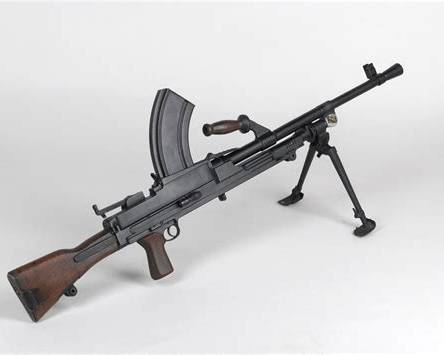
The South African military had been converting its stock of Bren guns from .303 to 7.62mm NATO calibre between 1972 and 1976, recommissioning weapons that had sat in storage since the Second World War, bringing them back into active service for the Border War. A Bren on public display in Strand in 1975 or 1976 was not a museum piece. It was a current service weapon, recently overhauled, the same gun that South African soldiers were carrying in the bush of South West Africa at that moment. It sat on its bipod on the pavement of Conradie Street with the particular authority that a real weapon carries when you are thirteen years old and have never stood this close to one.
The soldier demonstrating the Bren was going through the drill of stripping and reassembling the weapon, the standard public demonstration, designed to show the mechanical elegance of the gun, the speed with which a trained soldier could break it down and put it back together. The crowd gathered around him. The boy stood at the front, close enough to see the parts clearly, watching the soldier’s hands move through the sequence.
What the soldier did not know, what no one in that crowd knew until it was too late, was that a round remained in the chamber.
The gun went off.
The sound of a Bren firing on a city street corner is not a sound that is easily described to someone who has not heard it. It is not a small sound. In the enclosed space of a street, with buildings on both sides, it is enormous. The round went into the air. One person was injured, possibly two. The crowd scattered in every direction simultaneously, with the particular explosive dispersal of a crowd that has just understood it was standing next to something dangerous.
The thirteen-year-old boy ran. He ran hard and he ran fast and he did not stop until he had put a considerable distance between himself and Conradie Street. He was later found, questioned by police and gave a statement as a witness to the incident. He had seen the whole thing from the front of the crowd.
He was not badly affected, physically. The injury he carried away was of a different kind, the sudden, specific, irreversible knowledge that weapons were not demonstrations and not displays and not the exciting objects they appeared to be from a safe distance. They were things that went off. They were things that hurt people. The gap between a controlled demonstration and a real event was exactly one round left in a chamber by a soldier who had made a mistake.
That lesson, learned on a Strand street corner on an ordinary afternoon, stayed with him into his national service years and beyond. Not as fear. As understanding. There is a difference.
The corner of Conradie and Main Road looks nothing like it did that afternoon. The building is a bank. The pavement is unremarkable. There is no plaque.
There doesn’t need to be. Some lessons are carried in the people who learned them.
Between You and Me:
One round, left in a chamber, by a soldier doing a routine demonstration to a crowd of schoolboys. That is the entire mechanism of the story, not malice, not a system failure, just one small human error in an otherwise unremarkable afternoon. I think about how much of history actually works this way. Not grand causes and inevitable forces, but one small thing that someone forgot to check, intersecting with a crowd of people who happened to be standing in the wrong place at the wrong moment. The thirteen-year-old who ran from Conradie Street carried that lesson into a decade where the stakes kept getting higher. He was lucky that the lesson arrived early, on a street corner, rather than later, somewhere it would have mattered more.
Historian – Harmen Bockelenberg
Next week: when the war came to us a Friday afternoon in Pretoria, a post office at three in the morning and the moment the Border War stopped being something that happened to other people.

Be the first to comment