
STORY 69
There are days in a nation’s life that divide time into before and after. In South Africa there have been a handful of them. The day Jan van Riebeeck’s ships anchored in Table Bay in 1652. The day the British defeated the Dutch at Blaauwberg in 1806. The day the National Party came to power in 1948. And then, on 27 April 1994, the day that all of those previous days were finally answered.
Democracy arrived in the Helderberg on a Tuesday morning, in a queue.
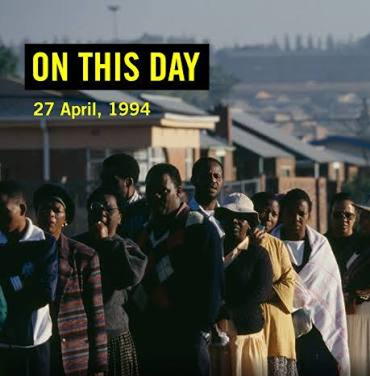
On 27 April 1994, voters stood for hours in queues often stretching over a kilometre long to vote in South Africa’s first democratic election. Around 20 million South Africans queued over a four-day voting period, with an 86.9 percent voter turnout. In a country with a history of political violence, of bombings and assassinations and right-wing threats right up until the final weeks before the vote, the overwhelming mood of that day was not fear. It was something much harder to manufacture and much more surprising.
Nobel Peace Laureate Desmond Tutu said the day felt like falling in love. FW de Klerk, apartheid South Africa’s last president, described it as our proudest moment as South Africans.
In the polling stations of Somerset West, The Strand and Gordon’s Bay, people who had lived side by side for decades who had shopped in the same supermarkets, whose children had played on the same beaches, who had watched the same mountain from different sides of a legally enforced divide stood in the same queue for the first time. Some of those queues stretched around the block and beyond. People brought folding chairs. They brought food. They talked to their neighbours sometimes, for the first time.
Some voters waited more than twelve hours to cast their ballot. Nobody left. Nobody that your author heard of, in the Helderberg or anywhere else, said it wasn’t worth the wait.
For white South Africans of the Helderberg, the Afrikaner families with Huguenot surnames who had farmed this valley for three centuries, the English-speaking retirees who had come for the mountain and the climate, the Lithuanian Jewish shopkeepers’ grandchildren who had grown up here. the day carried a complicated mixture of emotions. Relief for many, that the years of isolation and international condemnation were ending. Anxiety for some, about what came next. Pride for a few, who had quietly opposed what was being dismantled. And for others, a private grief over a world that was changing faster than they had prepared themselves for.
For the coloured community of Macassar, whose roots in this valley ran back to the slave ships of the 1600s, for the workers of Lwandle, separated for decades from their families by a law that had treated them as units of temporary labour rather than human beings, for every person in the Helderberg who had been told by a sign or a law or a policeman that they were in the wrong place, the queue on that Tuesday morning was something different. It was the first time in their lives that the country had officially acknowledged their full humanity.
The Western Cape, it turned out, voted differently from most of the country. The ANC lost to FW de Klerk’s National Party in the Western Cape, a major province without a black African majority. The coloured majority in the Western Cape did not feel drawn to the ANC and chose instead to vote for the party they knew. The National Party won 53.25 percent of the Western Cape provincial vote. The ANC won 33 percent.
That result made the Western Cape an outlier, one of only two provinces not won by the ANC nationally. It was a complicated signal from a complicated community. The coloured voters of the Cape, the descendants of the Khoikhoi, the slaves, the Huguenots and the free burghers, the people whose identity had been assigned to them rather than chosen, voted with their own calculus, their own fears, their own reading of what the future held. They were not wrong to have their own view. They had earned it.
On 10 May 1994, Nelson Mandela was inaugurated as the first black President of South Africa at the Union Buildings in Pretoria. In sitting rooms in Somerset West, in The Strand, in Gordon’s Bay, in the farmhouses of Lourensford and the flats above the shops on Main Road and the hostels of Lwandle, people watched a man who had spent 27 years in prison walk up those steps and take the oath of office.
Whatever you felt about it and people felt many different things, it was impossible not to understand that you were watching history happen.
The Helderberg that woke up on 28 April 1994 was officially the same place it had been on 26 April. The mountain had not moved. The sea had not changed. The wine estates were still there, the camphor trees at Vergelegen still standing, the fynbos still flowering on the slopes of the reserve.
But something fundamental had shifted. The long shadow that had fallen across this valley and across every valley in South Africa since 1948, had lifted. What would grow in the light was still unknown. It would take years to find out. It is still being found out.
The queue had been the easy part.
Between You and Me:
I stood in a queue on 27 April 1994. It was long. It moved slowly. The person behind me and the person in front of me were both strangers and we talked, the way people talk when they are doing something together that they understand to be significant. What struck me most was not the length of the queue or the waiting or the voting itself, it was the silence when I was actually in the booth. The particular silence of a decision that has been a long time coming and is finally, in this moment, yours to make. I have voted in many elections since. None of them have had that silence. I do not think they ever will again. You only get one first time.
Historian – Harmen Bockelenberg
Next week: what’s in a name the long conversation the Helderberg had with itself about what to call its home.

Be the first to comment