
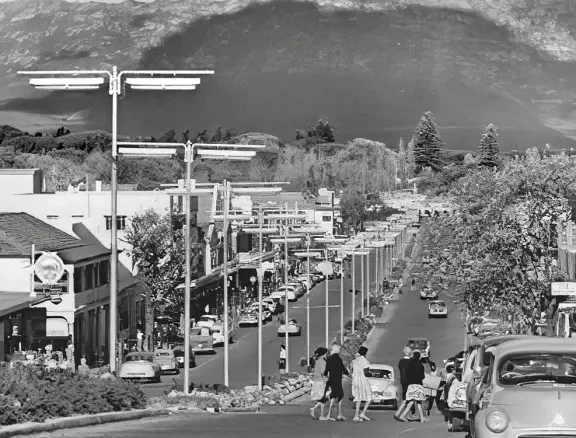
Somerset West’s economy was built on a network of small businesses and agricultural enterprises, with Victoria and Main Road serving as its supply route. General dealers met the everyday needs of residents and farmers. Blacksmiths, wagon makers and saddlers supported a transport economy still running on horse and cart, while butcheries, bakeries, inns and hotels provided the services a growing community needed. Estate agents, too many to mention individually, appeared alongside all of it. Together these businesses formed the commercial foundation from which old Somerset West grew into the industrial development and modern shopping centres of today. A handful of landmark businesses remain, at least in memory, to this day.
Central Stores was one of the town’s best known early retail landmarks and an important part of community life in old Somerset West. Situated in the Main Road shopping area, it served generations of local residents at a time when the town still had a strong village character and shopping centred on independent family businesses rather than large modern malls. As Somerset West grew from its nineteenth century farming origins into the commercial centre of the Helderberg region, Central Stores became a familiar meeting place where residents bought everyday household goods and found the personal service that traditional general stores were known for. Changing shopping patterns and the rise of larger retail centres eventually transformed the town’s commercial landscape, but Central Stores is still remembered as a symbol of a slower paced era in Somerset West’s history.
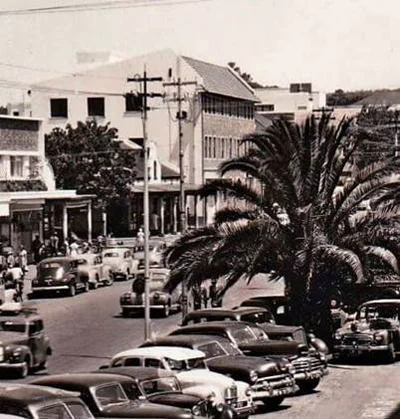
The town’s civic life was built in brick and stone rather than shopfronts. The Town Hall, designed by architect George Leonard Murray, went up in 1933 on the corner of Main Road and Church Street, a solid civic statement at the heart of the town. Nearby, at 126 Main Street, the old Magistrate’s Office had already been doing double duty since 1898, serving as both post office and magistrate’s court after Somerset West was declared an Assistant Magistracy, long before the modern court on Caledon Street took over that work. The police station rounded out the trio, the buildings where the actual daily business of running a town, licences, disputes, permits, arrests, got done, the sort of buildings a town stops noticing precisely because they have always been there.
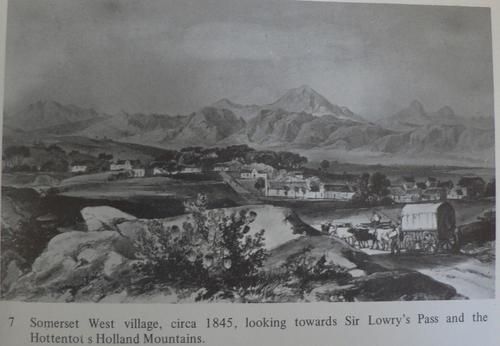
The churches tell an older story still. The first Dutch Reformed congregation at the Cape was established in 1819, three years before the town itself was formally founded and the building it worshipped in on Church Street, consecrated in 1820, remains one of the finest examples of Cape Dutch church architecture anywhere and a recognised Provincial Heritage Site. The congregation eventually outgrew it and in 1962 built the larger church on Andries Pretorius Street that still serves as the mother congregation’s home today. The Methodist story runs alongside it and cuts closer to the town’s harder history. In 1834, the year slavery was formally abolished at the Cape, the missionary Barnabas Shaw bought land in Somerset West and converted an old wine cellar into a chapel, a sanctuary built specifically for the newly freed. The congregation grew quickly enough that a permanent Gothic Revival church replaced it in 1861 and that building still stands today, though a partial structural collapse in 2010 required extensive restoration before it reopened in 2014. Attached to that Methodist mission was a school, the Wesleyan Methodist School, said to be the oldest school in the Helderberg, teaching long before Somerset West Primary and Hottentots Holland High School became the names most residents would now recognise.
My own family had a stake in the town’s commercial life too. My uncle ran a photographic studio in Somerset West that housed the only colour developing laboratory outside of Cape Town, a genuine rarity at the time and a small point of local pride, since it meant, a customer did not have to send a roll of film all the way into the city and wait a week to see whether the photographs had come out.
N. Hodge & Company has been part of Main Road’s fabric since Norman Hodge founded it on Caledon Street. His son Peter joined the business and eventually took it over and his grandson Andrew followed after him, making Hodge’s a rare three generation family business in a town where most of the old family names on the shopfronts have long since changed hands. Michael James built his own name in the property world from an office on Victoria Street and around town he was known for arriving to view or show a property by helicopter, the kind of detail that tends to outlive the actual property deals in local memory.
The Beehive Café and Ye Old Bell sat on the hill in Main Road and was, for as long as anyone can remember, simply where people went, a landmark less because of what it served than because of where it was, visible from half the town, a fixed-point people used to give each other directions. Luigi’s kept a different kind of hours, selling takeaways late into the night long after the rest of Main Road had closed up, the place you ended up at when everything else was shut. Rishian & chips, pies, the staple food of teenagers. And the old bridge, crossing the river that runs through the town, has carried generations of Somerset West residents back and forth without most of them ever stopping to think about who built it or when. Now more a landmark is the Old Bridge Tavern. One hardly notices the bridge.
Moving further up the mountain slope past De Hoop school where the Spar is situated just off the Old Stellenbosch Road was the Cylnor Hotel.
Between You and Me:
The development of the AECI land has changed and sculptured the identity of this town into what it is today, unrecognisable in comparison to the 1970s.
Historian – Harmen Bockelenberg
Next week: Gordon’s Bay’s own Main Road, the harbour town’s shops and gathering places before it became a byword for holiday houses and boat launches.


Be the first to comment