

A Monthly Grief Cycle
The Motoring Desk documents South Africa’s most reliably disappointing monthly ritual and the five stages through which Somerset West receives it
By our Motoring Correspondent, Kobus Liebenberg
It comes on the first Wednesday of the month.
Not always the first Wednesday, technically — the Department of Mineral Resources and Energy announces the new retail fuel price with a lead time that varies and is never quite when you expect it — but in the collective consciousness of Somerset West it arrives on a Wednesday, in the morning, in the way that bad weather arrives: you knew it was coming and it is still somehow a surprise.
The Helderburger Motoring Desk has observed the petrol price announcement cycle for several years and has identified, with considerable confidence, five distinct stages through which the Somerset West community processes it. We present them here as a public service and in the hope that naming the stages makes them slightly easier to bear.
STAGE ONE: PRE-ANNOUNCEMENT INTELLIGENCE
In the days before the official announcement, the information is already available to anyone who knows where to look. The Central Energy Fund publishes weekly data. The rand-dollar exchange rate is observable. The Brent crude price is a matter of public record. With a small amount of arithmetic, any motivated person can estimate the coming adjustment with reasonable accuracy.
This information is available. It is also entirely ignored by the emotional processing system, which will not accept the estimate as real and insists on waiting for the official number before beginning the grief cycle.
We have tried to estimate in advance and process the information early. It does not work. The brain refuses to grieve a petrol price increase until the petrol price increase has been officially confirmed. This is not rational. This is how we are made.
STAGE TWO: THE NUMBER
The number arrives. You see it on your phone, on the news, at the Engen where it is already posted on the board in fresh digits. The number is specific. The number is actual. The number will appear on the pump on the first of the month with the indifference of arithmetic.
For approximately thirty seconds after seeing the number, you do the primary calculation: what your usual fill costs now versus what it cost last month. This is a simple multiplication and its result is always worse than you expected, even though you already knew the number and could have done this calculation in advance.
The primary calculation produces a figure. The figure produces a feeling. The feeling is the beginning of Stage Three.
STAGE THREE: THE ARITHMETIC
Stage Three consists of extended arithmetic that is always performed and never leads anywhere useful.
The arithmetic begins with the monthly fuel bill and expands outward to encompass: the annual fuel bill, the accumulated increase over the past three years, what the annual fuel bill would be if you drove less, what it would be if you worked from home, what it would be if you had bought an electric car when André first suggested it three years ago, what the total amount of money you have spent on fuel over your entire driving life amounts to and what you could have done with that money if it had been invested in 1987 instead.
This final calculation produces a number so large and so irrelevant that it briefly destabilises your entire sense of financial history before dissolving into the more manageable unhappiness of the actual monthly increase.
Fanus Botes told us he does not do the arithmetic. He said he knows the number, he knows it’s too much and that is all he needs to know, and further arithmetic only makes it worse without making it better. He has driven to the Engen, he has paid the new price and he has got on with his life.
We asked Fanus if he wasn’t at least a little curious about the accumulated total. He said he was not, and that some doors are better left closed.
We respect this. We are not yet capable of it.
STAGE FOUR: THE VOW
Stage Four is the vow to drive less. It is made sincerely, in the moment, with full intention. The vow contains specific commitments: to combine errands into a single trip, to walk to the shop when it’s close enough, to work from home on Fridays, to stop idling, to check tyre pressure — Sipho’s recommendation, finally actioned — because properly inflated tyres improve fuel economy by a meaningful percentage.
The vow is held, on average, until Thursday.
Not because we are weak-willed — we are, broadly, a community of reasonable intentions — but because the vow was made in the abstract and the errands are concrete. The school pickup is at 3pm. The dry-cleaning is in Strand. The thing you need from the hardware store is not available online and you’ve been meaning to go for two weeks. By Thursday the vow has been quietly folded away until next month’s announcement, when it will be made again with equal sincerity.
STAGE FIVE: ACCEPTANCE
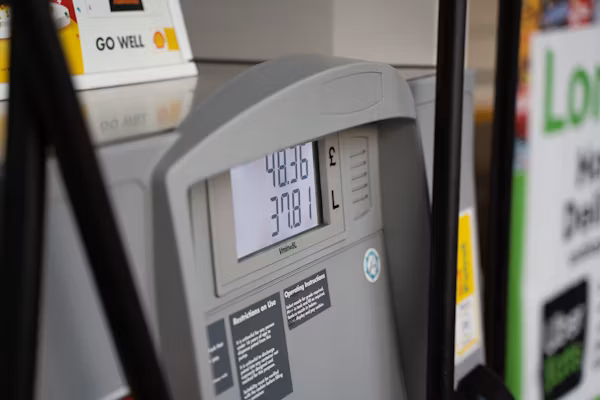
On the first of the month the new price appears on the pump. You tap your card. The number on the display climbs to wherever it climbs to. You return the nozzle, collect your slip and drive away.
There is, at this point, a specific feeling that is not quite peace but is its practical equivalent: the recognition that the thing has happened, that you have absorbed it and that you will, as you always have, manage. Somerset West has been managing petrol price increases since the 1970s. It will continue to manage them. The car will be filled. The roads will be driven. The school pickup will happen and the errands will be run and Fanus Botes will have been to the Engen and returned and gotten on with his life without doing the arithmetic.
We will do the arithmetic one more time. Just to see. And then we will also get on with it.
CONCLUSION
The petrol price announcement is South Africa’s most reliably disappointing monthly ritual and the five stages above are its reliable consequence. They do not shorten the grief cycle. They do not reduce the final number on the pump. They simply describe what is happening so that you can observe yourself going through it with the mild comfort of recognition.
Next month it will happen again. We will be here.
Meneer Swanepoel, for the record, says the price per kilometre is what matters, not the price per litre, and that if you calculate by distance the emotion is easier to manage. He suggested we try it.
We have tried it. The emotion is not easier to manage. It is just a different number.
The Helderburger Motoring Desk fills up on the last day of the month wherever possible. This is irrational, saves nothing and makes us feel marginally better. We have decided this is sufficient justification.
Corrections: A previous column described parallel parking on Main Road as requiring “conditions of complete personal silence.” A reader writes to say she parallel parks while listening to a podcast at full volume and does so without difficulty. We accept this correction and note that she is a more settled person than we are.

Be the first to comment