

STORY 76
Most people who drive across it are thinking about something else entirely.
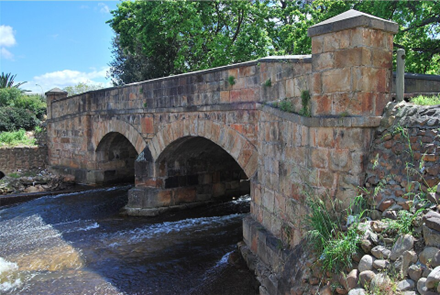
There is a bridge over the Lourens River that is believed to be one of the oldest surviving built structures in the Helderberg. Not the most dramatic. Not the most visible. Just old quietly, stubbornly, persistently old in a landscape where most things have been demolished and replaced and built again and replaced again.
The Lourens River was always the primary natural obstacle for travellers moving between the farms of the interior valley and the coastal settlements at Strand and beyond. Before any bridge existed, the river was forded at low water, a crossing that was manageable in dry season and deeply hazardous in winter, when the mountain sent its runoff down the kloofy slopes and the river rose fast and cold and wide. The 1953 flood, the worst on record, would have obliterated any ford entirely. Even in ordinary years, the crossing was unreliable.
The need for a permanent crossing was not merely convenient. It was economic. The farms upstream needed to get their produce to market. The market was downstream and across the river. A reliable bridge meant a reliable income.
The bridge that stands today or the remnant of it that carries provincial heritage designation was built in the nineteenth century. The exact date is contested. Provincial heritage records note its significance as a surviving example of early colonial road infrastructure in the Western Cape. The materials are the obvious ones: local stone, lime mortar, the same construction logic that built the wine cellars and farmhouses of the valley.
Stone bridge construction in the Western Cape followed Dutch and British engineering traditions, both of which had been building arch bridges in Europe for centuries and both of which adapted those traditions to local materials and local conditions. The bridges they built were not elegant. They were functional. Low parapets, shallow arch, wide enough for a wagon. Built to survive floods, not to be photographed.
This one survived them. The 2013 floods that inundated Main Street in Somerset West and forced the evacuation of Vergelegen Mediclinic also raised the Lourens to its second-highest recorded level. The old bridge was still there afterwards.
The provincial heritage designation that protects it came after a broader recognition in the Western Cape of what had been lost and what remained of the infrastructure of the first two hundred years of colonial settlement. Bridges, particularly, were vulnerable. They were repaired, widened, supplemented and eventually bypassed by newer crossings. Many simply disappeared under new road surfaces or were demolished when the roads they served were upgraded.
The old Lourens River bridge survived because it was not in the way. It was not the main crossing. It was not on the primary road that needed widening. It sat in the valley, carrying whatever small traffic used it, attracting little attention from engineers with upgrade budgets.
That inattention preserved it.
There is something worth considering in that. The Helderberg has lost most of its early built heritage, farms demolished, outbuildings cleared, wells filled in, slave quarters erased without record. The old bridge remains, not because anyone particularly set out to save it, but because no one got around to destroying it.
Now it is protected. Now it has a heritage plaque. Now people know to notice it.
Most of them are still thinking about something else when they cross it.
Between You and Me:
The old bridge survived because nobody got around to destroying it. I have thought about this sentence a great deal since writing it, because it might be the single most accurate description of how heritage actually survives anywhere. We like to imagine that the things which last do so because someone, at some point, made a deliberate decision to preserve them. Often the truth is the opposite: they last because they were inconvenient to remove or out of the way or simply not worth the bother of demolishing. Preservation, in this telling, is not always an act of foresight. Sometimes it is simply an accident that nobody corrected in time. The bridge is still there. That is enough.
Historian – Harmen Bockelenberg
Next week: the railway arrives in the Helderberg and the branch line that was never built.

Be the first to comment