

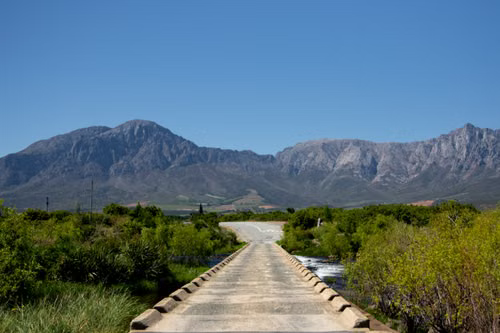
A farm is a piece of land with a name. The name usually tells you something: about the man who named it, the landscape he found there, the feeling the place gave him on the morning he arrived and decided to stay. The Helderberg valley’s early farms have names that carry three centuries of accumulated history in them, if you know how to listen.
Vergelegen — situated far away, was the name Willem Adriaan van der Stel gave to the thirty thousand hectares he illegally occupied in 1700. He was right about the distance, three days from Cape Town by ox-wagon. He was wrong about everything else. The estate was broken up by government order in 1707, reduced to a fraction of its original size and passed through several owners before Anglo American Farms took over in the twentieth century. Today it is one of the most visited wine estates in the Western Cape, its camphor trees, five of them, planted by van der Stel himself, now national monuments. The homestead has been carefully restored. The gardens are maintained. The history is acknowledged. Flora, the slave whose remains were discovered by UCT archaeologists in 1990 and reburied in 1991, lies here.

Lourensford — established after the breakup of the Vergelegen estate, the name came from Laurens Campher, one of the early grantees of the land. The farm sits at the head of the Lourens River valley, spreading up into the Helderberg slopes and spanning over four thousand hectares of forest, fynbos orchards and vineyards. The first traces of human activity in the Hottentots Holland Valley are found at Grootnek and Uitzicht, situated in the heart of Lourensford Estates, early and middle Stone Age artefacts leached out of the soil by winter rains. Three hundred years of wine and fruit farming on top of two hundred thousand years of human presence.
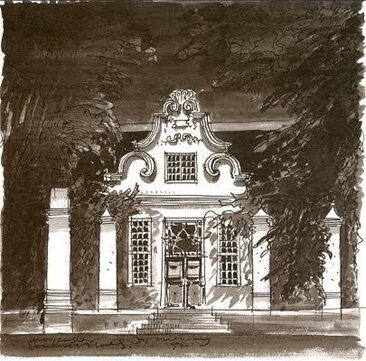
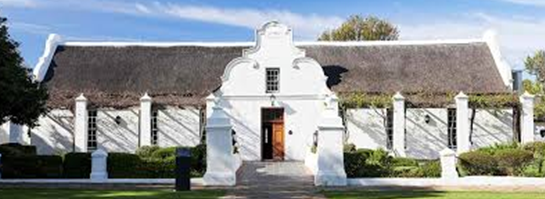
Morgenster — the morning star, takes its name from the motif above the front door of the Cape Dutch homestead: a carved morning star in the gable that has looked out across the valley since the eighteenth century and now appears on the estate’s wine labels. Morgenster was first purchased by French Huguenot Jacques Malan in 1711. He named the farm and fourteen years later passed it down to his only surviving son Daniel, who had thirteen children. The wine cellar, farmhouse and outbuildings were passed down to Daniel’s son Jacobus, whose widow constructed the six famed Cape Dutch gables on the house, including one of the greatest examples of the holbol style. A Huguenot refugee built it. His widow gave it the architectural form it still carries. In 1991, Italian entrepreneur Giulio Bertrand bought the farm and brought his Piedmontese passion for olive oil alongside the wine, the combination that defines Morgenster today.
Cloetenburg — named for Catherine Cloete, who in 1720 bought this portion of the original Vergelegen estate. The gable was added in 1785. The farm eventually became the property on which Somerset House School now stands, making it the only Helderberg farm whose homestead is now a school building. Children eat their lunch under a gable that was built when the American colonies were still British and the French Revolution was still five years away. They generally do not know this. It is worth knowing.
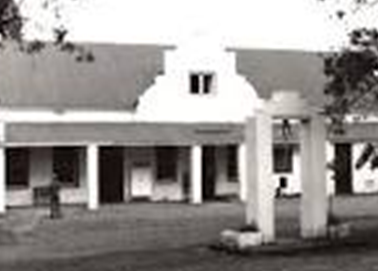
Vergenoegd — contentment, is the oldest farm in the personal history of this book, being the property where the author’s grandmother was born and where the Faure family farmed for six generations. A richly fertile piece of land beside the Eerste River was granted to Pieter de Vos by Simon van der Stel in 1696. It is no wonder he called it Vergenoegd, satisfaction achieved.
Colijn acquired Vergenoegd in 1740 (from his father-in-law’s estate, Ferdinandus Appel. It was his son, Johannes Nicolaas Colijn, son of Bastiaan Colijn and Swart Maria Everts, a woman of West African slave descent who inherited it from his mother in 1772 and built the current 1773 homestead.
In 1820, the Faure family took ownership and for nearly two centuries, six generations of the family farmed the land. The Faures introduced the pest-controlling runner ducks that became one of Vergenoegd’s most recognisable features. In 2015, German historian Professor Peter Löw acquired the estate. The hamlet on the N2 still carries the family name: Faure.
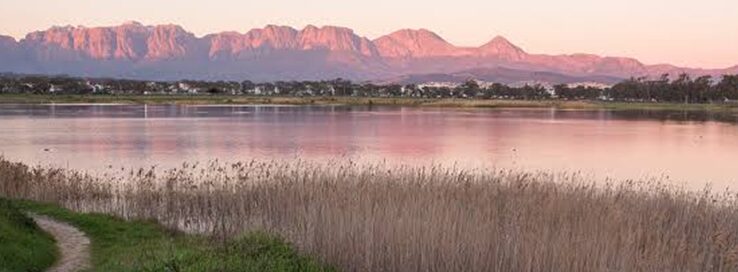
Paardevlei — horse marsh, takes its name from the wetland where horses grazed on the flat coastal plain between Somerset West and Strand. The farm that occupied this land became, in the twentieth century, the site of the AECI explosives factory, one of the most significant industrial installations in the Western Cape, its history including the catastrophic 1962 explosion that is covered elsewhere in this book. The wetland itself is now a nature reserve.
Welgelegen — well situated, is today the land on which Erinvale Golf Estate stands. Jacobus van der Heiden bought the original farm in 1707 and divided it into three portions, of which Welgelegen was one. It passed through many old Helderberg families, the Theunissens, Munniks, Morkels, Buisinnes and Hendricks. Edward Strangman, an Irishman, bought the property in 1868 and renamed it Erinvale, Irish valley, in memory of his home country. An Irish name for a Dutch farm on an African mountain. The Helderberg has always been that kind of place.
Morgenster. Lourensford. Vergelegen. Vergenoegd. Cloetenburg. Paardevlei. Welgelegen.
These names were given by people who arrived in an unknown valley and tried to describe what they found, the morning star above the door, the river through the land, the contentment of fertile soil beside water, the horses in the marsh. They were not grand names. They were practical names, the names of people who needed to call a place something in order to get on with farming it.
Three centuries later, the names are still on the gates. The farms are still being farmed. The valley has grown around them in ways the first grantees could not have imagined. But the shape of the land remembers what it was before the town arrived and the names, if you know what they mean, still tell you who found it and what they thought of it on the morning they rode in from the mountain.
Between You and Me:
Vergenoegd — contentment, is the farm where my grandmother was born and where the Faure family farmed for six generations. I have a particular relationship with the word contentment as a result. It is a modest ambition for a farm name. Not glory, not wealth, not conquest. Contentment. Pieter de Vos stood beside the Eerste River in 1696, looked at what he had been given and called it enough. That is either great wisdom or a very low bar. Given what the Helderberg has produced from that soil in the centuries since, I am inclined toward wisdom. We need to give thanks to the visionaries and current owners of these preserved estates that endured choices and hardships that we will not always be aware of.
Historian – Harmen Bockelenberg
Next week: God’s refugees — the French Protestant families who arrived in 1688 with almost nothing and left their surnames on every street sign in the Helderberg.


Be the first to comment