

STORY 108
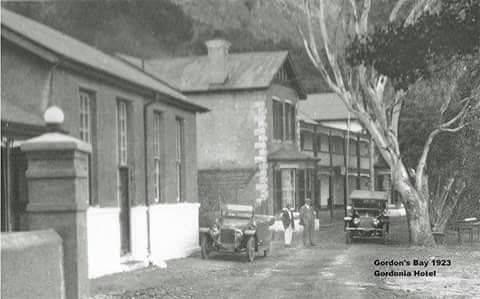
Featured image: Gordonia Hotel Gordon’s Bay 1923
The Helderberg has always needed somewhere for visitors to sleep that was not a tent. Before there were apartment blocks and shopping centres along our coast, there were hotels, grand ones, modest ones, some no more than a few rooms above a general dealer. For the better part of a century they were the beating heart of Strand, Somerset West and Gordon’s Bay and their stories tell you something the street names never will.
Let us start with fire, because that is how Strand’s hotel history begins.
The very first formal boarding house in Strand stood on the corner of Beach Road and Van Ryneveld Street. It was known simply as die Platdak, the Flat Roof and it was run by a Mrs van de Waal. For years it was the place where inland farmers and their families arrived by ox wagon for their annual dose of sea air. Then, in 1904, it burned to the ground. On the same spot, Nico Loubser built the Marine Hotel, which would go on to claim a small but genuine piece of history: it was the first beachfront establishment in Strand to have electric lights. Imagine standing on that dark stretch of Beach Road in the early 1900s and seeing an entire building glowing where before there had only been lamps and candles. The Marine would remain Strand’s oldest and most established hotel institution for decades to come, the one that looked out over the beachfront and served the visitors who came to take the False Bay air.
The Marine was not alone for long. Blake’s Boarding House opened nearby, close to what became known as Blake’s Beach, catering to visitors now arriving by the newly extended railway line rather than by wagon. The White House Hotel had already been standing since 1896. Not far off, the Victoria Hotel on Coast Road was built in 1872 by Charles Anderson, a retired ship’s captain who had settled in the Strand and decided, of all things, to go into the hospitality trade. His hotel stood on the site where the Sanlam Centre stands today. That is worth sitting with for a moment. Where shoppers now push trolleys past insurance offices, a sea captain once welcomed guests to the first licensed hotel on the coast.
More followed in quick succession. The Somerset Strand Hotel went up in 1892 for D.P. Rossouw. The Hotel Metropole opened its doors to travellers from Stellenbosch and further inland before 1906. The Melkbaai Private Hotel became a favourite mid-century holiday spot near Milk Bay. And as the twentieth century wore on, two names came to define Strand’s accommodation alongside the Marine: The Da Gama, which would go on to outlast most of its rivals and remain a landmark for more than sixty years and the Metropole, both carrying the slightly faded grandeur of the mid-century South African coastal hotel, dining rooms with white tablecloths, accommodation that was clean and sufficient and entirely without pretension. Later years The Da Gama was revamped and featured a Ladies Bar – Pebbles. Those where the days a Black Label, Castle or Lion cost 20c. There was also the National Hotel, sometimes remembered as the International, which absorbed the crowds pouring in from the expanding railway network in the early 1900s. All of them, in time, made way for the residential blocks and high-rises that now line the Strand promenade. Where holidaymakers once queued for a room with a sea view, people now simply own the view outright, forty storeys up.
Somerset West grew its hospitality differently, because Somerset West was never a beach town. It was a halting place, the last stop before the long, hard climb over the Hottentots Holland mountains on the old Sir Lowry’s Pass. Its earliest lodging was not seaside boarding houses but village inns and rooms let out in Cape Dutch farmsteads along the Lourens River, places where a traveller could rest his horses and himself before tackling the mountain the next morning. The Cylnor Hotel, on the corner of Old Stellenbosch Road and Helderberg College Road, became a well known local landmark through the 1950s and stayed the established hotel experience for the Somerset West side of the valley for decades after, a geographical marker for anyone turning off toward Helena Heights before the highways reshaped the town. Alongside it, Arksey’s occupied a different register altogether, more of a pub than a hotel in the purest sense, the kind of establishment where the bar was the point and the accommodation was secondary, the sort of place every South African town had and that served an essential function in the social ecosystem. The Alexandria and others filled out the landscape of options for a visitor arriving in Somerset West who needed somewhere to stay and somewhere to sit with a drink at the end of the day. The Cylnor itself eventually gave way to municipal subdivision and retail space.
Somerset West’s grandest hospitality legacy, though, came later and grew out of the land itself. Farms such as Cloetenberg and Land-en-Zeezicht, working estates dating back to the 1700s and 1800s, provided the template for what would become the area’s luxury hotels. Erinvale, built around a Cape Dutch farmstead sharing its history with neighbours like Vergelegen, Lourensford and Morgenster, was restored and reopened as the Erinvale Estate Hotel and Spa in 1994, timed to open alongside its new Gary Player golf course. Not far away, the Lord Charles Hotel rose in the late twentieth century as something altogether more modern, a resort built for conferences and international visitors rather than farmers escaping the heat.
And then there is Gordon’s Bay, which we already know began its life as Vischbaai, a fishing village, before Robert Jacob Gordon gave it the name it carries today. Its early hospitality served the same rough trade as everything around it: fishermen and travellers braving the paths beneath the Hottentots Holland range. In 1862, along Beach Road, a grand house was built as the summer residence of the wealthy Beit family, who had made their fortune far away in Ireland and it survives today as the Manor on the Bay, a four star hotel. Think about what that building represents. In the same decades that Robert Stanford was being ruined and driven back to England for the crime of supplying a convict ship, the Beits were building themselves a summer house on the very bay that had broken him. The Gordon’s Bay Hotel followed later, growing up alongside the construction of Clarence Drive around 1950, along with Best’s Private Hotel and the two names that would come to define Gordon’s Bay hospitality for the rest of the century: the Van Riebeeck and the Gordonia. Between them they served the small harbour town’s visitors and its own community simultaneously, the way hotels in small towns always do. The hotel bar was often the social centre of the village, the place where the fishing community and the visitors and the local businesspeople overlapped on a Friday evening.
It was the Gordonia that gave the Helderberg something none of the other hotels ever did: the Windjammer disco, the birthplace of a specific and generationally significant form of social life that the 1970s and 1980s constructed around a DJ, a dancefloor and music played at a volume that made conversation secondary. The Windjammer was where Gordon’s Bay went on a Saturday night in those years. Not everyone. Not the older generation, who found the whole enterprise bewildering. But the younger generation of the Helderberg, the people who were eighteen to thirty in the 1970s and 1980s, who had grown up watching the disco era arrive on television and in the music, they bought at the record shop, went to the Windjammer and danced and took part in the social ritual that every generation constructs for itself in the years between school and everything that follows school.
Almost none of these buildings still function as hotels. Fire took some. Time and changing tastes took the rest, converted into something else or absorbed into the general commercial landscape of towns that have grown beyond the scale they were built for. The Windjammer is a memory now. The Gordonia and the Van Riebeeck are names that people of a certain age say with a particular tone, not quite nostalgia, which implies something lost, but recognition, which acknowledges that something real happened there. It did. The Helderberg’s social life was conducted in those bars and dining rooms and on that dancefloor for the better part of a century and the people who were there know it.
Between You and Me:
Traveling for 4 days from the city to Hermanus one need a resting place and the Helderberg was just the area to make that stop. A hotel is not like a church or a town hall. Nobody preserves a hotel once it stops being useful. It just quietly becomes something else, a block of flats, a Sanlam Centre, a Saturday night that nobody under fifty remembers and within two generations nobody driving past has any idea that travellers once slept there or that a ship’s captain built the place or that a whole generation once danced there until the small hours. I like to imagine Mrs van de Waal watching her Platdak burn down in 1904 and having absolutely no idea that the ground she stood on would one day be a shopping centre. And I think that is why the distinction between nostalgia and recognition matters so much here. Nostalgia sands the edges off things, makes the past softer and simpler and better than it was. Recognition does something different. It says: this place existed, these people were here, this is what they did with their evenings and none of that requires the past to have been better than the present in order to be worth remembering. The Windjammer was a disco in a hotel in a small harbour town. It was not more than that. It was also not less than that. Real things happened there, to real people, on real Saturday nights and that is enough reason to write it down.
Historian – Harmen Bockelenberg
Next week: the night the mountains moved the 1969 Tulbagh earthquake and the family that decided, after the second tremor, that enough was enough.

Be the first to comment