

STORY 103
Somewhere behind Strand’s rows of cottages and church halls sat a quiet primary school teacher who spent his evenings dreaming up pirates, spies and vengeful rebels. Karl August Kielblock and Strand share a story that stretches from 1928 to 1991 and along the way he became one of Afrikaans literature’s most-read adventure writers, all while marking essay books by lamplight.
He was born on 23 October 1907 in Beaufort West, the second-youngest of eleven children. His father worked as a post office engineer and the household spoke German and English at home, not Afrikaans, a fact that would follow young Karl into some painful schoolyard years. When his father died in 1914, Karl was only seven and his mother was left to raise all eleven children alone on very little. He remembered, decades later, standing outside a visiting circus tent because there was no sixpence to spare for a seat inside.
He wanted, at first, to be a journalist. After matriculating at Beaufort West Boys’ High in 1925, he applied to Die Burger and was turned down, then found an English-language paper willing to pay him only six pounds a month for the work. He chose teacher training at Paarl instead and in 1928 the Secondary School in Strand, later Laerskool Hendrik Louw, took him on.
Strand gave him more than a career. It gave him his wife. Susan Vera Abel, a fellow teacher, met Karl there and they married on 31 March 1939. They had a son, Johan and a daughter, Suzette.
It was also in a Strand classroom that his writing career began, almost by accident. He set his pupils an essay exercise: imagine walking along the beach between the dunes and suddenly hearing a gunshot. What do you see when you crest the sandhill? He promised that if their essays were good enough, he would write his own version. That promise turned into the opening pages of Die Skat van Java, published in 1936, his first novel. His friend, the well-known Afrikaans writer Mikro (C. H. Kühn), encouraged him to keep going and Kielblock never really stopped. Over more than forty titles he built a loyal following with characters like the detective Frans Lindenhof, the young privateer Lafras Cuyper, the vengeful Jasper le Feuvre and the frontier heir Guillam Woudberg, stories of sea battles, murders on quiet Boland farms and Cape history retold as adventure. In 1970 he won the Academy’s Scheepers Prize for Youth Literature for Rebel, a novel set during the Anglo-Boer War.
His day job never disappeared behind the typewriter, though. When Hendrik Louw grew too crowded in the 1950s, Kielblock helped lead the move to a new school. On the morning of 17 July 1956, after the winter holidays, he marched seven staff members and 243 pupils from Hendrik Louw to a newly purchased site, the old Methodist Church school and stood as its acting head when Laerskool Lochnerhof officially opened on 20 July 1956. He is often remembered as Lochnerhof’s first principal, though the record is more modest than that. He served as acting or temporary headmaster only until 5 December 1956, not much more than four months, before a permanent principal took over. He returned to Hendrik Louw and retired from there in 1967, as deputy principal rather than principal, a detail worth keeping honest in the retelling even if it makes for a slightly less tidy sentence.
Outside the classroom and the writing desk, he was a familiar face around Strand’s sporting and civic life. He chaired the Strand Tennis Club and ran the Boland Tennis Championship there for years, played golf and rugby and cricket in his younger days and served as the last chairman of the old Strand Municipal Library before it was folded into the Provincial Library Service.
Karl Kielblock died in Strand on 26 November 1991, at eighty-four, in the town where he had lived almost his entire adult life. He was survived by his wife Vera, his son Johan, his daughter Suzette and five grandchildren, though earlier accounts from his career mention three grandsons and four granddaughters, a small discrepancy the record never quite resolves. One granddaughter appears in a newspaper mention from 1997, placing second in a schools’ letter-writing competition, a small echo of her grandfather’s gift for a good story.
His own words, offered as the epitaph he hoped for, sum up a life spent choosing readers over medals: he was never honoured with prizes or festivities, he said, but he knew this much, that his books had been read.
Between You and Me:
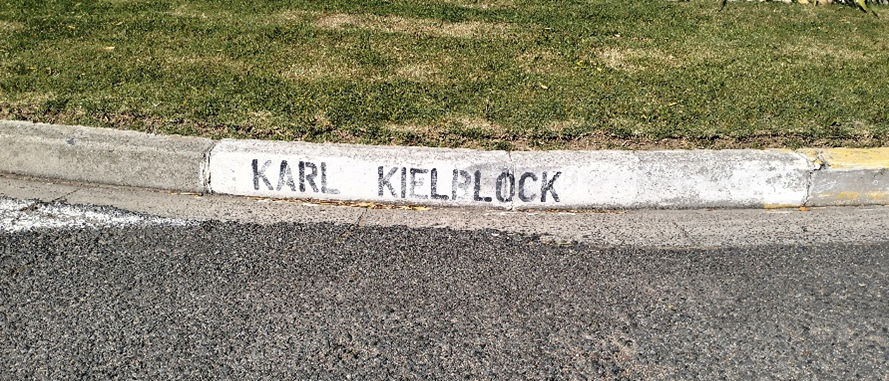
I never sat in Karl Kielblock’s classroom and I never met him. But growing up in Strand you couldn’t avoid him entirely. His name came up again and again, the way a town keeps returning to someone it’s proud of and there’s a street bearing his name to this day. That’s a strange kind of afterlife for a man who spent his days marking essays and his evenings inventing pirates and detectives. Most of us who grew up here probably walked or drove down that street a hundred times without giving much thought to who it honoured or why. I like to think that’s exactly how he would have wanted it, no fuss, no festivities, just his name quietly stitched into the town he taught in for almost forty years.
Historian – Harmen Bockelenberg
Next week: the voice in the shower Manuel Escórcio, Helderberg College and the tenor who was discovered by accident.

Be the first to comment