


There is a photograph that many old Strand families have somewhere in a drawer or an album, black and white, slightly faded, showing the beachfront as it looked in the 1930s or 1940s or 1950s. In the foreground, the jetty extends out into False Bay, its timber decking running straight and purposeful toward the horizon. Behind it, the Pavilion sits on the beach, solid, civic, certain of its own importance. Between the two structures and the long pale beach stretching away in both directions, you can see exactly what Strand was trying to be.
A proper seaside town. The kind with infrastructure.
The story of how Strand acquired its two most iconic beachfront structures spans three decades and includes a fire, a demolition, a construction company from Cape Town and several thousand jarrah timber piles driven into the seabed of False Bay by a machine that the builders charitably described as an electrical hammer.
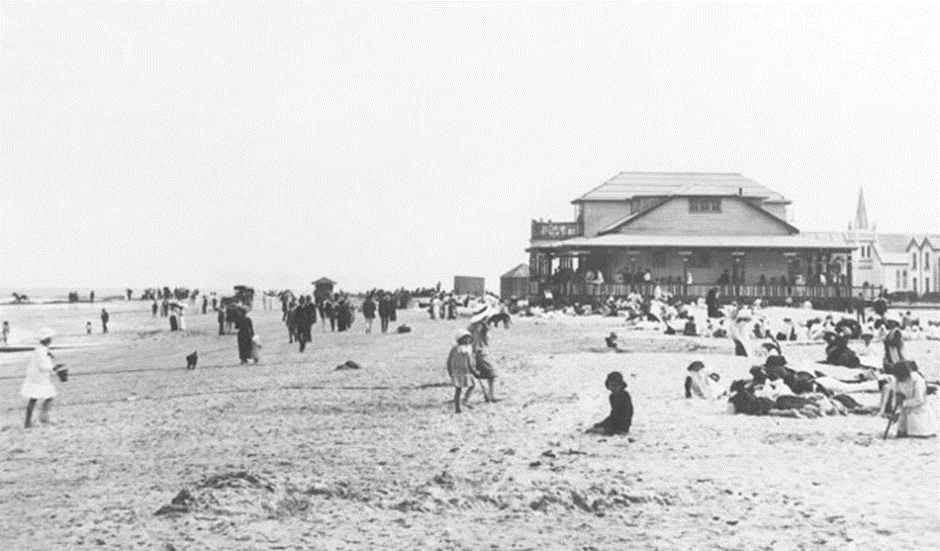
Strand pavilion
The Pavilion came first and it came modestly. The first wooden pavilion was completed in 1914, complete with changing cubicles and showers. This requires a moment of historical imagination. In 1914, arriving at a public beach in your swimwear was considered presumptuous at best and indecent at worst. Bathers changed at home or they changed at the pavilion, the pavilion was not a luxury, it was a civic necessity, the infrastructure that made the beach usable by people who lived more than walking distance away. Without it, a day at the Strand beach required either a horse or a very thick skin.
The wooden pavilion served its community for less than a decade. In 1918 it was damaged by fire. Repaired, it was reduced to ruins in 1923. Fire and wood are an old story on the South African beachfront, the combination of dry summers, coastal winds and the particular combustibility of weathered timber made wooden seafront buildings everywhere vulnerable. Strand’s pavilion made it nine years before the fire got it. The ruins sat on the beach while the municipality gathered itself for the next attempt.
The next attempt was considerably more ambitious. In 1929, a brick pavilion was built more or less in the same place, with a playground and a cinema. Brick. And a cinema. The 1929 Pavilion was not merely a facility for changing clothes before swimming, it was a statement of civic confidence, a declaration that Strand intended to be taken seriously as a resort destination. The interwar years were the golden age of the South African seaside town, when families from the interior farming districts and from Cape Town discovered that a week at the coast was available, affordable and restorative in ways that a week at home was not. Strand had the beach, five kilometres of it, warm False Bay water, sheltered from the Atlantic swell that made the other side of the Peninsula difficult for children and uncertain swimmers. What it needed was infrastructure to turn that beach into a destination. The 1929 Pavilion was that infrastructure.
Five years later, the jetty followed.
The jetty was constructed in 1934 by Murray and Stewart, employing local labour. It comprised a seventy metre long, two-and-a-half metre wide walkway ending in a larger platform of seven-and-a-half by nine metres, projecting into the ocean. Jarrah timber log columns were driven into the seabed with an electrical hammer carrying a weight of two thousand five hundred kilograms.
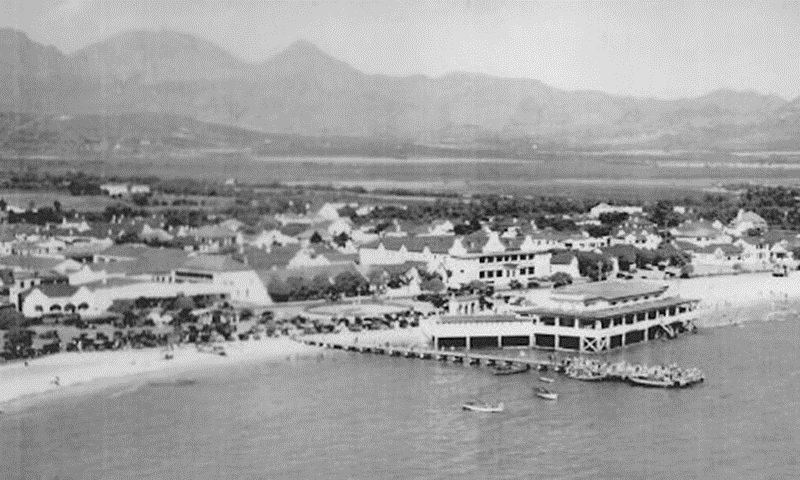
Strand pavilion & jetty
Jarrah is a Western Australian hardwood, dense, oily, extraordinarily resistant to the marine boring organisms that destroy ordinary timber in seawater within years. The people who built the Strand jetty in 1934 intended it to last. They drove those columns into the seabed of False Bay and built a platform at the end wide enough for fishermen to lay out their lines without crowding each other and connected it all to the shore with a walkway narrow enough to feel adventurous and wide enough to be safe.
Apart from being Strand’s most iconic landmark, the jetty became the heart of community life on the beachfront. The new structure assisted with the offloading of fish, boats could be moored to the platform and buyers could make their purchases without getting wet. While the professional fishermen made their living here, amateur hobbyists soon took up position to cast their own lines into the saltwater.
For many working-class families in Strand, fishing off the jetty was not recreation. It was income. The routine was fixed: out before dawn, fishing through the morning, selling the catch on the beach before noon. The fish were galjoen, kabeljou, elf, stumpnose, the reliable False Bay species that the bay produced in quantity when the conditions were right. Payment was cash, negotiated face to face on the sand. No shop. No middleman. The ocean was the shop.
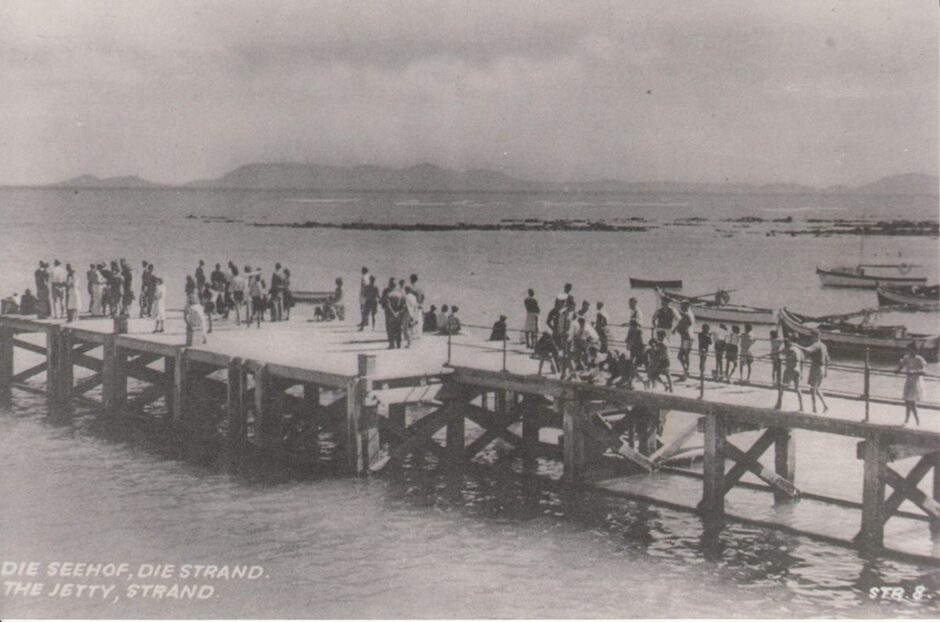
The Strand jetty in later years
Older fishermen watched the Helderberg mountains more than the sea. If clouds gathered over the Hottentots Holland range in a particular way, you went home. That local weather knowledge, accumulated over generations, passed from father to son, was the difference between a profitable morning and a dangerous one. Winter storms in False Bay could be serious. The same rough water that stirred fish activity and made a catch worthwhile could turn a small wooden boat into a liability within minutes. The fishermen went out anyway. If the fish were running, you didn’t sleep. That was your payday.
The jetty created the kind of community that shared physical space creates, regulars with their unofficial spots along the rail, lending bait and advice, watching each other’s children, warning each other when the weather was changing. Newcomers were quickly noticed. The community that formed around the jetty’s railing across four decades was not organised and not formally constituted. It was simply the community of people who showed up, in the way that fishing communities everywhere have always been constituted by the shared habit of showing up.
Boys learned to fish there before they learned to drive. The pattern was the same across the 1950s, 1960s and 1970s, leaving home early with a hand line and a bucket, walking barefoot from the nearby streets, spending the morning catching stumpnose and competing with friends for the biggest fish. You could walk out on the jetty before school, throw a line in and still make it to class on time. The jetty did not demand much of you. It just required that you show up.
The Pavilion in those same decades was doing different work. From the 1940s through the 1960s, the Saturday night at the Pavilion ballroom was one of the fixed social institutions of the Strand beachfront. Live bands. Strict dress codes. Young men polishing shoes. Young women in their best dresses. Parents waiting outside to collect their children at the end of the evening. First dances, first dates, the full ceremonial apparatus of mid-twentieth century South African social life, conducted in a brick building on the beach with the sound of False Bay outside the windows.
Summer days had their own rhythm. Swim in the ocean, rinse off at the Pavilion, eat lunch on the sand, buy ice cream, repeat until the wind picked up or the sun went down. Children went home sunburned and sandy and completely satisfied. It was a full day’s commitment, not a quick visit and the infrastructure of the jetty and the Pavilion made that full day possible.
Storm days were their own category. When big winter swells rolled in from the south and hit the jetty, Strand residents gathered to watch. Huge waves crashed over the structure. Spray blew across Beach Road. Children skipped school to witness it. The Helderberg mountains sat dark and indifferent behind the town while False Bay demonstrated, at considerable volume, that it is larger and more powerful than anything built on its shores.
Those storms did their work on the jarrah timber over the decades. Gradually, then more obviously, then irreversibly.
The Pavilion’s popularity began to wane when Melkbaai, a kilometre or so away, was opened as a swimming spot. The Pavilion was declared unsafe and demolished in 1972. The Strand Pavilion complex as it looks today with a restaurant over the water and an Olympic-sized swimming pool was completed in 1990 on the foundations of the earlier building.
The jetty lasted longer and its end was more publicly mourned. The structure had deteriorated beyond repair and had become a liability. It was closed to the public in 2002 and the City’s attempt to have it demolished was met with strong public outcry. The people who had fished on that jetty as children, who had walked to its end on summer evenings to look back at the shore, who had their first conversations with their future spouses somewhere along its seventy metres of jarrah decking, those people were not mourning a structure. They were mourning the specific geography of their own memories.
It felt like losing an old friend. That is what people said when the jetty closed. Not a building. A friend.
The regulations changed too, as regulations always eventually change. Catch limits, licensing requirements, restrictions on the informal fish selling that had been the jetty economy since 1934. For the small-scale fishermen who had built their livelihoods around the structure, the new rules arrived at the same time as the structural deterioration, a double ending, the legal framework and the physical framework collapsing together. The sea didn’t change. The rules did.
What remains is the skeleton, the jarrah piles still visible at low tide, the ghost of Murray and Stewart’s 1934 structure projecting into False Bay from the Strand beachfront. The modern Pavilion extends twenty-five metres over the ocean, housing self-catering apartments, a restaurant and a swimming pool. The beach in front of it is the same beach it has always been.
Strand was a seaside town before the jetty and a seaside town after it. But it was a particular kind of seaside town while the jetty stood a town where the fishermen and the holiday-makers and the Saturday night dancers and the barefoot boys with hand lines all shared the same seventy metres of jarrah timber above False Bay.
That community is not nothing. It is, in fact, most of what a town is.
Between You and Me:
I remember the Pavilion. Specifically, I remember it being demolished in 1972 and the particular bewilderment of watching something that had always been there simply stop being there. This big steel ball crushing my childhood history. A gravel parking lot appeared in its place, which is the least poetic possible replacement for a building where people had danced on Saturday nights. The jetty lasted another thirty years before the sea made its final argument. What I remember most clearly about both structures is not a specific day or a specific event, it is the smell. Salt water and old wood and fish and the particular afternoon south wind coming off False Bay. Memory is mostly smell, if you wait long enough.
Historian – Harmen Bockelenberg
Next week: the dam in the mountain — how a water scheme begun during the First World War has been supplying Cape Town for over a hundred years.




Be the first to comment