

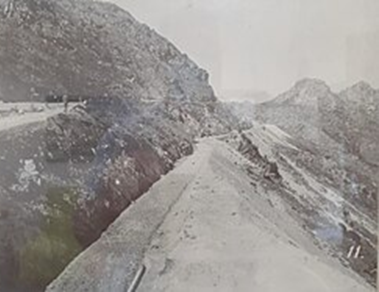
Featured image: Construction of Sir Lowry’s Pass
For the first 150 years of the Cape Colony, the Hottentots Holland mountains were a wall. Beautiful from the front. Terrifying to cross.
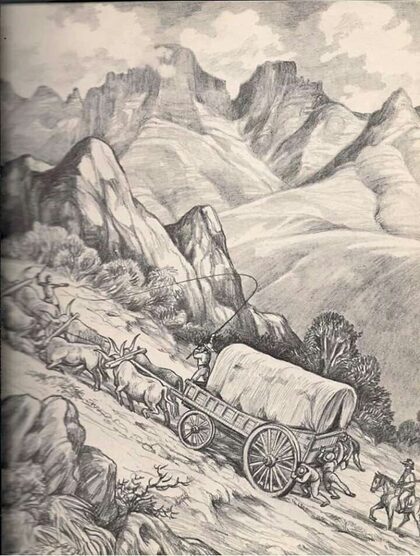
Gantouw pass – Before Sir Lowry’s Pass existed
Before Sir Lowry’s Pass existed, there was the Gantouw, a Khoikhoi word meaning eland’s path. The eland, those great heavy antelope, had worn a track through the mountain over centuries, seasonally moving between the coastal plain and the valleys on the other side. The Khoikhoi had followed the eland. The Dutch settlers had followed the Khoikhoi. And for nearly 150 years, thousands of ox-wagons had ground their way up a boulder-strewn track over the kloof. the Hottentots Holland Kloof Pass, that was barely a road and frequently a disaster.
By 1820, about 4,500 transport wagons per year used this route to carry trade between the coastal farms and the interior. The pass was so treacherous that one in every five wagons was damaged on the journey, along with injured and dead cattle. Farmers, forever fearful of losing their wagons and cargo down the steep precipices, had taken to locking their wagon wheels for the descent.
Locked wheels on a loaded ox-wagon, grinding down a rocky mountain slope. Imagine the noise. Imagine the terror. One slip, one broken wheel and a family’s entire harvest, their entire livelihood, was over the edge and gone. The deep grooves cut into the rock are still visible today, worn into the stone by countless hooves and feet over a very long period. The evidence of repeated use is undeniable.
Anyone who has stood on the slopes of the old Gantouw Pass and looked up at its steep ascent cannot help but wonder how it ever became a route of travel. The traditional explanation is that the path followed the tracks of eland moving through the mountains. Standing there, however, one is tempted to question the story. The route climbs directly up the mountain with little regard for comfort or convenience. Looking at it today, it feels less like a trade route and more like a path of necessity, a route used by people seeking the quickest escape over the mountains when danger threatened. Whether fleeing enemies, raiding parties or conflict on the plains below, the pass has the character of a route chosen for urgency rather than ease.
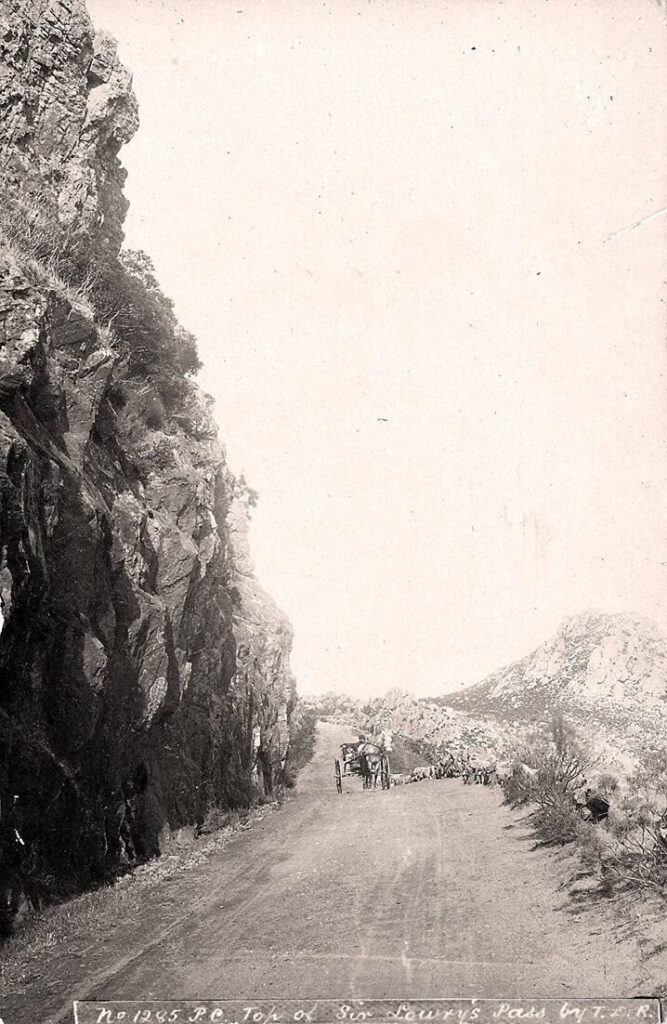
Construction of Sir Lowry’s Pass
The man who decided this had gone on long enough was Sir Galbraith Lowry Cole, an Irish-born British general, veteran of the Napoleonic Wars, who arrived as the new Governor of the Cape Colony in 1828 and sized up the situation immediately. He saw that the colony could not develop without proper access roads and recognised the critical importance of the Hottentots Holland pass. He ordered his chief engineer, Colonel Charles Michell, to stop trying to repair the terrible existing track and build a completely new road instead.
Michell was the colony’s Surveyor-General, a precise, methodical military engineer who had already been thinking about this problem. He inspected the old kloof, declared it beyond saving and drew up plans for a new route two kilometres to the south, with gentler gradients designed specifically for loaded ox-wagons.
Michell set to work using 50 soldiers, 10 sappers and miners from the Royal Engineers and the 72nd Highlanders regiment and 40 convicts. No dynamite. No heavy machinery. No diesel engines. Just men breaking rock by hand on a mountainside, in the heat of a Cape summer and the cold of a Cape winter, for two years.
On 6 July 1830 the new pass was officially opened and named Sir Lowry Cole’s Pass.
The initial estimated cost was £2,672, roughly R220 million in today’s money. The actual cost came in at £3,000. A toll house was set up at the summit to recover the costs, collecting £490 in its first two years alone. It paid for itself quickly. The economic effects were immediate and enormous. Farmers from the Overberg and the interior could suddenly reach the Cape markets without destroying their wagons or their nerves. Somerset West, founded just eight years earlier, had an artery connecting it to the wider colony.
There was one unfortunate footnote. Sir Lowry had given the go-ahead to build the pass without first asking permission from his masters in London. The colonial office responded with a sharp reprimand and Sir Lowry was censured for his insubordination. No further mountain passes were built by British authorities in the Cape for twelve years.
He built one of the most important pieces of infrastructure in South African history. Then he got in trouble for it.
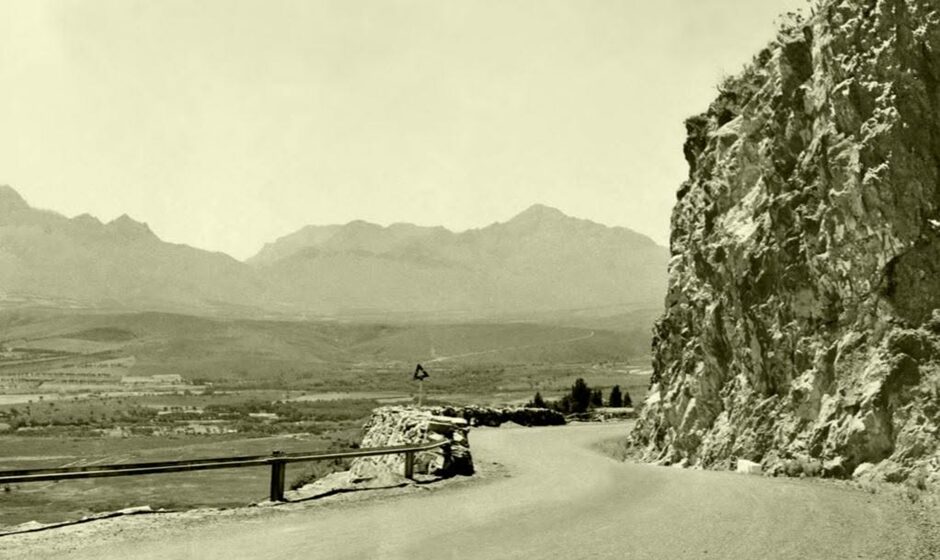
Sir Lowry’s Pass c1935
Sir Lowry’s Pass was planned and built so well that it remained in continuous use for 100 years. In the 1930s it was widened and tarred. In 1984 it was widened again into the four-lane highway you drive today. The summit viewpoint, where the south-easter wants to toss you off the mountain and where paragliders launch on a good day, gives you the same view that a tired ox-wagon driver would have seen coming over the top in 1831, cargo intact, wheels slightly unlocked, the whole of the Helderberg and False Bay spread out below him like a reward.
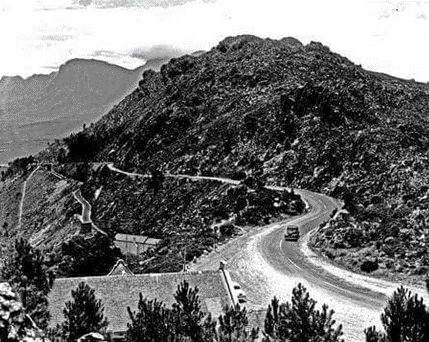
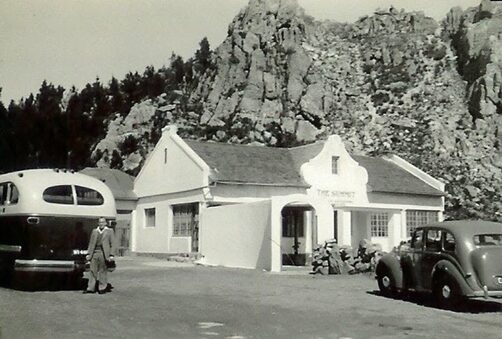
Sir Lowry’s Pass with the tea room in the foreground
In the image above the Tearoom on the summit of the pass and the railroad to the left.
Between You and Me:
Sir Galbraith Lowry Cole built one of the most important pieces of infrastructure in South African history, opened the Overberg to the colony, transformed the economy of the entire region and was then formally reprimanded by London for building it without permission. No further mountain passes were authorised for twelve years. This is, I think, the most British outcome imaginable, extraordinary achievement followed immediately by a stern letter about proper procedure. The pass is still there. The letter is presumably filed somewhere in the colonial archives under M for Magnificent Insubordination.
Historian – Harmen Bockelenberg
Next week: the jetty and the pavilion, the two structures that turned Strand from a fishing settlement into a seaside destination and what the sea eventually did to both of them.

Be the first to comment