

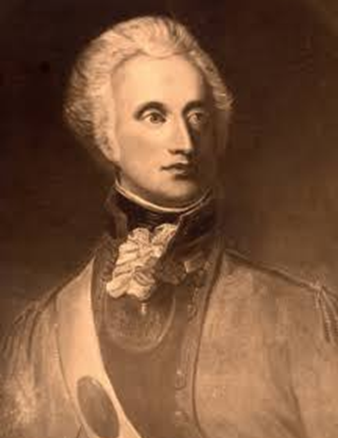
Every time you say the name Somerset West, you are saying the name of a man who never set foot in the place. Lord Charles Henry Somerset, British Governor of the Cape Colony from 1814 to 1826, never visited the town that bears his name. He was too busy running and occasionally mismanaging an entire colony from Cape Town.
He also never visited Somerset East, the other town named after him in the Eastern Cape. During a tour of the eastern frontier in 1814, Somerset had recognised the agricultural potential of the fertile Boschberg region. He commissioned a botanist named Dr Mackrill, a man with a useful combination of scientific knowledge and geographical instinct, to tour the colony and identify land that could supply crops and horses to soldiers guarding the increasingly contested eastern border. Mackrill found his site at the foot of the Boschberg: at least a thousand acres of excellent sweet pasture, not an inch of useless ground, a good water supply and approximately six thousand tobacco plants already growing. He suggested naming it Somerset Farm, on the grounds that the land merited his Excellency’s noble and ancient name. A government farm was established. A town grew up around it. It became Somerset East.
But his name is on our town. And even a hotel named after him. So who was he?
Lord Charles Somerset was born on 12 December 1767 in Badminton, England, the son of the fifth Duke of Beaufort, which meant he came into the world trailing the kind of aristocratic privilege that opened doors without anyone knocking. He was educated at Westminster and Oxford, did the obligatory Grand Tour of Europe and embarked on a military and political career that eventually landed him the governorship of the Cape Colony in 1814 at a salary of £10,000 a year, an enormous sum for the time, equivalent in modern purchasing power to something in the region of R23 million annually (depending on the exchange rate and how one will interpret the conversion). It placed a man among the wealthy elite of the British Empire.
He has been described as a hard-living, hard-hunting squire of an overbearing disposition, but with a distinct sense of duty. That description, overbearing but dutiful, is about as diplomatic a summary of Lord Charles Somerset as history has managed to produce. Those who liked him admired his energy and his genuine efforts to develop the colony. Those who did not and there were many, called him an autocratic tyrant who sacrificed the interests of the country for the personal advantage of the governor and his friends.
Sound familiar? The Helderberg had seen that before, with Willem Adriaan van der Stel a century earlier. History, as always, had a taste for repetition.
To be fair to Somerset, he also left marks of a different kind. In 1818 he launched the South African Public Library in Cape Town — one of the oldest public libraries in the southern hemisphere. He brought the 1820 Settlers to the Eastern Cape frontier, encouraging approximately 4,000 British immigrants to settle in the area between April and June 1820 a decision that shaped the demographic and cultural character of the Eastern Cape for the next two centuries. He mediated between Xhosa chiefs and English settlers during years of escalating tension that no mediation could ultimately resolve. The man was complicated, as men of that era and that power tend to be.
And then there were the scandals.
Lord Charles’s private life was the subject of considerable gossip during his years at the Cape. His close friendship with the surgeon James Barry gave rise to rumours of a homosexual relationship and in 1824 an anonymous accusation was publicly circulated in Cape Town. An official inquiry found no proof of misconduct. It was later discovered, after Barry’s death, that the surgeon had been a woman living as a man throughout an entire medical career, one of the most remarkable stories of gender concealment in the history of the British Empire. Whether the relationship between Somerset and Barry was romantic or merely close friendship, nobody could say for certain. It caused a considerable stir in the small, gossipy world of the Cape Colony in the 1820s.
Back at Somerset Farm on the eastern frontier, local farmers as well as the 1820 Settlers began to feel aggrieved that the government operation was undercutting their prices and threatening their livelihoods. Serious charges were laid against Lord Charles and under pressure he decided to close the farm in 1825. He left the Cape Colony in 1826 at the end of his term, returned to England to face his critics, answered his accusers and died on 18 February 1831 at the age of 63.
He left behind something more lasting than scandal or controversy.
Somerset West was founded in 1822 on part of the historic farm Vergelegen, the Cloetenburg portion specifically and named Somerset after Lord Charles Henry Somerset. The town grew from almost nothing: a church, a few buildings, a handful of settlers, on the same soil that Willem Adriaan van der Stel had once called his own. The suffix West was only added after 1825 to distinguish it from Somerset East in the Eastern Cape, which had also been named after Lord Charles Somerset, because when you are a governor with an ego that size, one town is apparently not enough.
The Cloetenburg farmstead, one of the oldest surviving structures in Somerset West, is named after Catherine Cloete, who in 1720 bought that portion of the original Vergelegen estate. The gable was added in 1785. Today it is a national monument, sitting at the heart of Somerset House School. The children who eat lunch under that gable every day are sitting inside the oldest surviving structure in their town.
There is one more detail worth recording. The municipal crest of Somerset West incorporates a portcullis — the same heraldic device that appears in the badge of the Beaufort family, of which Lord Charles Somerset was a son. The portcullis on the town’s coat of arms is his family’s mark — still there, still connecting this valley to a man who was born in Badminton in 1767 and never came within five thousand kilometres of the Helderberg mountain.
So the next time someone asks why we are called Somerset West and not something more interesting, that is your answer. A hard-living, hard-hunting English aristocrat who never visited, his family crest still on our municipal coat of arms, his name on our streets, our hotel and our town, named not once but twice by a governor who did not have to ask anyone’s permission.
That is how towns got their names in the British Empire.
Between You and Me:
Lord Charles Somerset never visited Somerset West. He never visited Somerset East either. He had two towns named after him in a colony he governed from Cape Town and apparently felt no particular urge to see either of them. I find this oddly relatable. There are places I have recommended to people, described with confidence, spoken of warmly, that I have also never actually visited. The difference is that nobody put my name on a street sign. Lord Charles got the street signs and the hotel. I got nothing. The aristocracy really did have the better arrangement.
Historian – Harmen Bockelenberg
Next week: the beach that kept changing its name — Vlooitjiesbaai, Mostert’s Bay, Somerset Strand and finally, in 1937, simply The Strand.

Be the first to comment