

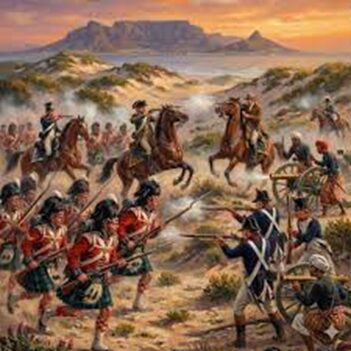
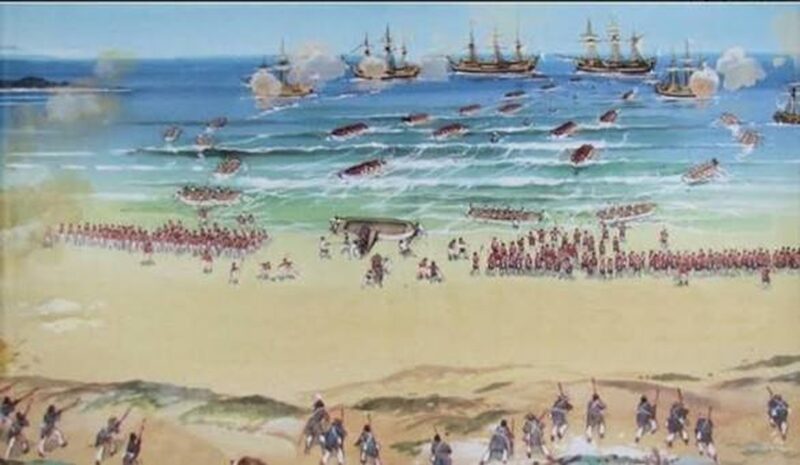
On 8 January 1806, two armies met on the beach at Blaauwberg, just north of Cape Town. On one side, a ragged force of Dutch, French and local troops under a general named Janssens. On the other, a disciplined British force that had just crossed the Atlantic from England. The battle lasted less than two hours. The Dutch never had a chance.
Ten days later, General Janssens signed the surrender. The Cape Colony changed hands for good. And the Helderberg, without anyone in the Hottentots Holland valleys being consulted, woke up under a new flag. New problems came with it.
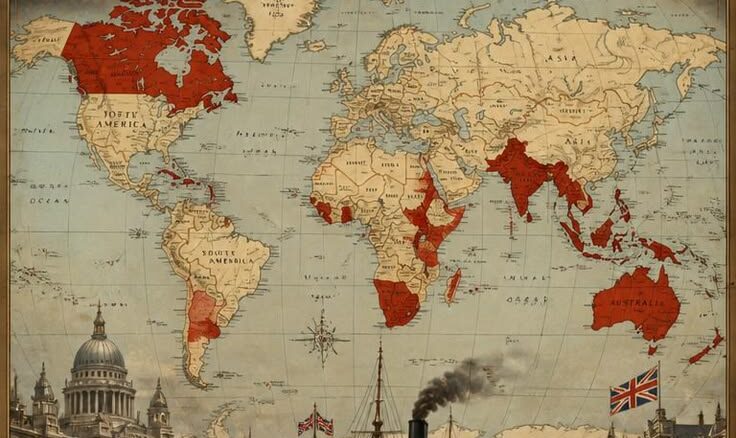
It had actually happened before. In 1795, the British had already seized the Cape, not because they wanted it for itself, but because Napoleon’s armies had swept through the Netherlands and the British were terrified that France would take the Cape and use it to threaten the sea route to India. Britain first gained control in September 1795 when British forces captured the Cape of Good Hope, claiming to act on behalf of the Dutch Prince of Orange who had been driven from the Netherlands by French republican allies. In reality, it was a strategic move. The Cape was the most important way station on earth for ships travelling between Europe and Asia. Britain was determined it would not fall into enemy hands.
Then, in 1803, Napoleon and Britain signed a temporary peace agreement, the Treaty of Amiens and the Cape was handed back to the Dutch, now calling themselves the Batavian Republic. The Helderberg had three years of Dutch rule again. And then in 1806, the wars resumed, the British came back and this time they stayed.
The British retained Roman Dutch law and many local institutions and customs, as well as Afrikaans-speaking officials who ran them. They were not stupid. You do not take over a colony by dismantling everything the settlers know. You keep the laws they trust; keep the officials they recognise and then quietly begin reshaping things your way.
Reshaping things quietly, piece by piece, while nothing on the surface seemed to change.
English became the language of government and courts. British settlers began arriving especially after the 1820 settlers’, when Britain sent 4,000 immigrants to the Eastern Cape to solve its post-Napoleonic Wars unemployment problem. English churches appeared. English newspapers were founded and then suppressed and then fought for, in battles over press freedom that echo into South African history all the way to the present.
The Dutch East India Company had long been known as bankrupt, corrupt, restrictive and exploitative, so its demise was welcomed by many settlers. After 150 years of VOC rule, the British actually brought some reforms that the Helderberg farmers appreciated. Economic restrictions were lifted. Officials had to take salaries instead of taking bribes. Things worked a little better, at least for the settlers.
For everyone else, the picture was more complicated. But the flag had changed. The Helderberg was now, officially, British.
And somewhere in Government House in Cape Town, a governor named Lord Charles Somerset was about to attach his name permanently to a little town in the Hottentots Holland.
Between You and Me:
The British took the Cape in 1795, gave it back in 1803 and took it again in 1806, this time permanently. Which part of the world did they not stay, as someone once observed. I have been trying to think of the diplomatic way to describe the British Empire’s approach to other people’s territory and the best I can manage is: persistent. They were extremely persistent. The Helderberg woke up under a new flag in January 1806 and nobody in the Hottentots Holland valleys was consulted. In fairness, nobody in the Hottentots Holland valleys had been consulted about any flag since 1652. Consistency, at least, was maintained.
Historian – Harmen Bockelenberg
Next week: the man on the street sign — the British governor who gave Somerset West its name and never once came to see it.

Be the first to comment