

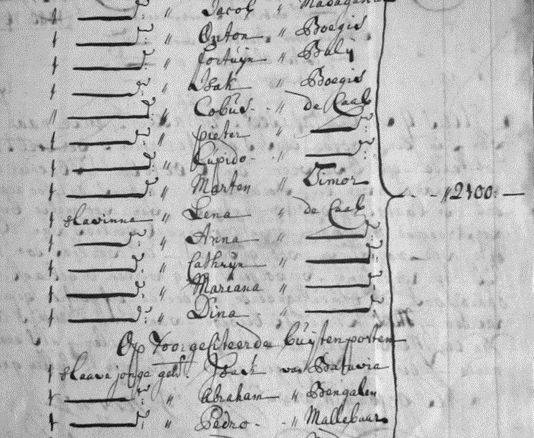
Featured image: Enlisted slaves
On 1 December 1834, slavery was formally abolished in the Cape Colony. It was a Monday.
Imagine what that morning felt like for the descendants of those 63,000 people who woke up that day technically free for the first time. No more being bought and sold. No more being mortgaged as assets. No more having your children taken and sold to another farm. A Monday morning in December, with the mountain behind and the sea in front and the weight of two centuries lifted, in law, at least.
Except it was not quite that simple. Nothing in South Africa ever is.
The British Emancipation Act of 1833 ended formal slavery, but from 1834 to 1838 the formerly enslaved had to spend four years as apprentices, continuing to labour for their former masters under effectively the same conditions as before. Apprenticeship contracts could be bought and sold in much the same way that slaves had been bought and sold. The second, real emancipation came only on 1 December 1838.
Even then, the freedom was paper thin. Facing the prospect of urban poverty or homelessness, the safest option for many of the newly liberated was to remain as waged labourers for their former masters. The farms still needed workers. The workers still needed food and shelter. The power relationship had been renamed, not ended. The wine estates of the Helderberg that had been built on slave labour continued to operate, now with workers who were technically free but practically bound by poverty and a legal system that remained heavily weighted against them.
The slave owners, meanwhile, were compensated by the British government for their loss of property. The people who had been that property received nothing. Not a rixdollar. Not a piece of land. Not an apology.
In the years following emancipation, the formerly enslaved, along with the Khoikhoi, San and mixed-heritage communities, gradually came to be identified under a single new category, coloured. It was not an identity they chose for themselves. It was assigned to them. But within that assigned category, over the generations, something genuinely distinctive was built, a culture that was neither Dutch nor French nor Indian nor Indonesian nor African, but something woven from all of those threads simultaneously. The Cape Malay cuisine. The Ghoema music. The kramats on the hillsides. The particular cadence of Cape Afrikaans. The naartjie and the koeksister and the bobotie.
Slaves where offered “oppressor” education which they simply did not accept and ran away from school.
The Helderberg’s coloured community, the people of Macassar, of Lost World, Lwandle, of the farms and fishing boats are the direct descendants of those 63,000 people and of the Khoikhoi who were here before any of them. They are the oldest community in this valley, if you count backwards from the first forced arrival in 1658. They built what you see. They speak a language shaped partly by their own ancestors’ tongues.
When slavery ended at the Cape, many emancipated men and women possessed no hereditary surnames recognised by the colonial authorities. Some adopted the surnames of former owners. Others took names associated with farms, occupations, Christian traditions or family usage that had developed over time. As a result, many surnames found today among descendants of the enslaved are also associated with old settler families — reflecting the complex social history of the Cape rather than necessarily indicating direct blood relationships.
Well-documented examples include Lombard, Van Wyk, Jacobs, Adams, Jansen, September, October, February, Cupido and Fortuin. Some originated from owners, while others developed through entirely different historical processes. The prevalence of month names, September, October, November, April, has attracted various theories: baptism months, registration dates, names assigned by officials. Historians generally agree there was no single explanation. There never is, with the Cape.
Between You and Me:
The slave owners received compensation from the British government for the loss of their property. The people who had been that property received nothing. The British government’s compensation payments to Cape Colony slaveholders were well documented and substantial. I have looked for the equivalent figure paid to the formerly enslaved. There is no equivalent figure. There was no payment. The ledger, as it turns out, only ran in one direction. This is the kind of accounting that history does not forget, even when the people who did it very much hoped it would.
Historian – Harmen Bockelenberg
Next week: the day the flag changed — how the British took the Cape, what they kept, what they changed and what that meant for the Helderberg.

Be the first to comment