

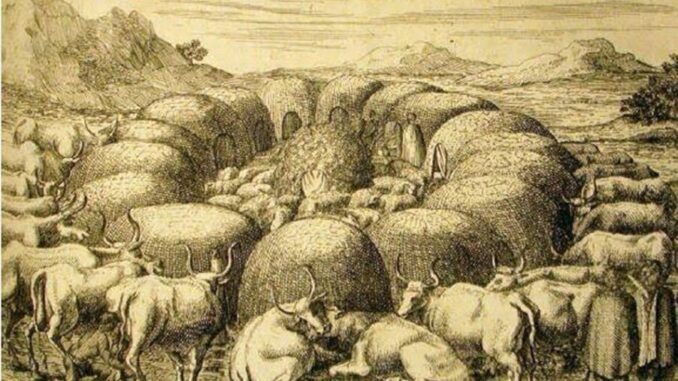
If the San were the people of the mountain and the fynbos, the Khoikhoi were the people of the valleys and the rivers. And in the Helderberg, they were everywhere.
The word Khoikhoi means men among men, real people or people of people, depending on who is translating. It is what they called themselves. The Dutch called them Hottentots, a name that stuck for centuries and is now set aside. They were not Hottentots. They were the Khoikhoi and they had been managing the valleys and coastal plains of the Western Cape for over a thousand years before Jan van Riebeeck’s ships appeared on the horizon.
It is worth remembering that Jan was not the first European to meet these people. That encounter began much earlier, in 1488, when Bartolomeu Dias became the first recorded European to round the southern tip of Africa, naming it the Cape of Storms. It was soon renamed the Cape of Good Hope by King John II of Portugal, who saw its strategic value. A few years later, Vasco da Gama proved the route’s importance by sailing around the Cape to India in 1497–1498, establishing the first direct sea route between Europe and Asia.
During the 1500s Portuguese ships began using the passage regularly and by the 1600s Dutch and English East India Company vessels had turned it into a major global shipping route. By the time of Adam Tas and the van der Stels in the late 1600s and early 1700s, the Cape had become one of the busiest maritime stopovers in the world, supplying ships bound for or returning from Asia.
Against this backdrop, it is striking to remember that the people who formed the Gordon’s Bay shell midden lived here more than 2,000 years before Dias rounded the Cape and nearly 3,000 years before the Cape became a global maritime crossroads.
The Khoikhoi were pastoralists. Where the San hunted and gathered, the Khoikhoi herded. They kept cattle and fat-tailed sheep in large numbers, hundreds, sometimes thousands of animals. They measured their status and their wealth in livestock. Their lives revolved around water, animals and land. A man’s standing in his community was counted in his herd. To lose your cattle was to lose everything. That understanding will matter very much as this story continues.
They were not a single nation but a collection of clans, each with their own territory, their own chief, their own grazing routes. In the area around and beyond the Hottentots-Holland mountains, the relevant clans were the Cochoqua and the Hessequa. The specific families whose territory included the valleys that would one day become Somerset West, The Strand and Gordon’s Bay. The Chainoqua ranged through the mountains themselves. The Hessequa grazed the Overberg plains beyond Sir Lowry’s Pass, the land which the Dutch would not reach for another generation.
Their lives followed the rhythm of seasons and grazing. They moved constantly, setting up their portable domed huts, made of bent branches covered with woven reed mats, at water sources, then moving on when the grazing was done, leaving the land to recover. They traded with the San. They traded with each other. They traded, cautiously at first, with Portuguese ships that began stopping around the Cape from the early 1500s onwards, long before the Dutch arrived, long before anyone called this place a colony.
They were not primitive. They were not unsophisticated. They made tools, weapons and ornaments from copper and iron obtained by trading with peoples from the north. They had political structures, inheritance systems, dispute resolution customs and long-distance trade networks that stretched hundreds of kilometres. The Dutch, when they arrived, would look at the Khoikhoi and see savages. What they were actually looking at was a society perfectly adapted to this land over many centuries.
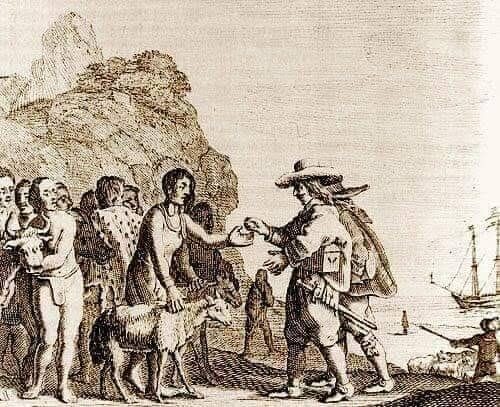
The Khoikhoi’s great vulnerability was their cattle. Because they measured everything in livestock, because their herds were visible and countable and moveable, they had something the Dutch wanted and could take. The Dutch needed meat to supply their ships. The Khoikhoi had meat. That simple equation set everything that followed in motion.
In 1659 the first armed confrontation over ownership of land took place between the Dutch settlers and a Khoikhoi clan. The dispute was over cattle. It would not be the last.
Between You and Me:
The Khoikhoi measured their wealth in cattle. The Dutch wanted the cattle. It really is that simple. I have been thinking about this while driving past the wine estates of the Helderberg, the beautiful farms with their elegant names and their Cape Dutch gables and their tasting rooms and wondering what the Cochoqua chief would make of Vergelegen’s camphor trees being national monuments. “Jan’s fault” The cattle are gone. The wine is excellent. History is uncomfortable that way. Today, nothing has changed do we ever consider when enough is enough.
Historian – Harmen Bockelenberg
Next week: 6 April 1652 — three ships drop anchor in front of a large flat mountain and nothing in the Helderberg is ever quite the same again.

Be the first to comment