

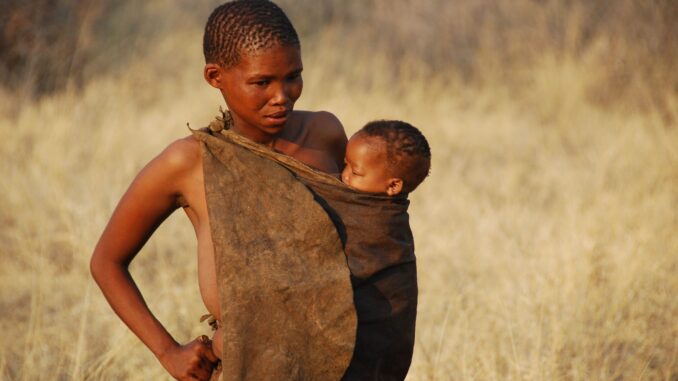
Long before anyone put a name to the mountain, long before the first vine was planted or the first Cape Dutch homestead was built, long before the Dutch or the French or the British arrived with their flags and their documents and their plans — people were living in the Helderberg valleys. They had been living here for a very long time.
They are called the San. The word comes from the Khoikhoi language — sonqua — meaning simply those without cattle. The Dutch settlers who arrived in 1652 called them Boschjesmans — Bushmen, men from the bush. Neither name is theirs. They had their own names, their own languages, their own ways of describing themselves that nobody thought to write down before it was too late.
What we know about them — and it is considerable, if you know where to look — comes from three sources: archaeological sites, rock art and genetics.
The genetics are extraordinary. Modern genetic research has established that the San are among the oldest, if not the oldest, continuous human populations on the planet. Their DNA contains markers found nowhere else on earth — markers that place them at the very root of the human family tree. When a small group of early humans left Africa around 70,000 years ago and eventually populated the rest of the world, the San’s ancestors stayed. They were here first. They were here longest. When the Dutch arrived at the Cape in 1652, the San had been living in southern Africa for perhaps 20,000 years. The Helderberg valleys — the sweet water, the game-rich fynbos, the sheltered kloofs, the caves and overhangs in the sandstone cliffs — were home.
They were hunter-gatherers. Small, mobile bands of related families, moving with the seasons, following the game. In summer, up into the mountain kloofs where the eland and rhebok grazed. In winter, down to the coastal plain and the sea. They carried everything they owned. They built nothing permanent, which is why so little physical trace remains. But they left behind one extraordinary legacy.
They painted.
On rock faces and cave walls across the Western Cape, the San left thousands of paintings — animals, hunters, half-human figures, dancers in trance. The eland appears most often, large and luminous, painted with a skill and an understanding of animal movement that still astonishes people who see it today. The paintings were not merely decorative. They were spiritual records — maps of a world that included dimensions invisible to outsiders. The medicine men — shamans — entered trance states during the great healing dances and described what they saw. Then they painted it.
South Africa is thought to have the richest treasure trove of rock art in the world and the Western Cape, including the belt of mountains from the Cederberg south to the Helderberg, falls within one of the richest concentrations per square kilometre on earth.
They were not only mountain people. Along the shores of False Bay, hidden beneath what appears today to be an ordinary coastal dune at Hendon Park in Gordon’s Bay, lies one of the most remarkable archaeological sites in the region. Known to archaeologists as Dune 111 or Sandkop, the midden was excavated in 1967 and revealed layer upon layer of shells, fish bones, animal remains, stone tools, charcoal and ash — the accumulated traces of generations of coastal hunter-gatherers who returned repeatedly to this favourable spot on the shore. Here they gathered shellfish from the rocky coastline, caught fish in the bay, hunted game in the surrounding landscape, fashioned tools from beach pebbles and cooked their meals over open fires. Windblown sand gradually covered these deposits, preserving them beneath the dune. Distinct layers separated by clean sand revealed a pattern of occupation, abandonment and return — not the work of a single generation but of many communities over hundreds of years, stretching back nearly three thousand years.
Although the site is often described as a San settlement, archaeologists are more cautious. The people who camped here were coastal hunter-gatherers, likely ancestors of the San-related populations who inhabited the southwestern Cape long before European arrival. Standing on that dune today, it is remarkable to think that beneath your feet lies a silent archive of thousands of meals, campfires and daily lives — one of the last significant shell-midden dunes along the False Bay coastline and a rare glimpse into a world that flourished centuries before the first ships rounded the Cape.
Their language was unlike anything the Dutch had ever heard. It was built on click consonants — sharp percussive sounds made with the tongue against the teeth, the palate, the side of the mouth — that gave European ears the impression of stammering or stuttering. It is this same unfamiliar sound that led the Dutch to misname the San’s pastoralist neighbours the Khoikhoi as “Hottentots” too — a separate people, but caught by the same colonial ear making the same mistake. The San themselves were not stuttering. They were speaking one of the most complex and ancient languages on earth.
They asked for nothing. They wanted the land left as it was. That was the one thing nobody was prepared to give them.
Between You and Me:
The dune in Hendon Park, a to the right as you enter Gordon’s Bay with the marker on top. It is a shell midden that most people in Gordon’s Bay have never heard of. Nearly three thousand years of accumulated meals, campfires and daily life, sitting quietly under a dune while above it people built houses, drove to work and argued about parking. The San did not ask to be remembered. They asked to be left alone, which is a different thing entirely and considerably more reasonable. We managed neither. The least we can do now is pay attention to the dune.
Historian – Harmen Bockelenberg
Next week: the other people of the Helderberg valleys — the Khoikhoi, the cattle herders who had everything the Dutch wanted and no way to keep it.

Be the first to comment