
STORY 62
Every seaside town needs a place to arrive, a place to sleep and a place to eat and Strand built all three the same slow, improvised way it built everything else.
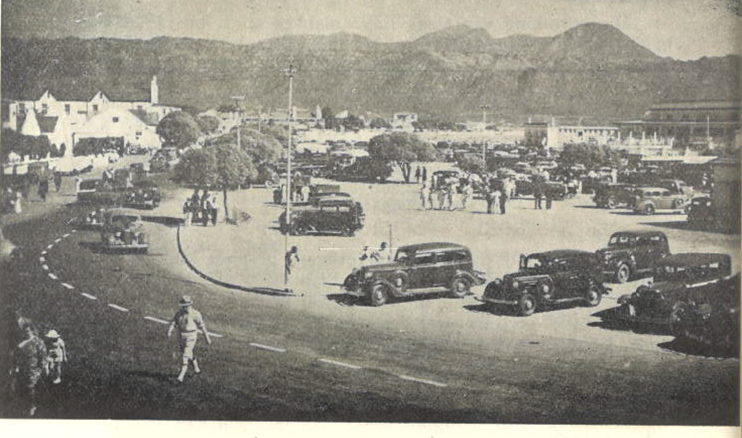
Beach Road before the traffic circle opposite the pavilion

A map of the Strand c1900
Start with arriving. For decades there was no grand entrance to Beach Road, no roundabout to slow the holiday traffic and point it toward the sea. That changed in 1967, when the town’s first proper traffic circle went in alongside the old Strand Pavilion, part of the same push to develop the promenade and manage the crowds pouring in for summer. At its centre sat a fountain built to catch the wind, its spray rising and falling with the gusts off the bay, a small piece of engineering theatre for people queuing in their cars. A second circle took shape further up, at the meeting point of Main Road and the old town square and it too has had its own late chapter. In May 2026 the City of Cape Town began a reconciliation process around the square, renaming it Strand Muslim Square while the circle beside it became the Ben Friedman Traffic Circle, a small act of naming meant to hold two different threads of the town’s heritage in the same intersection.

Before there was a circle to drive around, there had to be somewhere to stay. The first real answer to that was a boarding house nicknamed Platdak, flat roof, standing on the corner of Beach Road and Van Ryneveld Street and run by a Mrs van de Waal. It burned down in 1904. Out of that fire came the Marine Hotel, built by a new owner, Nico Loubser, on the same cleared ground and it earned its own small distinction as the first building on Beach Road lit by electricity. In the early 1930s a Mr Albertyn, who also owned the Hotel Metropole, took the Marine over and modernised it, stripping out the old Victorian wooden balconies for brick. It stayed a favourite spot for parties and dancing until around 1960, when it came down to make way for the Helderberg apartment building. It was not, in fact, the very first hotel in the area. The Somerset Strand Hotel had opened back in 1892, commissioned by a DP Rossouw and the White House Hotel followed in 1896, both closer to the town centre, in the years before the beachfront itself had much to offer.

Beach Road Strand c1906
Eating out took even longer to become its own thing. In the earliest years a meal in Strand meant a meal in whichever hotel or boarding house you were staying at, the Platdak and the Somerset Strand Hotel among them. The shift toward something more public began with the Strand Pavilion, first built in wood in the 1920s, its tearoom becoming the real social centre of the town, a place to sit over the water for tea and something light long before the modern Bossa Strand Pavilion rose on the same spot in 1990. From there came the cafés, the classic South African kind, milk bars and fish-and-chip counters lining Beach Road through the 1930s to the 1950s, among them the Friedman & Cohen Café, which grew up alongside the family’s department store in the town centre. The real change came in the 1970s, when the beachfront boom brought the first sit-down family franchises. The San Francisco Spur arrived as part of the brand’s rapid expansion across the peninsula after the very first Spur opened in Newlands in 1967 and it has held its spot on Beach Road as a landmark ever since. Wimpy followed close behind, bringing its own version of the milk bar and the quick burger to a crowd that, by then, had a proper circle to drive around before they even parked.
Between You and Me:
It strikes me that a fountain, a hotel and a milk bar are not usually thought of as belonging to the same story, but in a small town they always do. The traffic circle only mattered because there were hotels worth driving to and the hotels only mattered because eventually there was somewhere nearby to get a milkshake afterward. None of it happened on purpose. It just accumulated, the way a beach town accumulates, one summer at a time.
Historian – Harmen Bockelenberg.
Next week: the men who came home — the MOTHS of Somerset West and what veterans built when the wars were over.

Be the first to comment