


STORY 55
Before the Dorpsmeent was built on the open field opposite the municipality in Strand, that field was, for a few weeks every year, the most exciting place in the Helderberg.
The circus came in December.
Not every year without fail, but regularly enough that the pattern established itself in the memory of every child who grew up in Strand in the 1960s and early 1970s, the annual arrival of Boswell Wilkie’s Circus, the big top going up on the open ground, the smell of sawdust and animals and canvas and something indefinably other, the sound of the generators running after dark, the lights visible from streets away on a warm summer evening when the whole town seemed to know that something was happening.
James Boswell had come to South Africa in 1910 with his three brothers to perform in a circus and stayed to establish his own. The Boswells established their first circus in South Africa in 1913 and it prospered and expanded over the years, surviving both world wars and the Great Depression. By the time a child in Strand was watching it arrive on the open field opposite the municipality, Boswell Wilkie’s had been touring South Africa for half a century, a rolling village of trucks and trailers and animals and performers that covered the country’s towns on an eleven-month annual circuit, stopping in each place for long enough to set up, perform and move on.
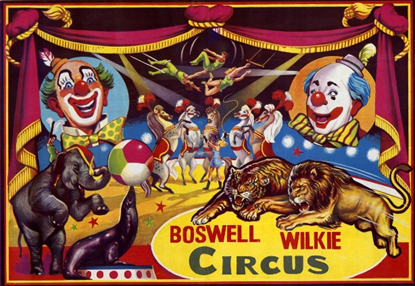
Each year the circus stopped at its base farm in Randvaal for a two-week layover, where the new season’s show was rehearsed and the trucks repainted for the next tour. Then it went back on the road. Red and yellow trucks. The big top seating 2,500 people. Lions, tigers, bears and elephants. Acrobats and trapeze artists and the particular theatre of the circus ring, three things happening simultaneously, each demanding your attention, none of them possible in any other context.
Tickey.
Tickey the Clown, whose real name was Eric Hoyland, born in England in 1916, was undoubtedly one of South Africa’s best-known and best-loved performers. The nickname Tickey, after the smallest coin then in use in South Africa, was given to him because of his small build. He had come to South Africa in 1933 for what was supposed to be a six-month tour and stayed on, beginning with a trampoline act for Boswell’s Circus before becoming a clown. He became, over the decades, a household name, the face of the circus to generations of South African children who had never heard his real name but knew Tickey the way they knew Father Christmas. Small, white-faced, endlessly falling over, endlessly getting up again.
The merry-go-round arrived separately, usually in December, occupying its own corner of the open field with a mechanical cheerfulness that required no tent and no ticket and no darkness to work its magic. Just the music, that specific, slightly tinny, looping music that a merry-go-round makes and that no other machine in the world makes quite the same way and the painted horses going up and down and the children who had been on it three times already and were already negotiating for a fourth.
The open field opposite the Strand municipality was that kind of civic space, unplanned, unbeautiful, available. A flat piece of ground between the town’s official buildings and the residential streets beyond, the kind of space that every South African town of that era had and that served, in the absence of formal parks or entertainment venues, as the default location for anything that needed room. The circus needed room. The merry-go-round needed room. The field provided both, year after year, while the municipality looked on from across the road with whatever expression municipalities wear when a circus parks on the public land opposite their offices.
Boswell Wilkie’s was killed off by television. South Africa had resisted television longer than almost any other country, the government, suspicious of its influence, kept it out until 1976. While the rest of the world was watching variety shows and sport and drama in their living rooms, South African families were still going out for their entertainment. The circus, the bioscope, the town hall concert, these were not nostalgic choices. They were the available choices. When television arrived in 1976 it hit South African entertainment with the accumulated force of a technology that the rest of the world had already absorbed over twenty years. Boswell Wilkie’s operated with increasingly declining success through the latter half of the twentieth century, stopped travelling in 2001 and closed permanently in 2015.
The Dorpsmeent shopping centre was built on the open field opposite the Strand municipality. The field that had hosted the circus and the merry-go-round became a car park and a shopping precinct, as open fields in South African towns reliably do when the economy decides they have a higher use. The municipality still stands across the road. The field is gone.
The children who stood on that field in December and watched the big top go up are in their fifties and sixties now. They remember the smell of it, sawdust and canvas and animals. They remember Tickey falling over. They remember the merry-go-round music starting up in the warm evening air, the painted horses going round, the specific joy of a thing that came once a year and was therefore, precisely because of its rarity, worth everything.
Television gave South African children more to watch. It gave them less to remember.
Between You and Me:
The merry-go-round music. I am convinced that the specific sound a merry-go-round makes, that slightly off-key, looping, mechanical cheerfulness, is encoded somewhere in the memory of every person who heard it as a child and cannot be separated from the feeling of standing on a summer evening on a field with the lights going and your parents somewhere nearby and the understanding, which you did not have the words for at the time, that this was happiness. The Dorpsmeent centre is a perfectly adequate shopping facility. It has a Pick ‘n Pay and a pharmacy and reasonable parking. It has never, in my experience, produced that feeling. The field it replaced had it every December without trying.
Historian – Harmen Bockelenberg
Next week: the field finishes its story — the new town hall that rose where the big top once stood, opened in the same year Mandela walked free.




Be the first to comment