
STORY 54
The National Sea Rescue Institute did not begin in a purpose-built facility with rescue craft and trained crews and a communications system. It began, as most necessary things begin, with a person who saw that something needed to exist and decided to make it exist.
The NSRI itself was born from tragedy. In 1966, a storm claimed the lives of seventeen fishermen off Stilbaai. A Simon’s Town teacher named Patti Price was so moved that there had been no organised help for them that she began an impassioned letter-writing campaign to various media, stating her case for a sea rescue service. She had been rescued as a child from a wrecked ship in the English Channel by the Royal National Lifeboat Institution and wanted something similar for South Africa. Her efforts were acknowledged by the Society of Master Mariners of South Africa, who started the South African Inshore Rescue Service in 1967, which later became the NSRI.
Two years after that founding, in 1969, Gordon’s Bay got its station.
The station was started by the then harbour master Doug van der Riet. It had humble beginnings in a wooden shed at the Gordon’s Bay Yacht Club. No purpose-built base, no endowment, no professional staff. A wooden shed at the yacht club, a harbour master who understood the sea and understood the need and the will to begin.
Doug van der Riet, known to the Gordon’s Bay community as Doughie, was exactly the kind of person a sea rescue station needed at its founding. Long before he was harbour master, he was known on the racetrack and it was there that his name became permanent. He first appeared at the Prince George Circuit in 1934, driving an Austin in South Africa’s first international motor race. Four years later, at the 1938 Rand Grand Prix in Kelvin, Johannesburg, he very nearly did not race at all. His supercharged Austin suffered brake failure and he spent the night before the race putting it right. Forty thousand spectators turned out on race day regardless, eager to see whether the Capetonian would even make the start.
He did more than that. Running on the handicap system that decided South African racing in those years, van der Riet led early, lost the lead to Roy Hesketh’s ERA and then watched Hesketh’s car falter just long enough to let him back through. He held the lead to the flag, beating Hesketh, Count Johnny Lurani’s factory Maserati and a strong field besides, for a win the crowd was clearly happy to see. It did not matter to them that the fastest man on the day, on pure scratch time, finished a distant sixth. Van der Riet had beaten cars that outclassed his own on paper and the racing press gave him the name that stuck for the rest of his life. Giant Killer van der Riet.
By the time the cars gave way to the sea, Giant Killer had settled in a house looking straight out over the old harbour, close enough to watch the water from his front step. In 1968 he became the first elected Commodore of the Gordon’s Bay Yacht Club. A year later, still serving as harbour master, he started Station 9.
False Bay demanded it. The bay that had swallowed ships for three centuries, that had built the fishing community of Gordon’s Bay, that had made and destroyed reputations across two hundred years of maritime history, was not a forgiving body of water. The southeaster could raise dangerous seas within hours. People got into trouble in False Bay with depressing regularity.
After 1969, there was Station 9.
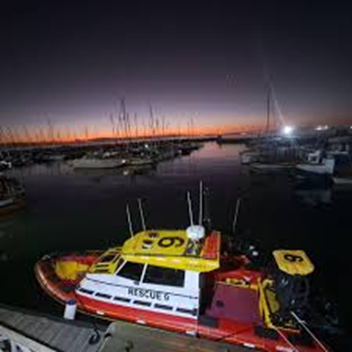
The station grew from its wooden shed into a permanent presence on the Gordon’s Bay waterfront. The rescue craft evolved from whatever was available in the early years to purpose-built fast rescue boats capable of operating in the sea states that False Bay produced. The crew grew, volunteers, all of them, giving their time and their expertise and their willingness to go out in conditions that kept everyone else ashore. The station celebrated its fiftieth anniversary in 2019. It now boasts forty-one active crew members and nineteen coast watchers who are the NSRI’s eyes on the water.
The current base, completed in 1986, was named after Doug van der Riet in his honour. The Doug van der Riet Base on the Gordon’s Bay waterfront is his memorial, not a plaque on a wall or a street name, but a working building from which working crews go out in all-weather to save people who need saving. That is the kind of memorial that suits a man who started a rescue station in a wooden shed.
The author of this book remembers seeing Doug van der Riet performing the naming honours at an NSRI vessel launch at the Gordon’s Bay Naval Base in the early 1980s, presiding over the ceremony with the particular authority of a man who had built the institution being celebrated, who understood what the vessel would be asked to do and why it mattered that it be done well.
Station 9 has been doing the thing that needs doing ever since 1969. On every day since then, in every weather that False Bay has produced, someone has been watching the water from the station that Doug van der Riet started in a wooden shed.
The shed is gone. The double hull speed boat replaced. The station remains.
Between You and Me:
I was at one of those launches myself, though not as a spectator. I was a young freelance reporter for the Hottentots Holland Advertiser, back when Ethny von Michaelis ran the paper and I’d been sent to cover the christening of a new NSRI boat at the Naval College. It must have been 1979 or thereabouts. What I remember most is the boat and Giant Killer performing the honours. The SABC television crew there as well one could not miss them with their cameras. Somewhere in the footage that went out that evening, there I was, notebook and camera in hand, doing my job. It was the only time in my life I was ever on television and I owe that small piece of vanity to a man who, forty years earlier, had put a battered Austin ahead of a field of Maseratis and ERAs and earned a nickname that outlived him.
Follow an interesting story on the following link: https://web.facebook.com/groups/autoandsport/posts/1819200372043734/?_rdc=1&_rdr
Historian – Harmen Bockelenberg
Next week: the circus comes to Strand — and for a few December weeks, the open field opposite the municipality becomes the most exciting place in the Helderberg.

Be the first to comment