


Ask anyone who grew up in the Strand before the malls arrived to name the town’s landmarks and you will not get heritage plaques or street names. You will get a list of shops that no longer exist, recited from memory by people who can still tell you exactly what the pancakes tasted like or which corner the jeweller occupied. The KOÖP. Friedmann and Cohen. The Rialto. The Golden Apple. Miller’s. This is a story about those names and about a Main Road that worked the way small town main roads used to work, before anyone thought to call it a mall.
Sunday afternoons had their own liturgy. As the weekend wound down and Monday’s school morning loomed, families climbed into the car for the beachfront drive, soft serve in a cone rather than a cup, windows down, salt air replacing the week’s ordinary air. The drive was rarely complete without a stop at the Golden Apple, the bakery where Main Road met the N2, its smell of fresh bread reaching customers before they reached the door. Parents stopped there on the way home as a matter of course. Children waited for the treat that came with it. The Golden Apple eventually disappeared as shopping habits changed and the area developed around it, but the memory of carrying a warm loaf home on a Sunday evening has outlasted the bakery itself by decades.
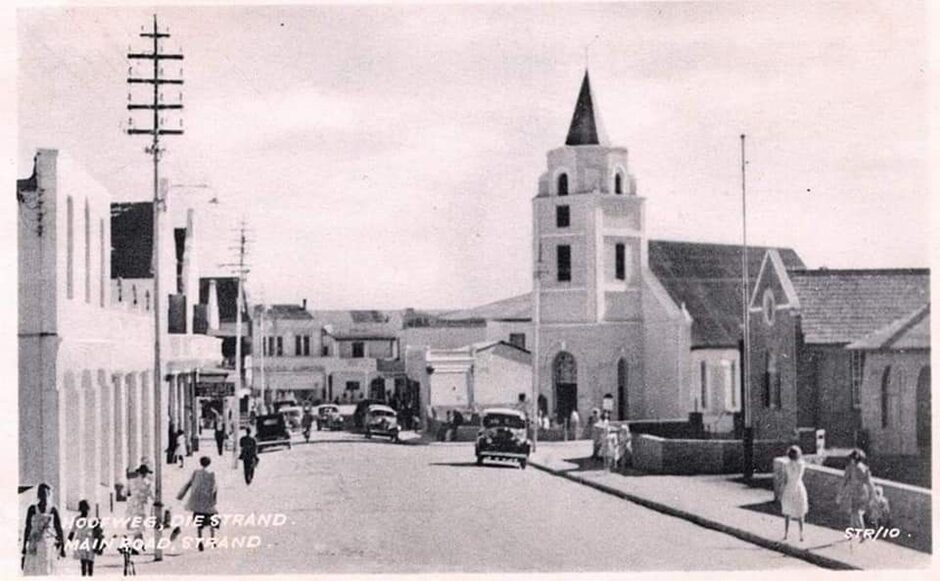
Before streaming and multiplexes, the Rialto Cinema was Strand’s window onto the wider world. Saturday matinees, evening screenings and the particular excitement of a new release drew audiences from across the district and gave several generations of Strand teenagers their first proper night out. The cinema’s story begins with Isaac and Rose Barenblatt, who opened a cinema in the old Strand town hall in 1918 and, in the 1930s, went on to build the Empire Rialto itself. Barenblatt was part of a wider story too, of Jewish owned businesses that shaped much of Strand’s early commercial life, though his name has mostly slipped from memory except for the parking area named after him a few streets from where his cinema once stood, a small municipal thank you for a man most people parking there have never heard of.
No memory of old Strand is complete without Die Koöperasie, known to everyone simply as the KOÖP. It sold household goods, farming supplies and groceries to generations of Strand families, but what people actually remember is the restaurant upstairs and, above all, its pancakes, golden, generous and by local consensus unmatched anywhere else in town. A Saturday shopping trip was not really complete without them.
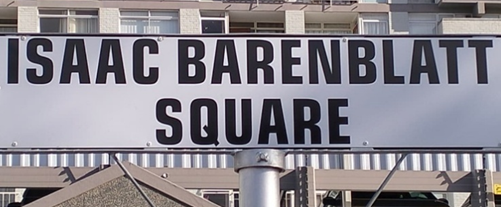
The Strand named a parking area as a token of gratitude.
A short walk away stood Friedmann and Cohen, one of the Strand’s best known general stores until fire destroyed the original wooden floored building. F & C rebuilt as the most modern shop in the Helderberg and the business survives to this day, though the loss of that original building was felt deeply at the time.
Miller’s Outfitters told a longer story still. Jack Miller bought an existing drapery business in 1940, while still managing the local Ackermans and he and his wife Esther built it steadily over the years that followed. In 1955 the family put up new premises across Main Road, the building Miller’s would trade from for the rest of its life. School uniforms were fitted there. Suits were chosen there for weddings, church clothes for Sundays, jackets bought to last rather than to replace. Cedric Miller took over from his parents and kept the business independent through decades when family stores everywhere else were folding into chains, renovating in 1986 to stay competitive. I remember talking to Cedric about the pressure closing in on him in his later years, cheaper imported clothing, the malls, the larger shops, all the same forces that were quietly ending small retail across the country. He had grown up in that shop. I remember him working there as a teenager. My own mother worked there for a while too. When the doors finally closed in February 2020, after eighty years of trading, Strand lost more than a clothing store. The timing, just ahead of the pandemic, turned out to be oddly fortunate. It did not make the closing feel any less final.
Strand Jewellers held its corner near Friedmann and Cohen and the old KOÖP, the place where engagement rings were chosen with nervous excitement and watches were bought to mark a milestone. Repairs happened behind the counter while you waited, no batteries in those days, just the quiet precision of a mechanical movement. It was the kind of business a town does not notice until it is gone.
The smaller trades filled in the rest of the rhythm. The chemist mixed remedies from memory while trading the day’s news. John Bougas practised as the optometrist on Beach Road for years and I got my first pair of spectacles from him.
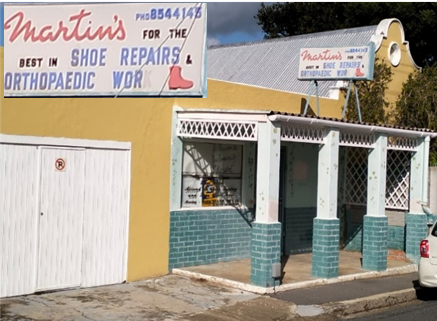
21 Church Street, Strand
Martin ran his shoe repair shop at 21 Church Street with a habit that became something of a local legend: he would examine a pair of shoes brought in for repair, declare them off balance and fold the correction into the job whether you had asked for it or not. He supplied shoes to the Springbok cricket team and was rightly proud of it. Further down the road, Scotty’s fixed bicycles. These were not simply places to buy or repair things. They were part of the personal history of the town, businesses passed down through families where the shopkeeper knew your name before you reached the counter.
The Springbok and Monaco Cafés were where the town actually talked to itself, over coffee and light meals, news exchanged and friendships kept up at a pace the modern world no longer allows. The Metropole and Da Gama Hotels did similar work for visitors, hosting the holidaymakers who came for the beaches and the warm False Bay summers as well as the local functions and celebrations that gave the town its social calendar. Out on Gordon’s Bay Road, the Blue Owl did the same job for travellers passing through, a roadhouse that became a landmark in its own right and gave directions to countless visitors who had never heard of Strand before that day.
Beyond the developed beachfront, where the dunes stretched toward Gordon’s Bay, lay the stretch known to generations of local teenagers simply as Lover’s Lane. It earned its legendary status among young couples looking for privacy among the sandy tracks and coastal scrub, though the south easter had an unromantic habit of lifting the coals clean off the braai grid if anyone was foolish enough to try cooking there in summer. Much of the area has changed since, but the name still carries the particular weight of a shared adolescent memory.
Change, when it came, arrived on Church Street. Pick ‘n Pay opened there in the late 1960s, probably 1967 or 1968, not long after Raymond Ackerman founded the company and I was there for the opening in short pants and bare feet, watching the band play through the shop’s big windows. It was one of the first modern self-service supermarkets Strand had seen and a real departure from the small family shops that had run the town’s retail life until then. What became Pick ‘n Pay Strand Square started life as the Dorpsmeent Centre before its 2013 rebrand, the same site carrying three different names across half a century, in keeping with the town’s habit of renaming things it can’t quite let go of.
Not everything in Strand’s commercial life happened behind a shop counter.
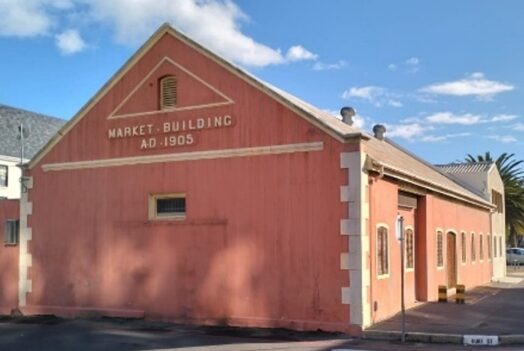
The Market Building and Once Fire Station
Opposite Dorrington’s Garage, next to the old fire station, an informal market of street sellers set up early most mornings, simple tables and crates rather than permanent stalls. One trader, known to everyone as Hadjie, brought in the freshest produce from nearby farms and smallholdings and sold it by the piece, the bunch or the dozen rather than by the scale, prices settled face to face rather than printed on a label. It was a small, lively pocket of trade alongside the town’s more formal shops and cafés and it faded the way such places usually do, as regulations tightened and supermarkets took over the business of feeding a town.
None of this was really about retail. It was about continuity, families returning to the same shops for decades, children growing up and later bringing their own children into the same spaces their parents had known. A pair of shoes from Miller’s, a repaired watch from the jeweller, a warm loaf from the Golden Apple, each purchase carried a small sense of belonging to a town that felt both familiar and entirely its own. Main Road and Beach Road, in those years, formed a complete social world within walking distance of itself, shops, cafés, hotels, a cinema and the beach all close enough to reach on foot. Most of those names are gone from the physical landscape now. They are not gone from the people who remember them.
Between You and Me:
The KOÖP pancakes. I have thought about this more than is probably dignified. Not the pancakes themselves exactly, although they were, as everyone who had them will confirm, exceptional, but the specific combination of circumstances that made them memorable: the smell of the restaurant reaching you on the stairs before you arrived, the particular quality of a meal eaten after shopping with your family on a Saturday, the sense that this was how things were and always would be. The KOÖP is gone. The pancakes are gone. The Saturday shopping trips are gone. What remains is the particular ache of knowing that the thing you took for granted was, while you were taking it for granted, exactly as good as you later remembered it being.
Historian – Harmen Bockelenberg
Next week: Somerset West’s own Main Road, a different kind of village life built on farm supplies, saddlers and general dealers before the AECI land reshaped the town beyond recognition.




Be the first to comment